Algeria
 Egypt
 Libya
 Morocco
 Sudan
 Tunisia
 Benin
 Burkina Faso
 Cabo Verde
 Côte d'Ivoire
 Ghana
 Guinea-Bissau
 Liberia
 Mali
 Mauritania
 Niger
 Nigeria
 Senegal
 Sierra Leone
 The Gambia
 Togo
 Cameroon
 Central African Republic
 Chad
 DR Congo
 Equatorial Guinea
 Gabon
 Republic of the Congo
 São Tomé and Príncipe
 Burundi
 Comoros
 Djibouti
 Eritrea
 Ethiopia
 Kenya
 Madagascar
 Malawi
 Mauritius
 Mozambique
 Rwanda
 Seychelles
 Somalia
 South Sudan
 Tanzania
 Uganda
 Angola
 Botswana
 Eswatini
 Lesotho
 Namibia
 South Africa
 Zambia
 Zimbabwe
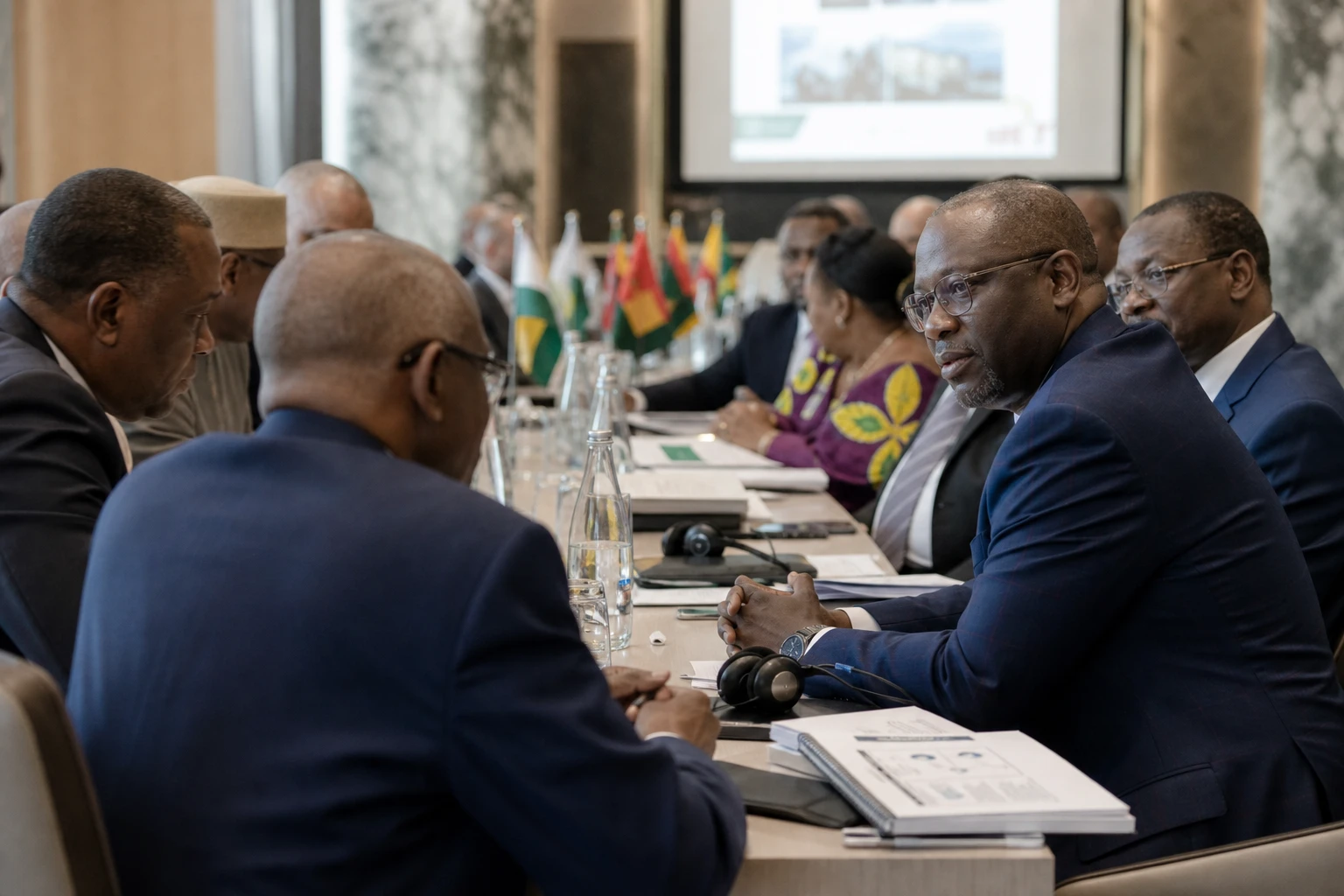
In Conakry, mobility remains the first test of the promise of transformation
In Guinea, modernising transport is about more than political display. It is a question of time lost in traffic jams, logistics costs for businesses and households’ real access to services. In Conakry, where a large share of administrative and commercial activity is concentrated, every slow journey weighs on productivity, family budgets and the movement of goods. The authorities now want to make the sector a central lever of the Simandou 2040 vision, presented as a long-term economic transformation strategy.
This choice comes in a country where mobility problems have been known for a long time. The World Bank points to inadequate roads, weak regional connections, urban mobility difficulties in Conakry and a rail network still largely geared towards mining freight. It also notes that the port of Conakry handles most of the country’s foreign trade, increasing pressure on urban routes and access infrastructure.
First package of measures for roads, buses and stations
On 25 July 2026, the Guinean government launched the first wave of Pillar 3 of Simandou 2040, focused on infrastructure, transport and logistics. According to the Ministry of Transport, this phase includes the rehabilitation of bus shelters and the Matoto bus depot, the forthcoming introduction of 50 buses for public transport and the launch of a programme for 300 ride-hailing taxis, with an initial fleet of 50 vehicles already available. The same statement also refers to the construction of eight bus stations and several railway projects.
The announced lines are presented as strategic. They are intended to connect Kaloum to Kouria, Kouria to Moribaya and Kankan to Kérouané. These are joined by maritime and logistics projects, including the Kagbélen dry port, new cargo-handling equipment, the Dobali industrial-port complex and the Benty logistics centre. Taken together, these elements outline a broader chain: moving people faster, while also improving the flow of goods from the coast to the country’s interior.
This direction is not isolated. In his general policy statement, Prime Minister Amadou Oury Bah said that government action on infrastructure, transport and technology was based on 52 megaprojects and 10 reforms, with $100 billion in investment announced. The document also cites 2,900 kilometres of motorways, 2,500 kilometres of railway lines and 5,500 kilometres of roads to be built by 2030.
What this means for Guineans and the real economy
The core of the problem is simple: Guinea has significant mining, agricultural and commercial potential, but its transport costs remain high. The World Bank notes that the road network, around 30,000 kilometres long, has few high-capacity roads and that only 17% of roads are paved. It also points out that the 383 kilometres of operational railway lines mainly serve extractive freight. In this context, reforming public transport in Conakry and intercity links is not a matter of comfort; it is essential to everyday economic activity.
For passengers, the stakes are immediate. More buses, better-organised stations and rehabilitated bus shelters can make journeys more reliable, reduce dependence on informal options and ease pressure on the capital’s congested routes. For traders, transport operators and SMEs, smoother networks mean less time lost, lower fuel costs and less vehicle wear. For inland areas, the expected impact is different but just as important: better links between regional capitals, then prefectural capitals and sub-prefectures, would open local markets further to rural producers.
The government also presents the Kagbélen dry port as a response to congestion in Conakry. The World Bank had already identified it as a tool that could ease pressure on the capital, given that the port of Conakry handles most foreign trade. This matters for urban Guinea, but also for the informal economy sustained by daily flows between the city centre, the outskirts and the hinterland. Logistics infrastructure has value only if it genuinely absorbs traffic volumes and is governed in a way that avoids administrative bottlenecks.
A West African perspective, beyond national borders
The issue extends far beyond Conakry. Guinea is a member of ECOWAS, where road and rail corridors have become tools of regional competitiveness. The organisation is already working on routes such as Praia-Dakar-Abidjan, while the Conakry-Bamako railway corridor project features on ECOWAS’s list of regional projects. At continental level, the African Union includes this infrastructure in the Programme for Infrastructure Development in Africa, or PIDA, which aims to connect states by road, rail, port and digital networks.
In other words, transport modernisation in Guinea is not just about travel within the country. It also affects the country’s place in West African trade and in supply chains linked to minerals, agricultural products and subregional commerce. The Simandou project, with its rail and port infrastructure, is already conceived as an artery for economic expansion. Pillar 3 now seeks to connect this vision to the daily life of cities and regions, so that the mining corridor does not remain a technical island in a territory that is still poorly connected.
The next stage will depend on the state’s ability to deliver, maintain and co-ordinate. The July 2026 announcements form part of a longer trajectory, already marked by roadworks in Kagbélen, Soumba and Bambéto, and by repeated commitments to a new economic geography. The true measure will not be the scale of the plans, but how quickly Guineans see their journeys improve, from Kaloum to the country’s interior, and from local markets to regional corridors.