Algeria
 Egypt
 Libya
 Morocco
 Sudan
 Tunisia
 Benin
 Burkina Faso
 Cabo Verde
 Côte d'Ivoire
 Ghana
 Guinea
 Liberia
 Mali
 Mauritania
 Niger
 Nigeria
 Senegal
 Sierra Leone
 The Gambia
 Togo
 Cameroon
 Central African Republic
 Chad
 DR Congo
 Equatorial Guinea
 Gabon
 Republic of the Congo
 São Tomé and Príncipe
 Burundi
 Comoros
 Djibouti
 Eritrea
 Ethiopia
 Kenya
 Madagascar
 Malawi
 Mauritius
 Mozambique
 Rwanda
 Seychelles
 Somalia
 South Sudan
 Tanzania
 Uganda
 Angola
 Botswana
 Eswatini
 Lesotho
 Namibia
 South Africa
 Zambia
 Zimbabwe
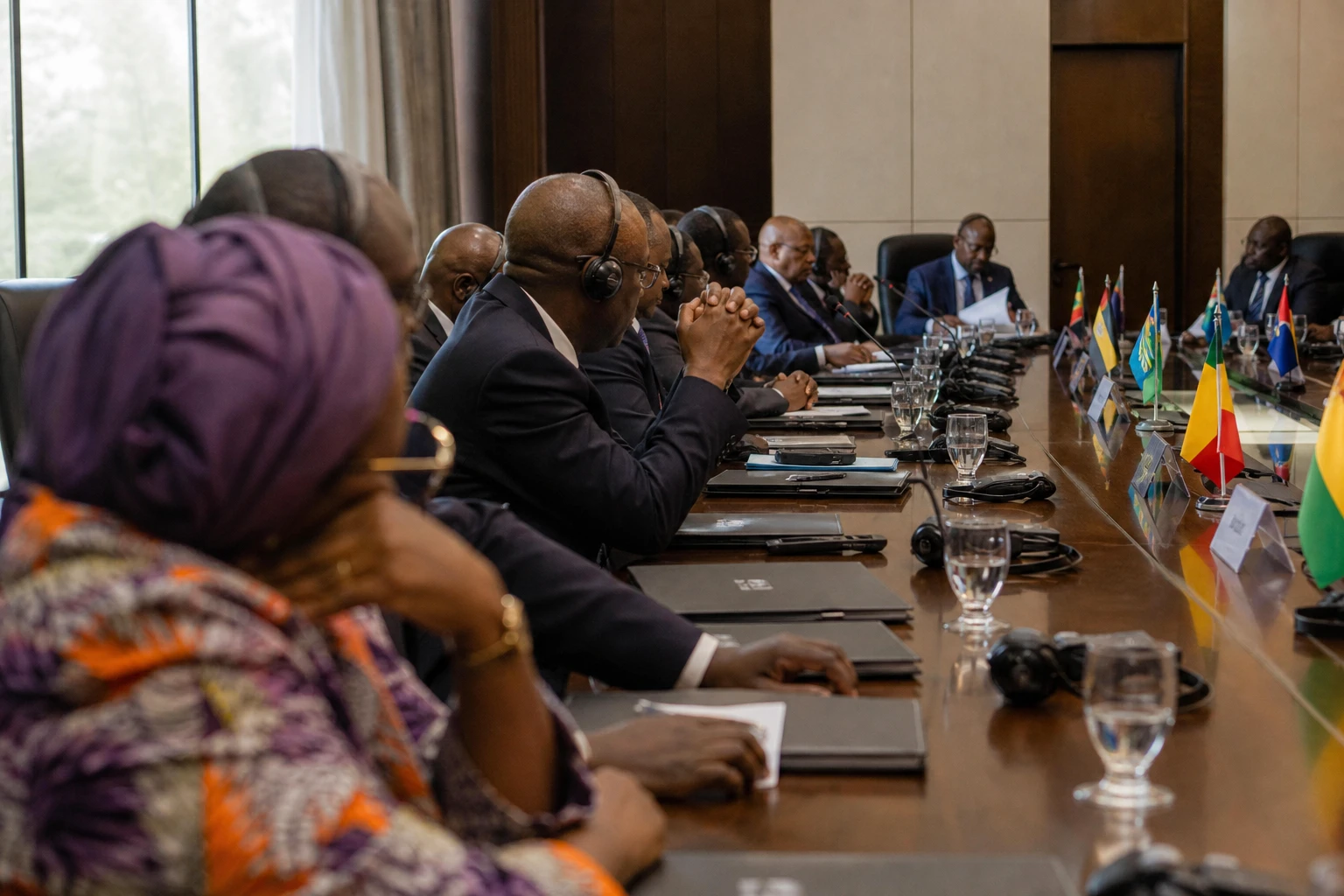
In Bissau, a vote that goes beyond the constitutional question
In Bissau, the 30 August vote was not simply a matter of answering “yes” or “no” to a legal text. Above all, it measured Guinea-Bissau’s ability, still shaken by the November 2025 coup, to rebuild a minimum of political trust in a country where every institutional reform is immediately seen as a test of power-sharing. The referendum was due to take place ahead of the general elections scheduled for 6 December, which are meant to mark the return of civilian rule, but the context remains one of a contested military transition under close scrutiny from the West African region.
The heart of the debate is well known. The transitional authorities want to replace the semi-parliamentary system inherited from the current Constitution with a more concentrated presidential system. The president could appoint and dismiss the prime minister, dissolve the National Assembly and more directly lead the executive. The text also provides for reducing the Assembly from 102 to 65 seats and cutting the number of constituencies from 29 to 12, in the name of reducing public spending and achieving what is seen as more stable governance. Opponents, meanwhile, see this as a framework that weakens parliament and further reduces the space for checks and balances.
Guinea-Bissau is not an isolated case in West Africa. The country remains under the scrutiny of ECOWAS, the Economic Community of West African States, and the African Union, which have closely followed the transition that began after the November 2025 coup. On 18 May 2026, the AU Peace and Security Council held a meeting specifically devoted to the political and security situation in Guinea-Bissau, showing that the issue extends beyond the national arena. In a region marked by several military transitions, each electoral step is also a signal to neighbouring countries and continental institutions.
A rainy morning, cautious turnout
On the ground, the first hours of voting were slow. In Bissau, polling stations opened at 07:00 GMT in a city hit by heavy morning rain, which delayed the start in several neighbourhoods. Correspondents on the scene described a calm atmosphere, with an increased police and national guard presence around strategic locations. The electoral commission described turnout as “reasonable” by midday, while the opposition spoke of low participation, a sign that the announced boycott had affected the vote.
The vote took place without independent observers, a point noted by the electoral authorities themselves, limiting outside assessment of the day. The first provisional results were expected from the following Tuesday, according to the timetable announced by the organisers. At the same time, the political climate remained tense. The opposition, notably the PAIGC, the African Party for the Independence of Guinea and Cape Verde, called for a boycott of a text it considers the product of unelected and non-inclusive transitional institutions.
This boycott is more than a symbolic gesture. It reflects deep opposition to the very framework within which the referendum was prepared. Civil society and human rights advocates denounced what they saw as an unbalanced campaign, with space almost exclusively reserved for the “yes” camp and restrictions on civil liberties. The debate is therefore as much about the legitimacy of the process that led to the text’s adoption as it is about the future Constitution. In a country marked by interrupted changes of power, this question matters as much as the final text.
What the text changes, and what it says about the transition
For the transitional authorities, the argument is simple: a stronger executive would prevent recurring deadlocks between the president, prime minister and Assembly. This view is rooted in Guinea-Bissau’s political history, marked by institutional crises, coups and periods of conflict-ridden cohabitation. But for opponents of the proposal, strengthening the top of the state without broadening dialogue amounts above all to concentrating power at a time when the country needs a rebalancing. The debate is therefore between two visions of stability: one through centralisation, the other through negotiation.
The timetable adds another layer of significance. The 30 August referendum was intended to pave the way for general elections on 6 December, presented by the authorities as the end of the transition. In a capital such as Bissau, this sequence is being closely watched by civil servants, traders and political parties, as well as by the informal economy, which is highly exposed to political upheaval. A constitutional text does not only change the composition of institutions; it can also determine how quickly the state pays, arbitrates and reassures. That is where the impact becomes tangible for households, businesses and local authorities.
At regional level, the Guinea-Bissau issue is a reminder of an often-underestimated truth: institutional stability in West Africa is not just about holding a vote. It also depends on guarantees for political parties, the space given to checks and balances, and the role played by regional organisations. ECOWAS, which has pursued numerous mediation efforts in the country, and the AU are therefore following not just a vote but a test of the transition’s end. If the December elections go ahead, the question will be whether the referendum has opened a period of calm or simply shifted the centre of gravity of power.
For Guinea-Bissau, the implications are even broader. In a West African region where several countries have undergone military transitions since 2020, each institutional arrangement becomes a precedent. A strengthened executive can be presented as a tool for emerging from crisis, but it can also serve as a model for other transitional regimes tempted by centralisation. That is why monitoring the results, and then preparations for the 6 December elections, will show whether Bissau is moving towards gradual normalisation or a new phase of political concentration.