Algeria
 Egypt
 Libya
 Morocco
 Sudan
 Tunisia
 Benin
 Burkina Faso
 Cabo Verde
 Côte d'Ivoire
 Ghana
 Guinea
 Liberia
 Mali
 Mauritania
 Niger
 Nigeria
 Senegal
 Sierra Leone
 The Gambia
 Togo
 Cameroon
 Central African Republic
 Chad
 DR Congo
 Equatorial Guinea
 Gabon
 Republic of the Congo
 São Tomé and Príncipe
 Burundi
 Comoros
 Djibouti
 Eritrea
 Ethiopia
 Kenya
 Madagascar
 Malawi
 Mauritius
 Mozambique
 Rwanda
 Seychelles
 Somalia
 South Sudan
 Tanzania
 Uganda
 Angola
 Botswana
 Eswatini
 Lesotho
 Namibia
 South Africa
 Zambia
 Zimbabwe
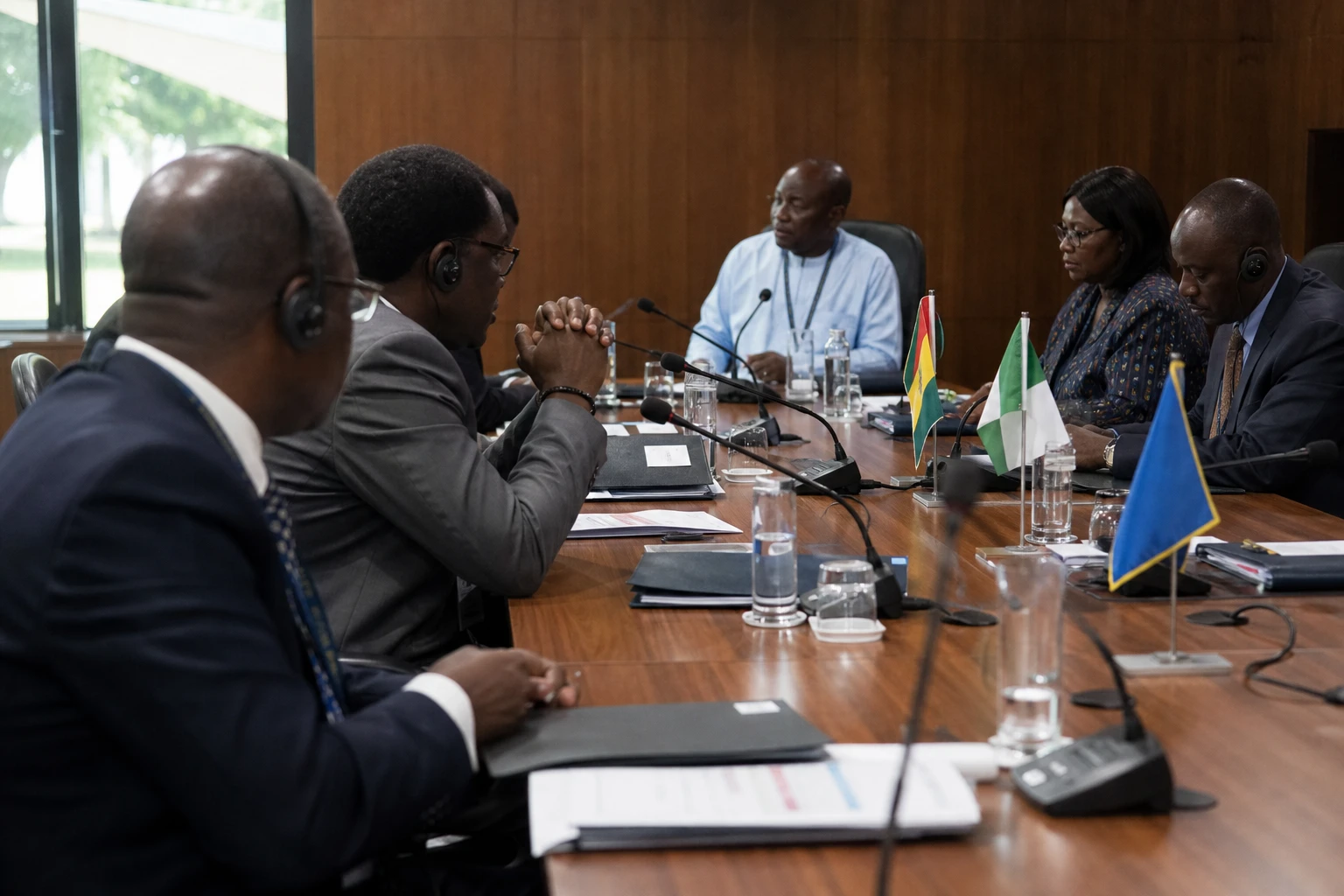
In Bissau, the return of a former president is already becoming a test for the military transition. Umaro Sissoco Embaló wanted to return to Guinea-Bissau on Sunday 4 October 2026 and stand in the presidential election scheduled for 6 December. The army is now putting a political and security obstacle in his way.
A transition under pressure in Bissau
Guinea-Bissau is undergoing another institutional rupture. The military authorities suspended the electoral process after Umaro Sissoco Embaló was ousted in November 2025, while the country was still awaiting the full publication of the presidential election results.
Since then, a transitional authority has governed the country. It says it wants to restore constitutional order. A military transition is a period during which the armed forces exercise power directly before a possible return to elected institutions.
This episode is part of a fragile political history. Since gaining independence from Portugal in 1974, Guinea-Bissau has experienced several coups, attempted overthrows and clashes between security units. Rivalries between the presidency, parliament, political parties and the army have repeatedly paralysed the institutions.
The country is also still a member of ECOWAS, the Economic Community of West African States. The regional organisation officially advocates a return to constitutional rule, but its influence is being tested by the growing number of military takeovers in West Africa.
Army refuses to guarantee Embaló’s return
Umaro Sissoco Embaló announced on Monday 28 September that he intended to return to Bissau. He said he wanted to submit his candidacy for the 6 December presidential election and help restore constitutional order.
Three days later, the military high command responded with a statement. It said the “necessary security conditions” were not in place to guarantee the former head of state’s return. The army also cited the need to maintain public order.
This wording does not amount to an explicit judicial ban. In practice, however, it prevents a normal political return from being organised. Without security guarantees or access to the country, a candidacy announced from abroad is difficult to put into effect.
Embaló’s camp has not abandoned its electoral plans. However, the military’s refusal leaves the former president facing several uncertainties: his return, his personal safety, the approval of his candidacy and the possibility of campaigning on a level playing field.
African and international media have reported that the former president has been in exile since his ousting. They have also recalled that his departure followed the suspension of the electoral process and the military takeover of the institutions.
Presidential guard at the centre of concerns
Tensions had become apparent even before the high command’s decision. On Tuesday 29 September, Guinea-Bissau’s interior ministry called for calm after reports that members of the presidential guard had been reassigned.
The authorities described the operation as an administrative measure. Other sources said some officers close to Embaló had allegedly been disarmed or arrested. These conflicting accounts have not been sufficiently substantiated to allow a definitive conclusion.
The presidential guard plays a distinctive role in Guinea-Bissau’s crises. It protects the head of state, but can also become an autonomous military actor when civilian institutions are weakened. Personnel changes within the unit are therefore being closely monitored by political parties and diplomats.
For now, the junta has reiterated the ban on demonstrations, gatherings and political meetings. The measure is to remain in force until the competent authority decides otherwise.
For Bissau residents, this restriction narrows the political space at a time when candidacies should be starting to shape the debate. It directly affects political parties, civil society organisations and local media. It could also complicate mobilisation in the regions, where election campaigns often rely on community networks and travel on the ground.
A presidential election with a fragile timetable
The 6 December vote is being presented as a step towards ending the transition. Yet its organisation depends on several conditions: a credible electoral timetable, an operational electoral commission, fair access to the media and freedom of assembly for candidates.
The military authorities say the conditions for free, transparent and credible elections are in place. That claim will nevertheless have to be tested against the reality on the ground. An election held without genuine pluralism could prolong the crisis rather than resolve it.
The legal question is another sensitive issue. The transitional authorities will have to clarify the rules applying to candidates, including residency and eligibility requirements and the submission of applications. Embaló’s case could quickly become a test of the credibility of the institutions responsible for reviewing candidacies.
The timetable is particularly delicate because the transitional leaders must avoid giving the impression that they are using security concerns to sideline a rival. At the same time, the authorities may argue that a hasty return by the former president could trigger clashes between rival forces.
ECOWAS and the African Union watching closely
The crisis extends beyond the capital. ECOWAS will have to monitor the course of the transition, respect for civil liberties and preparations for the vote. Its challenge will be to maintain pressure on the authorities without deepening the economic isolation of a population already dependent on regional trade.
The African Union is also concerned. The continental principle of rejecting unconstitutional changes of government calls for particular vigilance. However, the African response cannot be limited to a statement of condemnation. It will also have to take account of internal divisions, the role of the security forces and the expectations of the people of Guinea-Bissau.
The coming steps will be decisive: whether Embaló returns or remains in exile, clarification of the electoral rules, whether the ban on gatherings is lifted, and the transition’s ability to ensure genuine political competition.
In Bissau, the electoral timetable has thus become a power struggle. The military authorities want to control the pace of the return to constitutional rule. The former president is seeking to reclaim a central place in the political arena. Between them, citizens are above all waiting for clear rules, lasting security and an election whose outcome is not decided before the polling stations open.