Algeria
 Egypt
 Libya
 Morocco
 Sudan
 Tunisia
 Benin
 Burkina Faso
 Cabo Verde
 Côte d'Ivoire
 Ghana
 Guinea
 Liberia
 Mali
 Mauritania
 Niger
 Nigeria
 Senegal
 Sierra Leone
 The Gambia
 Togo
 Cameroon
 Central African Republic
 Chad
 DR Congo
 Equatorial Guinea
 Gabon
 Republic of the Congo
 São Tomé and Príncipe
 Burundi
 Comoros
 Djibouti
 Eritrea
 Ethiopia
 Kenya
 Madagascar
 Malawi
 Mauritius
 Mozambique
 Rwanda
 Seychelles
 Somalia
 South Sudan
 Tanzania
 Uganda
 Angola
 Botswana
 Eswatini
 Lesotho
 Namibia
 South Africa
 Zambia
 Zimbabwe
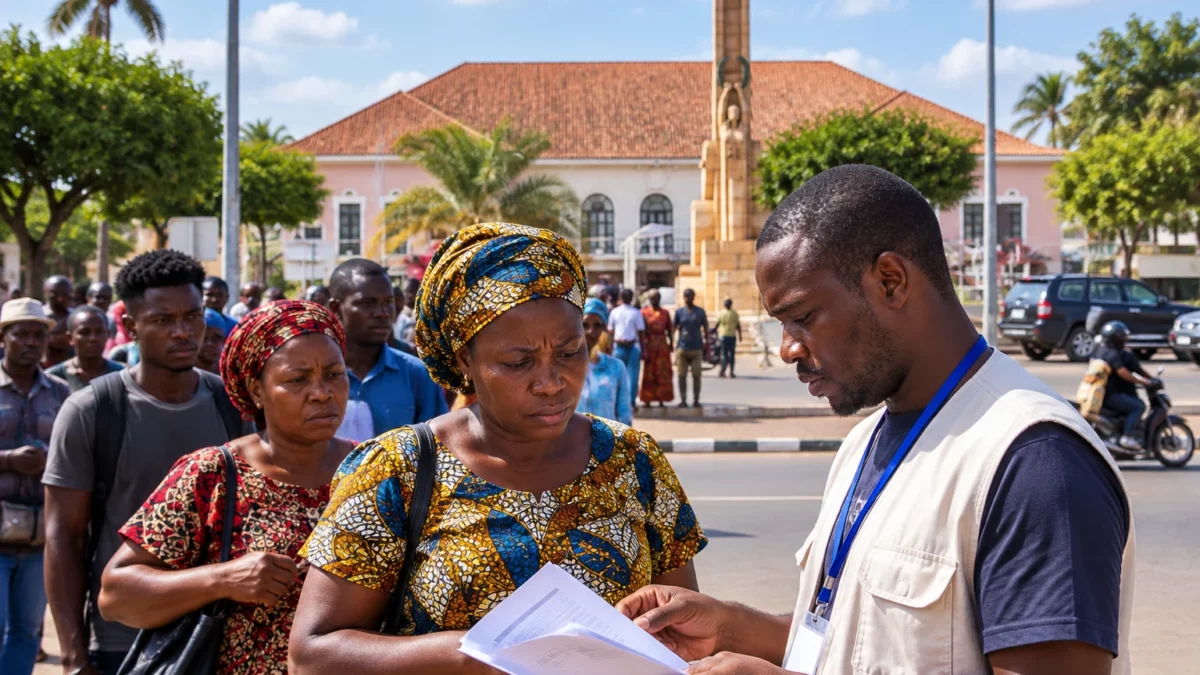
Electoral timetable without a replacement date
In Bissau, the announced return to the polls was meant to mark the end of a military interlude. Yet ten days before the planned vote, the transitional authorities and the electoral commission acknowledged that the conditions were not in place. The postponement announced in October, without a new date, has turned a promise of a one-year transition into political uncertainty.
On 26 November 2025, the military seized power in Guinea-Bissau, three days after presidential and legislative elections and on the eve of the expected publication of the results. General Horta N’Tam was installed as head of the transition. The military authorities had announced a one-year period. The Transition Charter adopted on 5 December suspended certain provisions of the 1996 Constitution.
ECOWAS, the Economic Community of West African States, suspended Guinea-Bissau from its decision-making bodies until constitutional order was restored. The African Union also condemned the seizure of power and suspended the country. These decisions signal institutional rejection of the coup, but are not, on their own, enough to set an electoral timetable or guarantee a return to civilian rule. The communiqué of the African Union’s Peace and Security Council called for constitutionalism to be upheld and for a political solution.
From interrupted vote to announced postponement
The November 2025 elections did not lead to the official announcement of results. The interruption of the process left competing claims of victory without an institutional resolution. This point is central: a new election does not automatically resolve the dispute over the previous vote, but the publication and verification of the results could have shed light on the political crisis.
The transitional authorities subsequently set 6 December 2026 as the date for the presidential and legislative elections intended to enable a return to civilian rule. That date still featured in regional mediation efforts and in documents consulted during the year. The APA news agency reported the announcement of that date, while the International Monetary Fund also mentioned it in its report on the country.
But the timetable fell apart before polling day. On 8 October, Felisberta Moura Vaz, vice-president of the National Electoral Commission, said the technical and legal conditions were not in place. The transitional prime minister, Ilídio Vieira Té, also said the vote could not be held on the scheduled date. He announced no new date. Reuters reported his remarks; separate reports by Anadolu Agency describe the same impasse.
The problem, then, is not limited to a date on the calendar. According to statements reported by these media outlets, some parties have not held the congresses required to select their leaders, and deadlines for submitting candidacies have passed. The electoral commission has cited obstacles but has not announced a new timetable. On the first anniversary of the coup, 26 November 2026, the presidential and legislative elections scheduled for ten days later cannot be considered certain: the postponement has been announced, but no replacement date has been made public.
A transition that is also redefining the rules
Electoral uncertainty comes alongside a major institutional shift. On 30 August 2026, a constitutional referendum approved changes that strengthen the role of the president and reduce that of the prime minister. The authorities presented the reform as a way to limit deadlock in the semi-presidential system, in which the president and head of government share executive power. For critics, changing the rules during a military transition raises a question of legitimacy: who can make lasting changes to the balance of power when elected institutions are not functioning normally? Associated Press’s report on the referendum documents the changes adopted.
The consequences are felt on several levels. For the transitional authorities, control over the timetable and conditions of the vote gives them a decisive role in organising the return to the polls. For parties and their candidates, the absence of a clear date complicates preparations and participation. Citizens, particularly those who depend on public services or economic activities sensitive to institutional stability, remain waiting for authorities whose mandate has not been renewed by a recognised election.
It is important, however, to distinguish established facts from political suspicions. At the time of the coup, opponents accused Umaro Sissoco Embaló, then president, of orchestrating an operation intended to prevent the results from being published. He denied it. The available evidence does not allow that accusation to be presented as proven. Similarly, the de facto extension of the transition and the absence of a replacement date have fuelled concerns about how long military rule will last, without, on their own, establishing the leaders’ personal intentions.
ECOWAS and the African Union face a test
Guinea-Bissau is not isolated from its neighbours. ECOWAS has stepped up mediation efforts, while the African Union has reiterated its opposition to unconstitutional changes of government. In March, the AU Peace and Security Council noted the 6 December election date and called for an inclusive transition. The postponement now changes the question: will mediators have to secure a new date, guarantees for the parties and rules accepted by political actors? The African Union’s March 2026 communiqué had already set out the importance of an inclusive process.
The regional implications extend beyond Bissau. ECOWAS’s credibility also depends on its ability to secure a verifiable timetable and guarantees, as unconstitutional changes of power have weakened its authority in West Africa. The African Union faces the same challenge: enforcing its principles without reducing mediation to a formal condemnation.
One year after the coup, the immediate test is therefore not just whether a vote takes place on a specific date. It concerns the transparency of preparations, the effective participation of political forces and the institutions’ ability to publish results that are accepted. For the people of Guinea-Bissau, the absence of a timetable leaves the essential question unanswered: when, and under what rules, can civilian rule return?