
 Algeria
 Egypt
 Libya
 Morocco
 Sudan
 Tunisia
 Benin
 Burkina Faso
 Cabo Verde
 Côte d'Ivoire
 Ghana
 Guinea
 Guinea-Bissau
 Liberia
 Mali
 Mauritania
 Niger
 Nigeria
 Senegal
 Sierra Leone
 The Gambia
 Togo
 Cameroon
 Central African Republic
 Chad
 DR Congo
 Equatorial Guinea
 Gabon
 Republic of the Congo
 São Tomé and Príncipe
 Burundi
 Comoros
 Djibouti
 Eritrea
 Ethiopia
 Kenya
 Madagascar
 Malawi
 Mauritius
 Mozambique
 Rwanda
 Seychelles
 Somalia
 South Sudan
 Tanzania
 Uganda
 Angola
 Botswana
 Eswatini
 Lesotho
 Namibia
 Zambia
 Zimbabwe
A return meant to bring safety ended in a death
In Accra, the repatriation of Ghanaians who had left for South Africa was meant to mark the end of a period of anxiety. Instead, it brought a harsher reality into focus: for some families, returning home does not always end the ordeal. In this case, the humanitarian emergency, passengers’ health and consular management are intertwined, under the scrutiny of a country that has made the protection of its citizens a matter of public concern.
Since May 2026, the Ghanaian government has organised a series of evacuations from South Africa following a resurgence of anti-foreigner violence reported in several urban and commercial areas of the country. Ghanaian authorities first welcomed a group on 27 May, followed by further arrivals in early June and late July. The operation was coordinated by the Ministry of Foreign Affairs, the diplomatic mission in Pretoria and several public services, including health, immigration and social welfare.
What Ghanaian authorities say
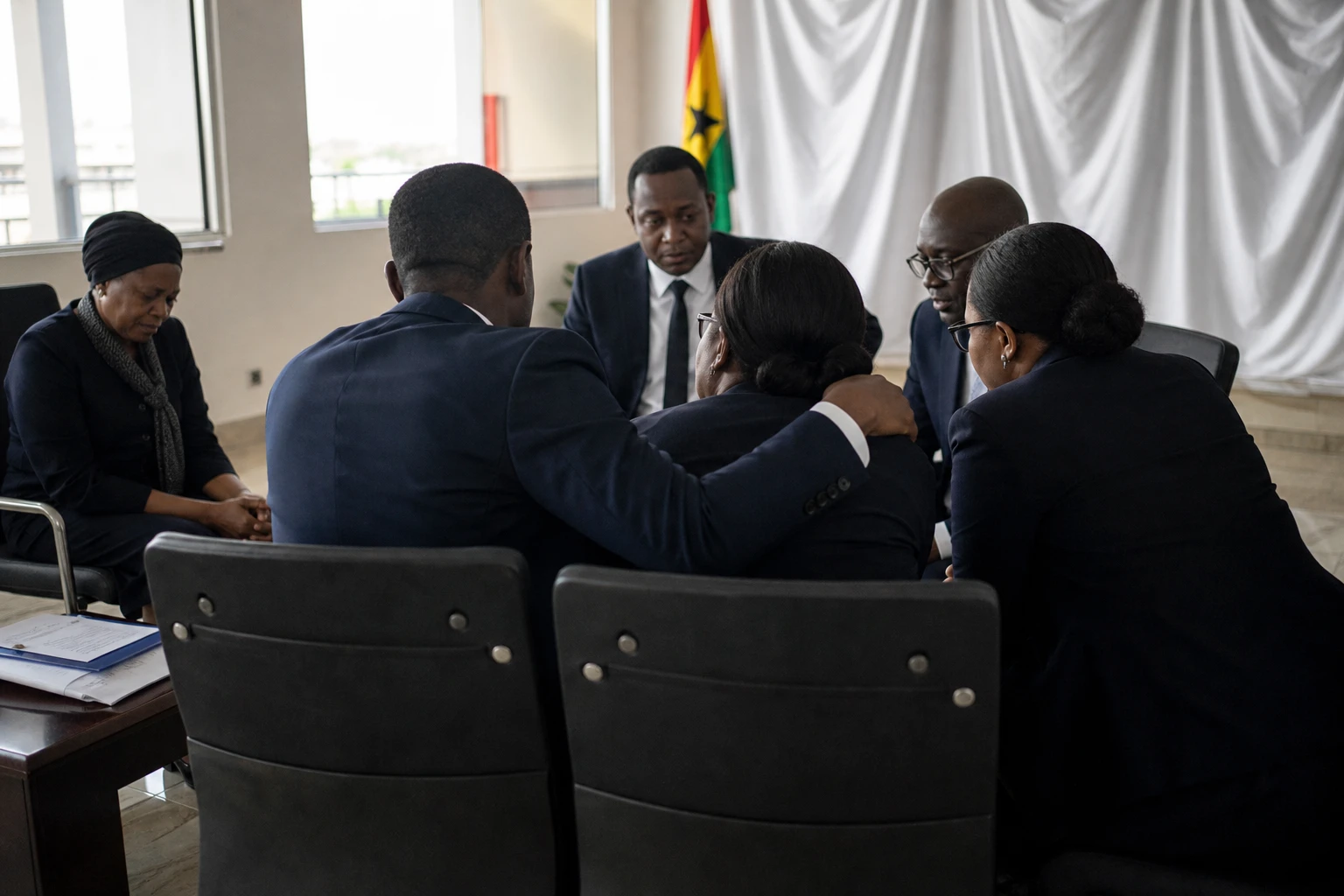
On Friday 14 August 2026, a plane carrying 50 Ghanaians repatriated from South Africa landed at Accra International Airport at 17:50, according to information made public by the authorities. A passenger whose health had deteriorated before landing was treated by an emergency medical team deployed at the airport. Despite attempts to resuscitate him, he was pronounced dead at 18:55. The authorities said the body had been transferred to the Police Hospital for an autopsy and that the family would be informed through official channels.
In communications about the operation, Ghana’s Ministry of Foreign Affairs has already stressed two priorities: assistance for returnees and support for their reintegration. People returning under these evacuations are to receive transport assistance and resettlement support, as well as, according to official announcements, psychosocial and medical care. The first group welcomed in May had been promised the same follow-up, as the authorities described the operation as a response to a situation that had become difficult for Ghanaians living in South Africa.
Another figure gives a sense of the scale of the operation. In July 2026, the ministry said that more than 1,000 Ghanaians had already been evacuated from South Africa, while other Ghanaian media had reported in June that more than 1,500 people had registered for voluntary return. These figures point to a large-scale mobilisation, but they do not align exactly: they refer to different stages of the process and different counting criteria.
Beyond one case, a question of consular protection
The death, which occurred at the end of a repatriation journey, puts the question of consular protection back at the centre of the debate. For Ghana, the task is not simply to bring citizens home. It must also receive them, provide medical care where necessary, inform families and document the circumstances of tragedies. In Accra, this chain involves several institutions: the Ministry of Foreign Affairs, public health services, immigration, social services and the emergency teams deployed at the airport.
The economic impact is also real. In South Africa, some of the Ghanaians concerned held precarious jobs in the informal economy, small-scale trade or services. Their forced or accelerated return means they must quickly rebuild an income in Accra, Kumasi or other cities across the country. The assistance announced by the state may cushion the shock, but it cannot replace secure housing or stable employment. The issue therefore goes beyond diplomacy: it touches on reintegration, social protection and the Ghanaian economy’s ability to absorb sudden returns.
The regional context also matters. Movement between Ghana and South Africa is extensive, driven by education, business, job-seeking and family networks. When anti-foreigner violence takes hold, West African capitals are quickly forced to respond. Across ECOWAS, free movement remains a major political achievement, but its promise runs up against realities on the ground, social tensions and weaknesses in systems designed to protect African migrants outside their region of origin.
What this repatriation says about Africa today
The episode resonates across the continent. It is a reminder that African migration cannot be understood solely through departures for Europe. It also takes place between African countries, in economies where people move, work and are sometimes exposed to waves of hostility. South Africa, the continent’s economic powerhouse in the south, remains a magnet, but it is also a place where surges in xenophobia can prompt mass returns.
For the Ghanaian authorities, the next challenge will be twofold. First, they will need to establish precisely the medical circumstances surrounding the death at Accra International Airport. Second, they will have to maintain the confidence of returnees and their families in a system that aims to protect without delay, assist without abandonment and reintegrate without diluting the state’s responsibility. In a sub-region where population movements are increasing amid crises, every successful—or failed—repatriation becomes a test of governance.



