Algeria
 Egypt
 Libya
 Morocco
 Sudan
 Tunisia
 Benin
 Burkina Faso
 Cabo Verde
 Côte d'Ivoire
 Guinea
 Guinea-Bissau
 Liberia
 Mali
 Mauritania
 Niger
 Nigeria
 Senegal
 Sierra Leone
 The Gambia
 Togo
 Cameroon
 Central African Republic
 Chad
 DR Congo
 Equatorial Guinea
 Gabon
 Republic of the Congo
 São Tomé and Príncipe
 Burundi
 Comoros
 Djibouti
 Eritrea
 Ethiopia
 Kenya
 Madagascar
 Malawi
 Mauritius
 Mozambique
 Rwanda
 Seychelles
 Somalia
 South Sudan
 Tanzania
 Uganda
 Angola
 Botswana
 Eswatini
 Lesotho
 Namibia
 South Africa
 Zambia
 Zimbabwe

When a part is missing, the machine stops
In many African factories, the real breakdown is not always the motor. Sometimes it is a spare part that cannot be found, arrives too late or is sold at a high price. That is precisely the bottleneck a new additive manufacturing network — in other words, industrial 3D printing — aims to ease by bringing production closer to where parts are needed.
The project is in line with a policy already championed by the African Union: industrialisation, added value and continental integration. The AU’s Agenda 2063 makes transforming African economies, industrialising through science and technology, and strengthening intra-African trade stated priorities. The institution also notes that frameworks such as BIAT and AIDA aim to expand the African market and improve the continent’s industrial performance.
A hub in Ghana, with operations driven from Lagos
The first announced hub for the network is in Ghana, with Sodah Engineering and Logistics Limited, or SELL, as its local operator. SELL is a Ghanaian company active in engineering and logistics for the energy and mining sectors. Its role is to act as a bridge between Ghanaian industrial companies and Arridex’s infrastructure in Lagos, Nigeria.
In this setup, Nigeria is the technological centre of gravity. Arridex describes its Lagos site as West Africa’s first multi-technology industrial additive manufacturing plant. The company says it produces on-demand components and spare parts there for sectors such as oil and gas, aerospace, defence and heavy industry.
The network’s logic is easy to understand. An obsolete, scarce or unavailable part is scanned, digitally reconstructed and then manufactured as close as possible to the industrial user. According to announcements in Ghana, the network is to operate through local national partners linked to a shared digital platform and infrastructure.
What industrial 3D printing changes
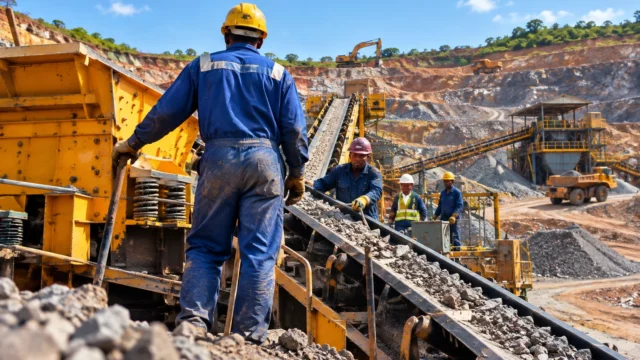
The expected benefit is not just technical. It is economic. In the mining, energy, maritime and aviation industries, a missing part can bring an entire piece of equipment to a standstill. When imports take weeks or months, the cost of downtime exceeds the price of the part itself. SELL and Arridex want to reduce this hidden cost by producing locally what can be made there, and limiting idle inventory.
This promise resonates amid current strains on global supply chains. IATA and Oliver Wyman estimate that disruptions to the aviation supply chain could cost the sector $11.3 billion in 2025, notably because of older aircraft, higher maintenance costs, more expensive engine leases and larger spare-parts inventories. Although the figure is specific to aviation, it gives an idea of the financial toll of component delays.
For African businesses, the stakes are broader still. UNCTAD notes that regional value chains remain fragile, with inadequate infrastructure and non-tariff barriers hampering the movement of intermediate goods. The organisation also says that supply-chain diversification and flexibility have become key drivers of resilience.
Against this backdrop, additive manufacturing could become a tool of productive sovereignty, in the industrial sense. It does not eliminate dependence on raw materials, machinery or software. But it can reduce reliance on imported finished parts. That is an important distinction. The continent does not yet produce everything, but it can make better choices about what it manufactures locally and what it circulates between African countries.
A test for AfCFTA and for skills
The project also aims to be part of the African Continental Free Trade Area (AfCFTA), which seeks to facilitate trade between African countries. The idea is to add the movement of production capabilities to the movement of goods. A part designed in Nigeria, produced in Ghana and destined for a customer in West Africa would illustrate a shorter, more regional and potentially more resilient value chain.
But skills will be decisive. Project stakeholders say they want to work with universities, research centres and training institutions to develop digital design, component scanning, materials selection and additive manufacturing engineering. In other words, technology alone will not be enough. Technicians, engineers and operators will also need to be trained to run this kind of ecosystem.
On this front, the challenge extends beyond Ghana and Nigeria. The African Development Bank had already noted that additive manufacturing is in use in Africa, but that a lack of expertise is still holding back its expansion. The same report said 3D printing has the greatest potential when it meets concrete local needs, with products designed for African markets.
What to watch in the coming months
The announced expansion to 25 hubs in 15 African countries over five years is ambitious. A second phase, dubbed “Mega Omnifactory”, is also planned for 2027 as a broader capacity base. If these milestones are achieved, they will offer a useful indication of how quickly a digital industry in Africa can move from ambition to scale.
The continental scope is clear. On the one hand, the network is testing a form of distributed production that aligns with the objectives of Agenda 2063. On the other, it is testing African economies’ ability to share technical capabilities rather than simply trade routes. The real issue, then, is not just 3D printing. It is how the continent turns a supply constraint into lasting industrial infrastructure.