Algeria
 Egypt
 Libya
 Morocco
 Sudan
 Tunisia
 Benin
 Burkina Faso
 Cabo Verde
 Côte d'Ivoire
 Guinea
 Guinea-Bissau
 Liberia
 Mali
 Mauritania
 Niger
 Nigeria
 Senegal
 Sierra Leone
 The Gambia
 Togo
 Cameroon
 Central African Republic
 Chad
 DR Congo
 Equatorial Guinea
 Gabon
 Republic of the Congo
 São Tomé and Príncipe
 Burundi
 Comoros
 Djibouti
 Eritrea
 Ethiopia
 Kenya
 Madagascar
 Malawi
 Mauritius
 Mozambique
 Rwanda
 Seychelles
 Somalia
 South Sudan
 Tanzania
 Uganda
 Angola
 Botswana
 Eswatini
 Lesotho
 Namibia
 South Africa
 Zambia
 Zimbabwe
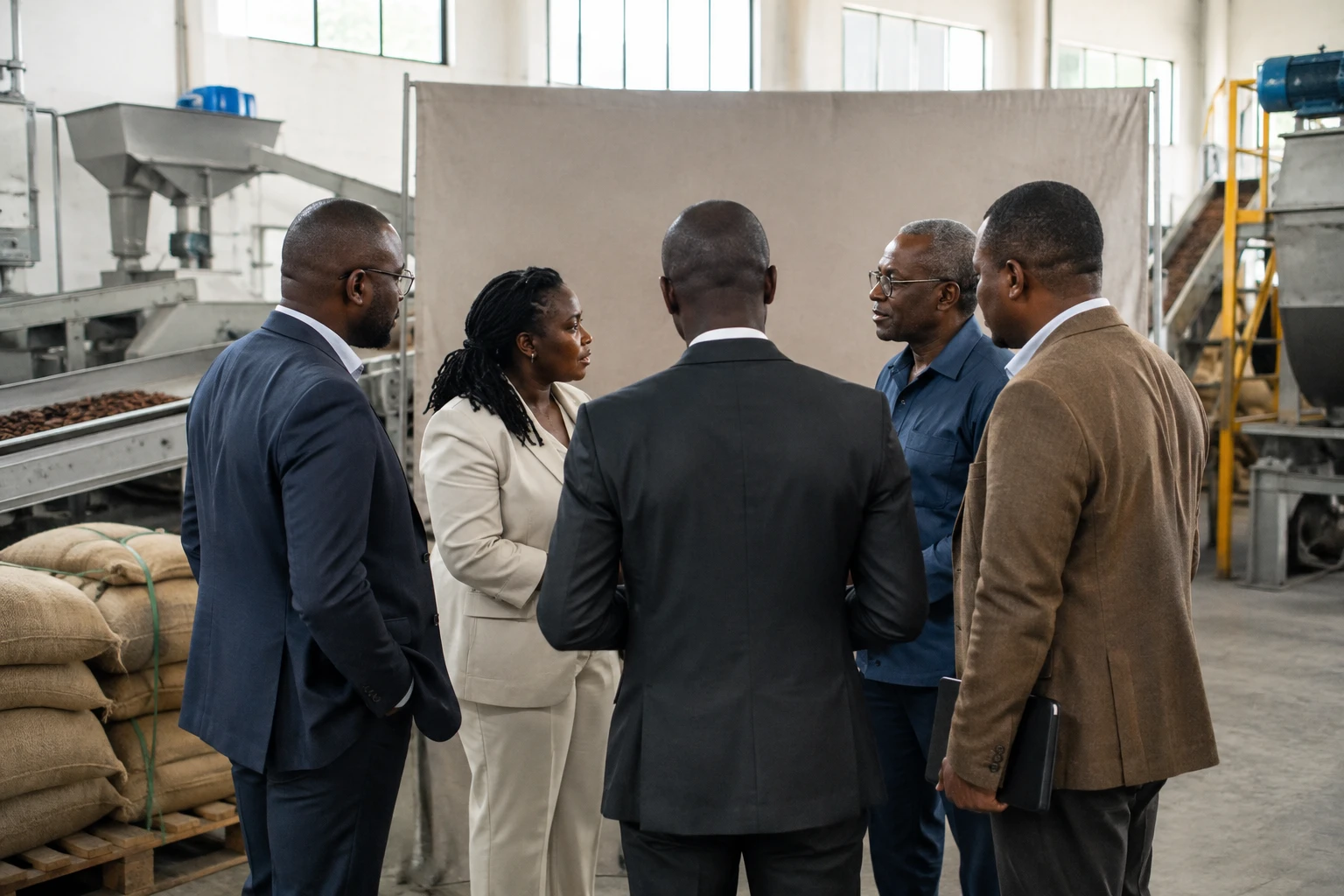
Processing more beans locally depends on more than the number of factories. They also need financing for purchases, secure supplies and customers for the products they make. In Ghana, this industrial equation lies at the heart of a public target due to take effect from the 2026/2027 cocoa season.
A national ambition in a West African market
Ghana and Côte d’Ivoire occupy central positions in global cocoa production. The two neighbouring countries account for a significant share of supplies to international markets, but much of the value of chocolate is created further along the chain: grinding, manufacturing, packaging and selling finished products.
Accra wants to increase the share of this activity carried out in the country. The government has set a target of processing at least 50% of beans locally from the 2026/2027 season. The measure forms part of a series of decisions announced in February 2026, including the revival of the Cocoa Processing Company (CPC), a state-owned processor. The Ghana News Agency reported that the CPC welcomed the move, while noting the challenges of accessing beans and industrial capacity. The Ghana News Agency’s account of the directive specifies that it is due to begin with the next targeted season.
The challenge also falls within the framework of ECOWAS, the Economic Community of West African States. Cocoa moves through a region where producers, port infrastructure and processing companies are connected to the same global markets. For Ghana, developing regional outlets could complement sales to Europe and North America, but this would require reliable trade flows and competitive products.
Financing factories and their markets
On 26 October 2026 in New York, Wisdom Kofi Dogbey, managing director of the Cocoa Marketing Company (CMC), presented investment opportunities in Ghana’s cocoa sector at the second Africa Cocoa Finance and Investment Forum. The CMC markets the country’s cocoa. The forum programme confirms that the event took place on that date and that Dogbey participated. The ACFIF programme in New York put finance and market access at the centre of discussions.
The areas discussed included rehabilitating plantations, processing, technology, research and risk management. The message to investors was concrete: existing facilities could produce more if they had working capital, upgraded equipment and identified customers for their products.
This last condition matters as much as building a factory. A facility cannot create lasting value if it lacks beans or cannot find buyers for its semi-finished products. Projects therefore need capable operators, clear commercial contracts and sufficiently stable demand. The New York forum also highlighted financing, risk management and access to the US market. A Citi Newsroom report placed these discussions in a context of price volatility and evolving sustainability standards. Citi Newsroom’s account of investment and market-access issues shows that capital alone cannot resolve commercial constraints.
For processors, financing can cover bean purchases, energy, maintenance and equipment. For producers, the challenge is to ensure that increased processing goes hand in hand with regular supplies and a sector capable of paying for beans. For policymakers, the task is to turn a national policy into a viable business without shifting risks on to farmers or local companies.
Consolidating export value
Cocoa derivatives are already an important part of Ghana’s non-traditional exports. The Ghana Export Promotion Authority’s (GEPA) 2025 report says total receipts from the sector reached about $5bn, up 30.7% year on year. The authority cites cocoa-derived products among the main drivers of this increase. GEPA’s 2025 annual report gives the overall figure, which should not be treated as cocoa receipts alone.
The Bank of Ghana, in data reported by the Ghana News Agency, estimates that cocoa exports — beans and processed products combined — generated $3.86bn in 2025, compared with $1.94bn in 2024. These figures do not measure local processing alone. They nevertheless show the sector’s weight in the country’s external earnings. The foreign trade figures attributed to the Bank of Ghana underline the need to distinguish export value from changes in production volumes.
Rising receipts therefore do not, on their own, guarantee that Ghanaian factories have processed more beans. International prices and the composition of exports can push up values without a corresponding increase in volumes. This distinction is essential when measuring progress towards the 50% target.
Ghana also wants to explore products beyond ingredients used by the chocolate industry, such as cocoa-butter cosmetics and drinks made from cocoa pulp. These avenues could diversify revenues, but they require appropriate investment, quality controls and markets able to absorb production. They are opportunities to develop, not outlets that are already guaranteed.
Implementation will be the test
The next step will be to see how the processing target translates into supply contracts, available financing and capacity actually being used from the 2026/2027 season. Announcements on reviving the CPC and mobilising investors will have to be tested against processors’ day-to-day constraints: liquidity, energy, logistics and access to customers.
For West Africa, the stakes go beyond Ghana’s borders. If producer countries process more locally, they can retain a greater share of value and develop industrial skills. But this outcome will depend as much on the strength of companies and their markets as on the targets announced. The New York forum brought this condition into focus: attracting capital is only the beginning; turning it into sustainable activity will be the real measure of the project.