Algeria
 Egypt
 Libya
 Morocco
 Sudan
 Tunisia
 Benin
 Burkina Faso
 Cabo Verde
 Côte d'Ivoire
 Ghana
 Guinea
 Guinea-Bissau
 Liberia
 Mali
 Mauritania
 Niger
 Nigeria
 Senegal
 Sierra Leone
 Togo
 Cameroon
 Central African Republic
 Chad
 DR Congo
 Equatorial Guinea
 Gabon
 Republic of the Congo
 São Tomé and Príncipe
 Burundi
 Comoros
 Djibouti
 Eritrea
 Ethiopia
 Kenya
 Madagascar
 Malawi
 Mauritius
 Mozambique
 Rwanda
 Seychelles
 Somalia
 South Sudan
 Tanzania
 Uganda
 Angola
 Botswana
 Eswatini
 Lesotho
 Namibia
 South Africa
 Zambia
 Zimbabwe

In workshops, markets and kitchens, electricity has become a political variable
In Banjul and the neighbouring urban area, a power cut is no longer just an inconvenience. It determines which goods are lost, which meals go unsold, which phones go dead and, sometimes, whether an entire working day is lost. In The Gambia, the electricity crisis is no longer a technical issue. It has become a test of the government’s credibility, an economic shock for households and a source of tension in public life.
The country is not facing this situation in isolation. The Gambia remains connected to the West African energy system, notably through electricity exchanges with Senegal, and its access to power has long depended on fragile balances between local generation, imports and public finances. In recent months, however, the authorities have made repeated announcements about new infrastructure and the goal of improving access to electricity. This points to a long-term strategy, but also shows how sharply the current emergency has caught up with it.
Prolonged outages slow activity
Load-shedding has intensified in The Gambia since June, peaking in August and early September. In some areas, outages lasted between 12 and 48 hours. They plunged entire neighbourhoods into darkness, forced businesses to close early and compelled health facilities to rely on generators, sometimes amid great uncertainty. In some places, water supplies were also disrupted for hours.
The effects were immediately visible in prices and incomes. In fish markets, ice became more expensive, weighing on the storage of produce and sellers’ margins. In tailoring workshops, grain mills and small shops, owners had to shift work to night-time hours, use manual machines or give up part of their output. The problem is simple: without power, the informal trade that is so prevalent in the Gambian economy loses momentum.
The situation also triggered two nights of spontaneous protests last week, with roadblocks and slogans directly targeting President Adama Barrow. The anger is not driven solely by energy bills. It also reflects broader frustration with a public service seen as unreliable in a country where the capital, Banjul, and peri-urban areas concentrate economic activity, small industries and essential services.
A technical crisis, but also a financial and regional one
Gambia’s public utility, the National Water and Electricity Company, said in mid-August that the outages stemmed from rising demand linked to hot weather, combined with constraints on electricity imports and a technical fault. This technical explanation matters, but it is not enough. In June, Adama Barrow acknowledged outstanding payments to Senelec, the Senegalese public utility, which complicated efforts to stabilise supply. In other words, The Gambia’s crisis is not simply a matter of hot weather: it combines rising consumption, external dependence and financial fragility.
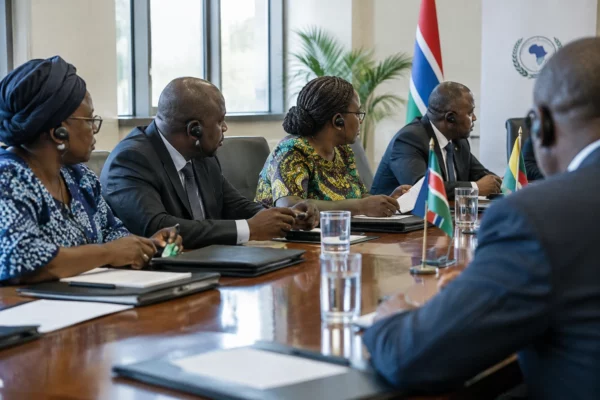
The regional context matters as much as the weather. The Gambia is one of the smaller West African states most dependent on cross-border electricity exchanges. Under the framework of ECOWAS, regional electrification and interconnection projects have already helped extend access to electricity in several Gambian communities. The authorities have said that the access rate rose from 73% to 90% thanks to regional programmes, with tens of thousands of new connections. But a higher access rate does not automatically protect against load-shedding when demand rises faster than available capacity.
This gap between structural progress and immediate vulnerability lies at the heart of the problem. The country can inaugurate power lines, extend its network and point to gains in rural electrification. Yet it remains exposed to interruptions in imports, technical faults at its partners’ facilities, payment delays and the operating costs of a system still under strain. That is precisely what the current blackouts reveal: an unfinished energy transition that still depends on external balances.
A social issue before an engineering one
For households, the outages abruptly change daily life. They force people to buy ice, look for places to charge their phones, delay food storage and endure nights without ventilation during the hot season. For businesses, they increase losses and disrupt production schedules. For public services, they expose the limits of backup solutions. And for self-employed workers, they create immediate uncertainty about the next day’s income.
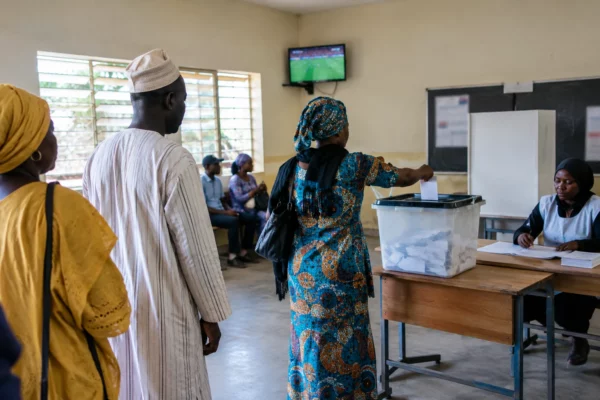
The government is staking its reputation on a particularly sensitive issue. President Barrow has promised a marked improvement in the situation by the end of October 2026, and the authorities have announced that a 24-megawatt generating unit at Brikama, not far from Banjul, will come into service. The promise comes as the country prepares for the presidential election on 5 December 2026, confirmed by the electoral commission’s official calendar. In this context, electricity has become an election issue as much as a matter of governance.
The significance of the crisis extends beyond The Gambia. In a sub-region where electricity grids are often interconnected, a local difficulty can quickly highlight the dependencies between neighbouring states. It is also a reminder that West African integration is not played out only at summits or in agreements, but in the ability to provide a basic service that is stable and affordable. When electricity falters in Banjul, the entire debate over energy sovereignty, regional co-operation and infrastructure reliability comes to the fore.