Algeria
 Egypt
 Libya
 Morocco
 Sudan
 Tunisia
 Benin
 Burkina Faso
 Cabo Verde
 Côte d'Ivoire
 Ghana
 Guinea
 Guinea-Bissau
 Liberia
 Mali
 Mauritania
 Niger
 Nigeria
 Senegal
 Sierra Leone
 Togo
 Cameroon
 Central African Republic
 Chad
 DR Congo
 Equatorial Guinea
 Gabon
 Republic of the Congo
 São Tomé and Príncipe
 Burundi
 Comoros
 Djibouti
 Eritrea
 Ethiopia
 Kenya
 Madagascar
 Malawi
 Mauritius
 Mozambique
 Rwanda
 Seychelles
 Somalia
 South Sudan
 Tanzania
 Uganda
 Angola
 Botswana
 Eswatini
 Lesotho
 Namibia
 South Africa
 Zambia
 Zimbabwe
In Banjul, the 2027 budget will have to contend with a constraint that has become central: a growing share of public resources will go towards repaying and servicing debt before national priorities can be funded.
The Gambian government expects debt service to rise by 20.2% in 2027. The bill would increase from 13.46 billion dalasis in 2026 to 16.17 billion in 2027, according to figures presented to the National Assembly by Seedy K.M. Keita, the Minister of Finance and Economic Affairs, on 25 September 2026.
Growing budgetary pressure
Debt service includes principal repayments and interest payments. In the Gambian draft budget, it is becoming one of the largest items of expenditure. This trend mechanically reduces the room available for public services, infrastructure and productive investment.
The authorities forecast 40.96 billion dalasis in revenue and grants in 2027. Debt service would therefore account for nearly 39.5% of that total. The overall budget, which includes external financing and loans, would reach about 66.8 billion dalasis.
The government is also banking on a 14.2% increase in revenue from the Government Local Fund, which pools resources raised domestically, as well as grants. Tax revenue is expected to rise by 16.5%.
To meet this target, Banjul plans to broaden the tax base. The draft mentions new taxes on single-use plastics, imported used tyres and scrap metal exports. These measures could boost revenue. They will, however, need to be implemented carefully to avoid increasing costs for households and small businesses.
Results for the first half of 2026 already show the scale of this effort. Public revenue, excluding project-related grants, reached 15.35 billion dalasis. At the same time, expenditure and net lending stood at 15.42 billion dalasis, leaving a deficit of 68.86 million dalasis.
The cost of domestic debt
The announced increase is not driven solely by external debt. Figures provided by the minister indicate that interest payments on domestic debt are expected to rise sharply in 2027. This debt consists mainly of securities issued on the Gambian market, including Treasury bills and bonds.
According to an analysis by Gambian outlet Askanwi on the 2027 draft budget, interest payments on domestic debt could increase by 34%. This reflects the high cost of refinancing and the state’s need to regularly renew part of its borrowing.
The situation can create a crowding-out effect. When the state draws on a large share of available savings, businesses may find it harder to obtain credit or have to pay higher interest rates. For small businesses, which are prevalent in trade, services and the informal economy, this pressure can limit investment and hiring.
The strain is also evident in budget execution. According to figures reported by The Point, The Gambia spent 3.10 billion dalasis on debt interest in the first six months of 2026. This amounted to 45% of the annual forecast for interest payments.
For the authorities, the challenge is to increase revenue without slowing economic activity. For citizens, the stakes are reflected in the quality of public services, the cost of goods and the state’s ability to support essential sectors.
High debt, but deemed sustainable subject to conditions
The International Monetary Fund estimates that Gambian public debt stood at about 79% of gross domestic product at the end of 2025. External debt then accounted for nearly 62.3% of public debt, with an estimated value of $1.32 billion.
These figures differ from some estimates published previously. The variation reflects different reference dates and calculation methods, as well as the gradual inclusion of certain public liabilities. The underlying point remains the same: The Gambia has limited fiscal capacity.
In its 2026 analysis, the IMF considers the debt sustainable, but says the country remains at high risk of debt distress. The institution highlights, in particular, the vulnerability created by the cost of domestic debt, still-low public revenue and refinancing needs.
The trajectory will therefore depend on several factors. Stronger growth could boost revenue and reduce the relative burden of debt. By contrast, a fall in tourism, a slowdown in diaspora remittances or higher interest rates would make fiscal balance harder to achieve.
The Gambian government forecasts real growth of 5.7% in 2025 and expects 5.6% in 2027. Agriculture, construction, tourism and remittances are expected to support this momentum. However, these sectors do not affect the country’s regions equally. Banjul and the urban area benefit more from administrative activity and services, while rural areas depend more directly on agriculture and infrastructure.
Banjul’s regional trajectory
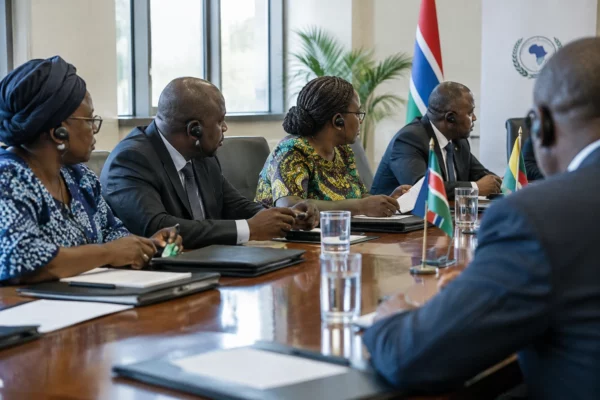
The Gambia is operating in a West African environment in which countries are seeking greater fiscal room. As a member of the Economic Community of West African States, ECOWAS, it remains part of a regional bloc whose states must fund public services, infrastructure and security arrangements.
This membership can facilitate trade, commercial revenue and economic cooperation. It does not, however, remove the Gambia’s specific constraints: its domestic market is small, and its revenue depends heavily on trade, tourism and diaspora remittances.
The 2027 budget also plans to extend programme-based budgeting across the central government. The principle is to link spending more clearly to objectives and expected results. The reform could make public choices more transparent, provided ministries have reliable data and Parliament can monitor the execution of appropriations.
The next test, then, will be less the adoption of the budget than its implementation. Banjul will have to show that revenue increases materialise, spending remains under control and debt financing does not excessively reduce the resources allocated to education, health, agriculture and infrastructure.
Across West Africa, the Gambian case is a reminder of a reality shared by several small economies: macroeconomic stability depends as much on growth as on the quality of tax collection and debt management. In 2027, figures for the deficit, revenue and interest payments will provide the first indicators of the strength of this trajectory.