Algeria
 Egypt
 Libya
 Morocco
 Sudan
 Tunisia
 Benin
 Burkina Faso
 Cabo Verde
 Côte d'Ivoire
 Ghana
 Guinea
 Guinea-Bissau
 Liberia
 Mali
 Mauritania
 Niger
 Nigeria
 Senegal
 Sierra Leone
 Togo
 Cameroon
 Central African Republic
 Chad
 DR Congo
 Equatorial Guinea
 Gabon
 Republic of the Congo
 São Tomé and Príncipe
 Burundi
 Comoros
 Djibouti
 Eritrea
 Ethiopia
 Kenya
 Madagascar
 Malawi
 Mauritius
 Mozambique
 Rwanda
 Seychelles
 Somalia
 South Sudan
 Tanzania
 Uganda
 Angola
 Botswana
 Eswatini
 Lesotho
 Namibia
 South Africa
 Zambia
 Zimbabwe
When the lights go out, so does patience
In Banjul, the Gambian capital, power cuts are no longer a mere inconvenience. They disrupt market stalls, damage stock and force small businesses to close just when they should be operating at full capacity. In a country where retail and restaurants support thousands of families, a few hours without electricity are enough to ruin an entire day. Residents describe daily life as unpredictable, marked by heat, falling incomes and extra expenses to find back-up solutions.
The discontent now goes beyond domestic comfort. It affects the informal economy, which is widespread in The Gambia, as well as services, workshops, fish outlets, hair salons and small neighbourhood shops. In the capital and peri-urban areas, electricity is more than a public service. It determines whether food can be kept fresh, businesses can operate at night and people can work during the hottest hours.
A local crisis rooted in regional vulnerabilities
The National Water and Electricity Company, NAWEC, acknowledges deep strain on the grid. In June 2026, its management said the crisis stemmed from maintenance work on ageing generators, delays in the arrival of spare parts, rising global fuel prices and electricity demand that now exceeds available supply. The company said annual consumption had almost tripled in a decade, rising from about 300,000 megawatt-hours in 2016 to a forecast 970,000 megawatt-hours in 2026.
The Gambian government places the issue within a broader trajectory. In its budget and planning documents, it has announced an increase in national capacity, the expansion of solar power at Jambur, preparations for a 150 MW solar project at Soma and the installation of a 225 kV transmission line to reduce losses and improve grid efficiency. These goals point to a simple fact: the country is seeking to move away from a system dependent on imports, fuel and costly thermal power plants.
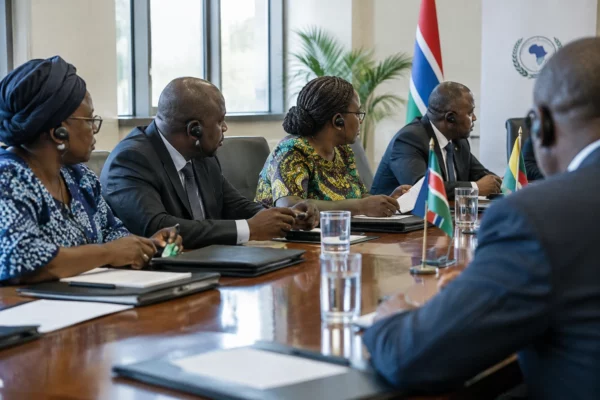
This vulnerability is not isolated. President Adama Barrow himself said in his address to the nation on 8 September 2026 that The Gambia was facing a situation similar to that of several neighbouring countries because of difficulties with the West African Power Pool, the regional electricity trading network. He also acknowledged shortcomings in planning, generation and maintenance. In other words, the crisis is local in its effects, but regional in several of its causes.
From Banjul’s streets to the cabinet room
Anger has spilled out of homes. On 8 September 2026, protests broke out in several parts of Banjul and the surrounding area. Demonstrators burned tyres and erected barricades. Police used tear gas to disperse gatherings, including near the president’s official residence. Some residents said they were enduring power cuts lasting up to 48 hours, according to Reuters.
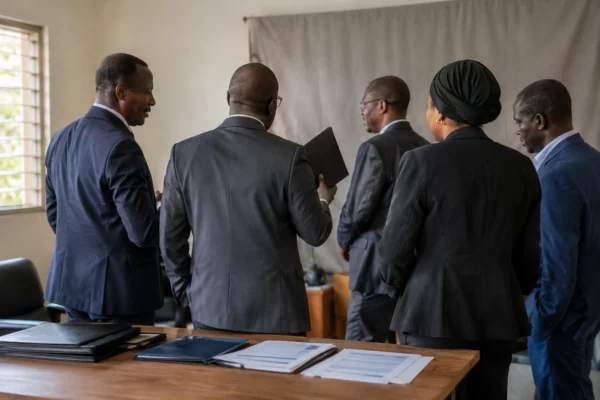
In the presidential address broadcast that same day, Adama Barrow acknowledged the seriousness of the moment. He spoke of an “electricity situation” affecting households, children studying in the dark and families forced to throw away food that had become unsafe to eat. He announced the installation of a 24 MW machine at the Brikama power plant, due to be commissioned by the end of October 2026, as well as a 50 MW solar project at Soma. He also set up a monitoring task force chaired by the vice-president, with public updates every two weeks.
A few weeks earlier, the presidency and local media had already reported rising tensions over electricity. In August 2026, NAWEC acknowledged peak demand of about 140 MW during the busiest hours, driven by the heat and constraints on electricity imports. The company later said rationing would focus mainly on the night, when consumption rises and the grid’s safety margins disappear.
What the power cuts reveal about The Gambia today
The electricity crisis is hitting low-income households first. Those who can afford a generator or an inverter can cushion the impact. Others endure the heat, lose food and have to stop working. In Banjul’s markets, fish sellers, traders and craftspeople see their incomes collapse as soon as the grid falters. The cost is therefore social before it is technical. It weighs on prices, margins and confidence in public services.
For the authorities, the stakes are as political as they are energy-related. The Gambia is entering a sensitive election year. The presidency has recalled that 2026 is the year of the next presidential election, scheduled for 4 December 2026, and regional observers are closely monitoring the social climate. In this context, electricity is a test of governance. It measures the state’s ability to protect households, but also to deliver on its investment and reform promises.
The implications extend beyond Gambia’s borders. In West Africa, energy remains a matter of practical sovereignty. ECOWAS states, the Economic Community of West African States, share the same vulnerabilities: dependence on fuel oil, high generation costs, incomplete interconnections and mounting urban demand. The Gambia illustrates this dilemma with particular clarity. The country has expanded electricity coverage, but must now turn that quantitative progress into lasting stability, or the gains will remain fragile.
The next few weeks will be decisive, with the announced commissioning at Brikama, the start of construction on the Soma solar project and the next public updates from the presidential monitoring task force. In a country where electricity shapes daily work and the relationship with the state, every delay will matter.