Algeria
 Egypt
 Libya
 Morocco
 Sudan
 Tunisia
 Benin
 Burkina Faso
 Cabo Verde
 Côte d'Ivoire
 Ghana
 Guinea
 Guinea-Bissau
 Liberia
 Mali
 Mauritania
 Niger
 Nigeria
 Senegal
 Sierra Leone
 The Gambia
 Togo
 Cameroon
 Central African Republic
 Chad
 DR Congo
 Equatorial Guinea
 Republic of the Congo
 São Tomé and Príncipe
 Burundi
 Comoros
 Djibouti
 Eritrea
 Ethiopia
 Kenya
 Madagascar
 Malawi
 Mauritius
 Mozambique
 Rwanda
 Seychelles
 Somalia
 South Sudan
 Tanzania
 Uganda
 Angola
 Botswana
 Eswatini
 Lesotho
 Namibia
 South Africa
 Zambia
 Zimbabwe
When unemployment meets the classroom
In Libreville, some Gabonese jobseekers could soon pass through the school system before returning to the administration. On paper, the idea is simple: turn available candidates into useful reinforcements for an education system under strain. Above all, it points to something broader than the issue at hand: in Gabon, the question of employment is no longer being addressed solely through the promise of a job, but also through the state’s ability to provide training quickly, effectively and in the right places.
This approach is part of a period of change that began with the political transition launched in August 2023. The Gabonese authorities have made the restoration of public services a stated priority, with a particular focus on education, health and public-sector jobs. In the sub-region, Gabon also remains tied to CEMAC, the Central African Economic and Monetary Community, whose member states face similar constraints: a high public-sector wage bill, heavily solicited public services and the need for economic diversification.
Training designed to fill a real gap
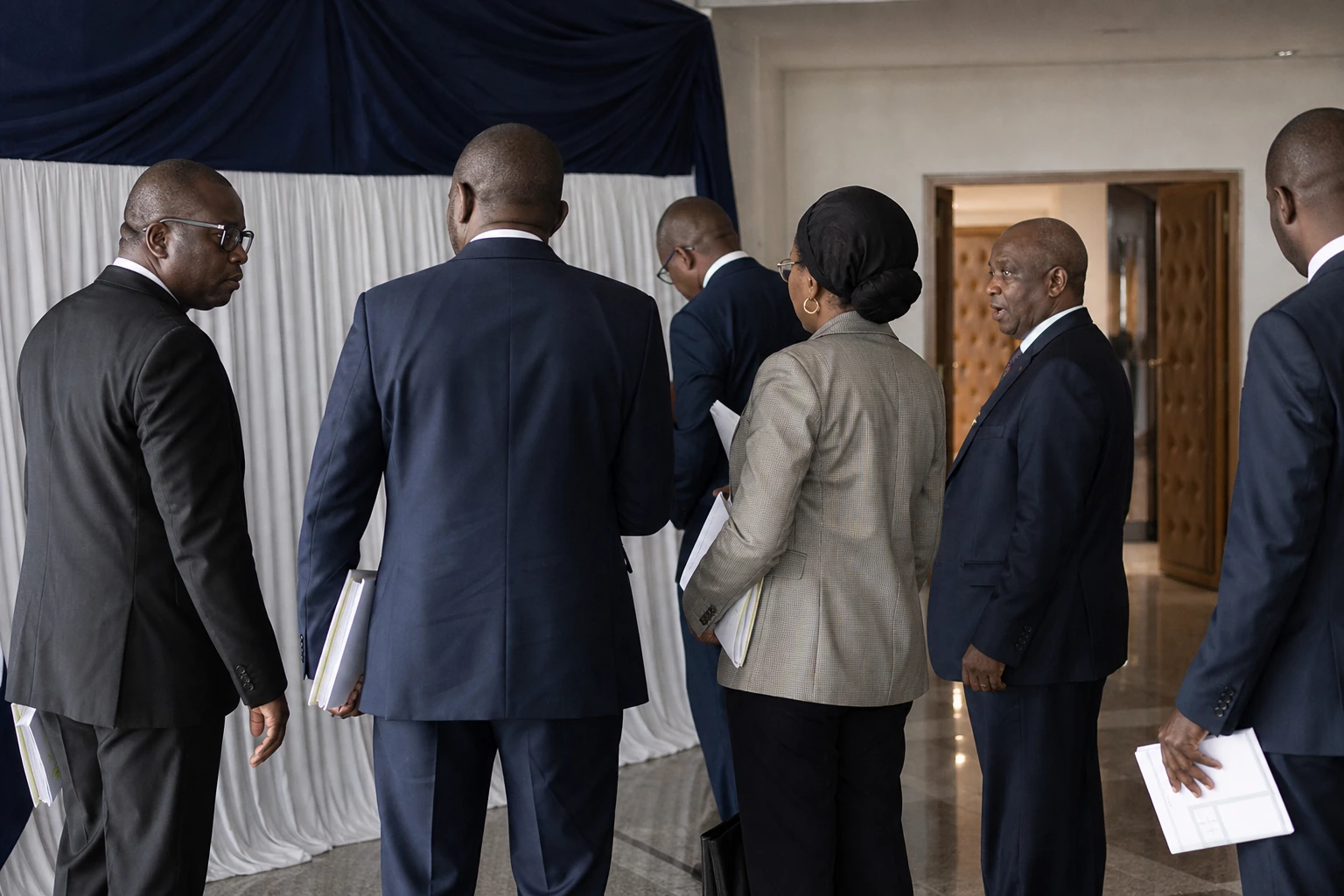
On Monday 14 September, in Libreville, the Minister of State for National Education, Camélia Ntoutoume-Leclercq, met members of the Mouvement national des visionnaires du Gabon, a collective of jobseekers seeking a response to their case. The meeting focused on interim solutions pending possible permanent integration into the civil service. The issue is not new: it follows up on a presidential promise mentioned two years earlier and forms part of a broader effort to regularise administrative situations.
The plan under discussion has two strands. Candidates with scientific and technical backgrounds would be referred to the Institute for Training and Personal Development for an 18-month work-study programme. Those with a bachelor’s or master’s degree would join the Institute for Training in Education Professions, formerly the École normale supérieure, to prepare to teach in middle and high schools. The plan is not intended merely to absorb unemployment. It also seeks to address a chronic teacher shortage, particularly in science subjects.
The government had already acknowledged the scale of the problem. In 2025, the shortfall in teaching staff was estimated at 1,347 posts, nearly 900 of them in scientific disciplines. The shortage was evident in schools, particularly in Libreville, where some classes had become extremely large owing to insufficient staff. Such overcrowding affects learning, as well as the teachers already in post, who have to take on more hours and more pupils.
An administrative response, but not only a budgetary one
Developments in 2024 and 2025 showed that the debate goes beyond recruitment. The ministry had to deal with cases involving teachers who had sometimes spent years without being granted permanent status, volunteers not included on the payroll and unpaid salary arrears. These tensions fuelled a strike launched in December 2025. In January 2026, a tripartite commission bringing together the Ministries of National Education, the Civil Service and the Budget was established. An agreement subsequently suspended the strike and set out several concrete commitments.
The first measures followed. On 28 January 2026, 1,810 former volunteers received their certificates of completion from IFETP, the Institute for Technical and Vocational Teacher Training. By 25 February, 609 administrative cases had been regularised. These figures show a genuine effort to bring matters into order. But they are not yet enough to end the shortages, especially in scientific fields where demand remains greater than supply.
At its core, the government is balancing three urgent priorities. First, containing social pressure from jobseekers and teachers awaiting permanent status. Second, maintaining continuity of lessons in state schools. Finally, ensuring the response is not purely a matter of numbers. Recruiting quickly without proper training may improve staffing figures, but it will not lead to lasting improvements in the quality of education. This is where the choice of different training pathways makes sense: it seeks to link public-sector employment to a basic increase in skills.
What the issue reveals for Libreville, the provinces and the region
For families, the stakes are immediate. An absent teacher can mean a subject is dropped for weeks. In the interior, where it is harder to bring in additional staff, shortages result in disrupted schooling. In Libreville, they are more apparent in crowded classes and pressure on middle and high schools. For the state, the issue is also one of credibility. Education reform is measured not only by announcements, but by the actual presence of qualified adults in classrooms.
The issue also has regional significance. In several Central African countries, public administrations have to contend with imbalanced age profiles, recruitment freezes followed by reopening, and constant pressure on education systems. Gabon is attempting a hybrid response: absorbing some unemployment through training while strengthening a strategic public service. If it succeeds, it could set a useful precedent in a CEMAC region where the shortage of skilled people is often as acute as the shortage of funding.
One concern remains: timing. The 2026-2027 school year and decisions by the civil service will show whether this strategy remains an emergency measure or becomes a lasting mechanism for renewing staff numbers. In a country where schools embody both social hope and demand for public services, the response to these jobseekers will also say something about how Gabon intends to rebuild its institutions.