Algeria
 Egypt
 Libya
 Morocco
 Sudan
 Tunisia
 Benin
 Burkina Faso
 Cabo Verde
 Côte d'Ivoire
 Ghana
 Guinea
 Guinea-Bissau
 Liberia
 Mali
 Mauritania
 Niger
 Nigeria
 Senegal
 Sierra Leone
 The Gambia
 Togo
 Cameroon
 Central African Republic
 Chad
 DR Congo
 Equatorial Guinea
 Republic of the Congo
 São Tomé and Príncipe
 Burundi
 Comoros
 Djibouti
 Eritrea
 Ethiopia
 Kenya
 Madagascar
 Malawi
 Mauritius
 Mozambique
 Rwanda
 Seychelles
 Somalia
 South Sudan
 Tanzania
 Uganda
 Angola
 Botswana
 Eswatini
 Lesotho
 Namibia
 South Africa
 Zambia
 Zimbabwe
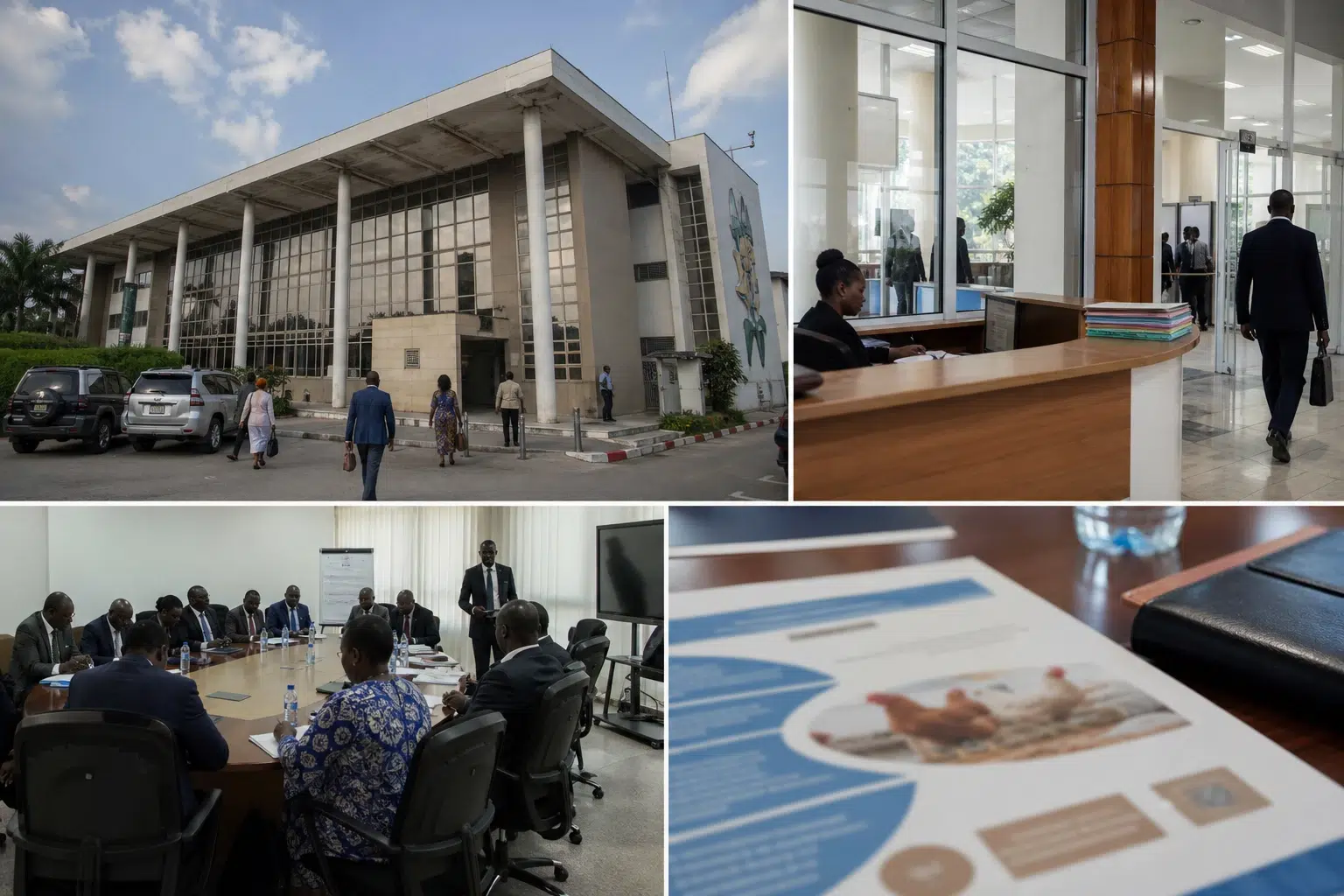
Libreville wants time before 2027
In Gabon, chicken is more than an everyday food product. It is a test of food sovereignty, industrial capacity and commercial leverage. For households in Libreville and across the country, the issue is simple: eat locally produced food without pushing up the bill.
This equation plays out within a specific regional framework. Gabon belongs to CEMAC, the Economic and Monetary Community of Central Africa, which brings together six countries and is seeking to deepen its common market. In this context, any measure affecting imports has implications for supply, customs revenue and the credibility of local-production policies.
For several months, Libreville has been preparing to halt broiler chicken imports on 1 January 2027. The government has already set up technical committees and signed agreements to support the poultry sector. The objective is clear: gradually replace imported meat with a more abundant domestic supply.
US challenge highlights risk of a trade dispute
The point of friction emerged at the multilateral level. At the Council of Ministers meeting on 18 September 2026, the Gabonese government said the United States had challenged Gabon at the World Trade Organisation over the announced ban. The official statement does not detail the US procedure, but it confirms that Libreville wants to avoid a dispute.
The government says it intends to rely on exceptions provided for under WTO agreements and on diplomatic negotiations. In practice, this means Gabon is seeking to defend a public policy of import substitution while remaining within the framework of international trade law. This is a cautious approach. It leaves discussions with Washington open without abandoning the decision to ban imports.
The US reaction is not entirely surprising. The United States closely monitors restrictions on access to African markets when they affect its agri-food exporters. The same logic had already led Washington to put pressure on South Africa in 2015-2016 to secure better access to its poultry market. This precedent shows that poultry remains a sensitive trade issue in relations between the United States and several African countries.
Why Gabon’s poultry sector is at the centre of the issue
The debate is not starting from scratch. In its trade policy review of Gabon, the WTO had already noted that the country was seeking to reduce its dependence on poultry imports. The document said that chicken imports had reached $97.7 million in 2021. In other words, the Gabonese market has long relied on external suppliers to meet rising domestic demand.
Since 2026, the state has accelerated investment. In May, the authorities announced five agreements worth a total of more than CFAF 775 billion to develop poultry farming and agribusiness. A few weeks later, the Ministry of Agriculture said that 150 poultry farms had been selected for a support programme. The message is as much political as economic: prepare production before closing the market.
Another factor is that Gabon increased its agricultural budget in 2026 and presented the creation of a public agropastoral company as a way to scale up. The authorities are therefore betting on a mix of private investment, public support and organisation of the value chain. This framework is intended to prevent a supply disruption on 1 January 2027.
The country nevertheless remains exposed. Its imports still come largely from Brazil and the European Union, and to a lesser extent from the United States. WTO trade data also show that Gabon imports more than $4.2 billion worth of goods a year, underlining the structural importance of external purchases to its economy. The challenge is therefore not only agricultural. It is logistical, industrial and budgetary.
What the case says about Africa’s commercial leverage
The Gabonese case goes beyond chicken alone. In Central Africa, several states are seeking to reduce imports of strategic food products without breaking with international trade rules. CEMAC is pushing for regional integration, but each government has its own urgent food needs and social pressures. Gabon illustrates the tension between a common market, protection of local production and continued dependence on goods from abroad.
For Gabonese producers, the announced ban could open up lasting market opportunities. For households, it will make sense only if local supply keeps pace and prices remain affordable. For the state, the risks are twofold: a supply shock if production is not ready, or a loss of political time if the transition is poorly calibrated. The issue is therefore not ideological. It is operational.
The continental significance is clear. Several African capitals are watching this type of decision because it touches on a question that has become central: how to strengthen food sovereignty without triggering a trade crisis or making the household shopping basket more expensive. At a time when AGOA and trade negotiations continue to influence exchanges with Washington, Gabon is testing an African approach to targeted protection, backed by productive investment rather than an outright market closure.
What happens before 1 January 2027 will therefore be decisive. If local capacity grows quickly, Libreville will be able to turn a sensitive measure into an industrial success. If the expansion is slow, the country will face trade tensions and increased pressure on prices. Either way, chicken is becoming a very tangible indicator of how Gabon intends to reshape its place in the Central African economy.