Algeria
 Egypt
 Libya
 Morocco
 Sudan
 Tunisia
 Benin
 Burkina Faso
 Cabo Verde
 Côte d'Ivoire
 Ghana
 Guinea
 Guinea-Bissau
 Liberia
 Mali
 Mauritania
 Niger
 Nigeria
 Senegal
 Sierra Leone
 The Gambia
 Togo
 Cameroon
 Central African Republic
 Chad
 DR Congo
 Equatorial Guinea
 Republic of the Congo
 São Tomé and Príncipe
 Burundi
 Comoros
 Djibouti
 Eritrea
 Ethiopia
 Kenya
 Madagascar
 Malawi
 Mauritius
 Mozambique
 Rwanda
 Seychelles
 Somalia
 South Sudan
 Tanzania
 Uganda
 Angola
 Botswana
 Eswatini
 Lesotho
 Namibia
 South Africa
 Zambia
 Zimbabwe
A mining pivot to reduce dependence on oil
In Gabon, the question is no longer simply how to replace oil. It is now whether the country can turn its mineral resources into jobs, roads and sustainable revenue. Much of the economic promise being pursued from Libreville hinges on this.
The context is clear. Gabonese authorities are seeking to diversify an economy still heavily exposed to hydrocarbons. The World Bank notes that the country’s growth in 2024 was driven by major public works and a rebound in oil production, but that significant vulnerabilities remain. The IMF, meanwhile, highlights the structural decline in oil production and the need for new sources of growth. At the same time, the African Development Bank says Gabon’s growth slowed in 2025, due in particular to a contraction in oil and mining output.
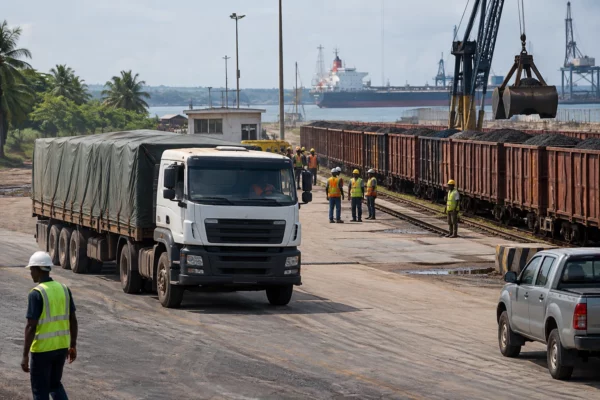
This shift goes beyond mining alone. It also affects Gabon’s place in CEMAC, the Economic and Monetary Community of Central Africa. In a region where logistics infrastructure, energy and local processing remain bottlenecks, the viability of a mining project depends as much on railways, ports and electricity as on what lies underground.
Projects already identified for 2026-2030
Gabon’s Ministry of Mines has set out a clear roadmap. In recent communications, it has referred to a 2026-2030 five-year strategy, with the aim of reaching annual turnover of 500 billion CFA francs by 2030 for the Société équatoriale des mines. The ministry and presidency have also cited several projects that are already well advanced, including Milingui for iron ore, the Mayumba potash project, Baniaka for iron ore, as well as gold projects around Étéké and other deposits still in preparation.
The Milingui project is one of the most concrete. On 15 May 2026, the Gabonese state and Havilah Mining Gabon signed a mining agreement in Libreville, paving the way for the exploitation of the iron ore deposit in Nyanga province. The Ministry of Mines subsequently said the project could create around 530 direct jobs and more than 1,000 indirect jobs from its launch. This sequence shows that the country is no longer talking only about exploration, but about production.
The Mayumba potash project follows the same logic. The Gabonese government has highlighted an agreement with Millennial Potash, backed by the US DFC, to develop what it describes as Africa’s first potash mine. Potash is a key agricultural input. If the project goes ahead, it could therefore support both the trade balance and regional food security.
Infrastructure, energy and local processing: the real test
For economist Orphée Mouelé, who studied at Omar Bongo University, infrastructure remains the decisive factor. His diagnosis is simple: without roads, railways, bridges, ports and reliable energy, mineral resources remain stuck at the project stage. This view is consistent with recent discussions between the Ministry of Mines, SETRAG and industry operators on access to the Trans-Gabon Railway, which links the country’s interior to the coast.
Gabon has faced this problem for a long time. Exporting raw materials does little to enrich the local economy if the value chain remains elsewhere. That is why the government is also emphasising local processing. This is not merely theoretical. It is reflected in recent decisions on industrialisation, adding value to resources and capturing a greater share of the wealth within the country.
On the ground, there are two challenges. For the state, the task is to diversify revenue in a country where oil still accounts for a large share of exports and public finances. For the population, the question is whether they will see tangible benefits. Edmiaune Zouga, president of the NGO Éthique et bonne gouvernance, says what matters is not simply the signing of agreements, but their impact on the daily lives of Gabonese people. In other words, on household budgets, public services and local employment.
What this strategy means for Gabon and Central Africa
The mining sector could become a new economic buffer for Gabon, but it will not replace oil through announcements alone. Recent figures already show that growth remains sensitive to commodity cycles. The African Development Bank even estimates that activity slowed in 2025 despite a recovery in some investment. This means that the expansion of mining will need to be accompanied by strict governance, oversight of permits and a more visible sharing of benefits with the provinces concerned.
The regional implications are significant. In Central Africa, Gabon could become an example of successful diversification if its projects reach production and infrastructure keeps pace. Within CEMAC, where the movement of goods still depends heavily on fragile corridors, a well-integrated mining portfolio could also strengthen trade with Cameroon, Congo, Equatorial Guinea, Chad and the Central African Republic. But the opposite is also true: without energy, railways and local processing, the country risks reproducing with minerals the dependence it is seeking to leave behind with oil.
The 2026-2030 timetable will therefore be decisive. Milingui, Baniaka, Mayumba and Étéké are already serving as a full-scale test. If projects meet their deadlines, and if the first tonnes extracted also translate into jobs, taxes and processing plants, Gabon will be able to present a credible diversification strategy. Otherwise, mining will remain a promising prospect, but one still far removed from the everyday economy experienced by people in Libreville, Nyanga and Ngounié.