Algeria
 Egypt
 Libya
 Morocco
 Sudan
 Tunisia
 Benin
 Burkina Faso
 Cabo Verde
 Côte d'Ivoire
 Ghana
 Guinea
 Guinea-Bissau
 Liberia
 Mali
 Mauritania
 Niger
 Nigeria
 Senegal
 Sierra Leone
 The Gambia
 Togo
 Cameroon
 Central African Republic
 Chad
 DR Congo
 Equatorial Guinea
 Republic of the Congo
 São Tomé and Príncipe
 Burundi
 Comoros
 Djibouti
 Eritrea
 Ethiopia
 Kenya
 Madagascar
 Malawi
 Mauritius
 Mozambique
 Rwanda
 Seychelles
 Somalia
 South Sudan
 Tanzania
 Uganda
 Angola
 Botswana
 Eswatini
 Lesotho
 Namibia
 South Africa
 Zambia
 Zimbabwe
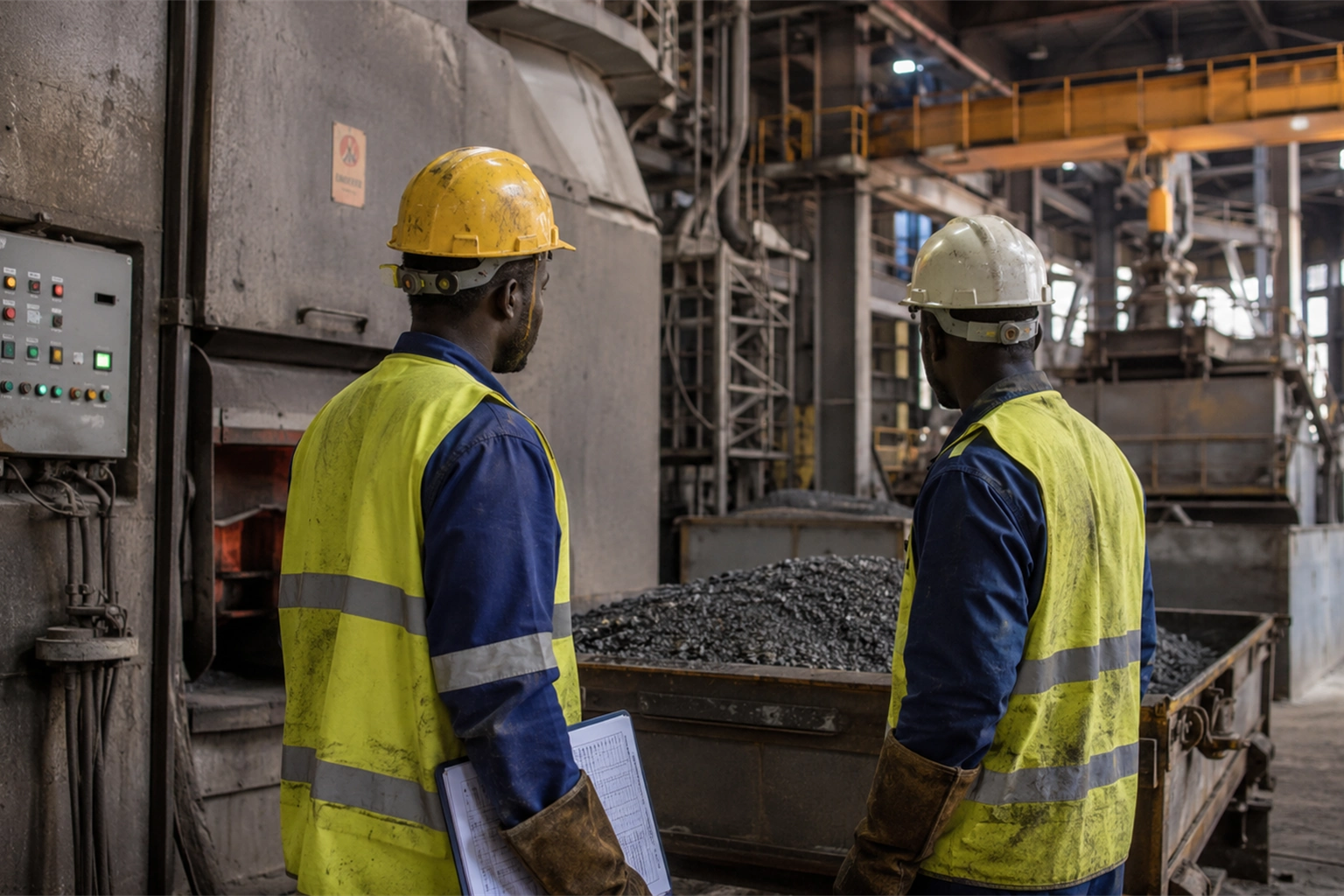
Seven million tonnes mined each year at Moanda. Seven hundred thousand tonnes processed locally by 2031, in the best-case scenario. The memorandum of understanding signed on 20 July in Paris between the Gabonese state and mining group Eramet sets out a real industrial ambition — and, by implication, the distance Libreville still has to cover to achieve its goal of economic sovereignty.
Behind the Élysée Palace ceremony lies a negotiation that began more than a year ago, when the Council of Ministers announced on 30 May 2025 that exports of unprocessed manganese would be banned from 1 January 2029.
A 2025 political decision in search of an industrial timetable
Gabon is the world’s second-largest manganese producer. The Compagnie minière de l’Ogooué (Comilog), a subsidiary of France’s Eramet and partly owned by the Gabonese state, accounts for most of that production from Moanda, in Haut-Ogooué.
In May 2025, President Brice Clotaire Oligui Nguema made his decision. No more exports of unprocessed ore after 2029. Operators were given three years to invest in processing plants. The government presented the measure as an irreversible assertion of sovereignty.
Eramet greeted the announcement cautiously. In a statement on 2 June 2025, the group said it had noted the government’s intention and pledged to safeguard the 10,460 Gabonese jobs supported by Comilog and Setrag, the operator of the Transgabonais railway. Eramet’s share price fell on the Paris stock exchange before stabilising.
In the meantime, an interministerial commission was set up on 16 July 2025 to oversee the issue. Emmanuel Macron then travelled to Libreville in November 2025. The Paris protocol is therefore the culmination of a 14-month stand-off, conducted during a three-day state visit in which the Gabonese president was accompanied by a delegation of more than 80 people.
What the protocol actually contains
The agreement, signed in the presence of both heads of state, identifies three industrial options under consideration, with a combined capacity of up to 700,000 tonnes of ore processed per year by the end of 2031.
| Project | Target capacity | Ore processed | Timeline |
|---|---|---|---|
| Manganese oxide plant (Libreville region) | 10 kt/year | ~20 kt | end of 2028 |
| Refurbishment of the Moanda Metallurgical Complex | up to 70 kt of alloys/year | ~150 kt | end of 2029 |
| New alloy plant near the coast | 265 kt of alloys/year | ~530 kt | 2031 |
None of the three projects has been committed to. The group’s statement consistently uses conditional language and makes each stage dependent on a final investment decision. The third project, by far the largest, also requires a separate investment agreement.
Two complementary measures accompany this roadmap. First, a biocharcoal supply chain, using by-products from the forestry industry to replace imported metallurgical coke. A pilot furnace has been operating since July 2026 in Lastourville, in partnership with Precious Woods. Second, a seed fund called “Made in Gabon”, which aims to create 3,000 industrial jobs.
Electricity, the central sticking point
The most revealing point in the agreement is a clause on power. Smelting manganese ore into alloys consumes enormous amounts of electricity, and the Gabonese state has undertaken to develop the energy solutions needed for the future coastal plant — with support from third parties, but not from Eramet or Comilog.
In other words, the French group is making its industrial investment conditional on infrastructure that Gabon must deliver. This division of responsibilities is no trivial matter. The Moanda Metallurgical Complex, commissioned in 2015, was expected to produce an average of 65,000 tonnes of silicomanganese a year. In 2024, only 18,000 tonnes of silicomanganese were exported, less than a third of installed capacity, according to figures cited by the Gabonese press. The protocol also provides for a study into refurbishing the site to “ensure its profitability” — an admission that the first attempt at local processing has not lived up to expectations.
The decision to locate the large alloy plant near the coast rather than in Moanda follows the same logic. It would bring production closer to the port of Owendo and energy infrastructure, while reducing reliance on the Transgabonais, a single 650-kilometre railway line that already carries about six million tonnes a year.
The arithmetic the statement leaves out
Comilog produced 6.8 million tonnes of high-grade manganese ore in 2024, down from 7.4 million in 2023. Against that volume, the 700,000 tonnes targeted by the end of 2031 amount to about one-tenth of annual extraction.
The gap with the political goal is therefore considerable. A ban on exports of unprocessed ore from 1st January 2029, if strictly enforced, would leave most of Gabon’s production stranded. In November 2025, Gabonese media reported that Eramet had pledged to process two million tonnes locally and create more than 16,000 jobs: figures never confirmed by the group and nowhere to be found in the 20 July protocol.
Two interpretations therefore coexist. For Libreville, the agreement sets out a sovereign path and breaks with 60 years of exporting unprocessed ore. For Eramet, whose chief executive Christel Bories welcomed an “ambitious roadmap” based on technical studies, it primarily secures a framework for discussion and a say in the profitability of each project. A joint monitoring committee will meet quarterly.
A precedent watched across Central Africa
The debate extends far beyond Haut-Ogooué. Over the past decade, several African producers have sought to enforce local mineral processing through regulation. Indonesia did so with nickel, drawing on abundant, cheap electricity. That is precisely what most countries in the Congo Basin lack.
Gabon, a member of the Central African Economic and Monetary Community (CEMAC), faces the same dilemma as its neighbours: banning exports of unprocessed ore does not create factories; it creates an obligation to negotiate. The Paris protocol shows the price of that negotiation — a drawn-out timetable, multiple conditions precedent, and the energy burden shifted to the state.
Three milestones will now shape the issue: the final investment decision on the oxide plant, expected ahead of its hoped-for commissioning at the end of 2028; 1st January 2029, the theoretical date of the export ban; and the separate investment agreement required for the coastal project. Gabonese manganese accounts for about 11% of the country’s exports. There is a seven-year gap to bridge between the political deadline and the industrial timetable.