Algeria
 Egypt
 Libya
 Morocco
 Sudan
 Tunisia
 Benin
 Burkina Faso
 Cabo Verde
 Côte d'Ivoire
 Ghana
 Guinea
 Guinea-Bissau
 Liberia
 Mali
 Mauritania
 Niger
 Nigeria
 Senegal
 Sierra Leone
 The Gambia
 Togo
 Cameroon
 Central African Republic
 Chad
 DR Congo
 Equatorial Guinea
 Republic of the Congo
 São Tomé and Príncipe
 Burundi
 Comoros
 Djibouti
 Eritrea
 Ethiopia
 Kenya
 Madagascar
 Malawi
 Mauritius
 Mozambique
 Rwanda
 Seychelles
 Somalia
 South Sudan
 Tanzania
 Uganda
 Angola
 Botswana
 Eswatini
 Lesotho
 Namibia
 South Africa
 Zambia
 Zimbabwe
A partnership taking a new direction
In Libreville, many are now looking at international agreements with a simple question: do they bring jobs, added value and greater national control? This is precisely the ground on which Gabon and France have sought to position themselves, as bilateral relations emerge from a long period of political and military realignment.
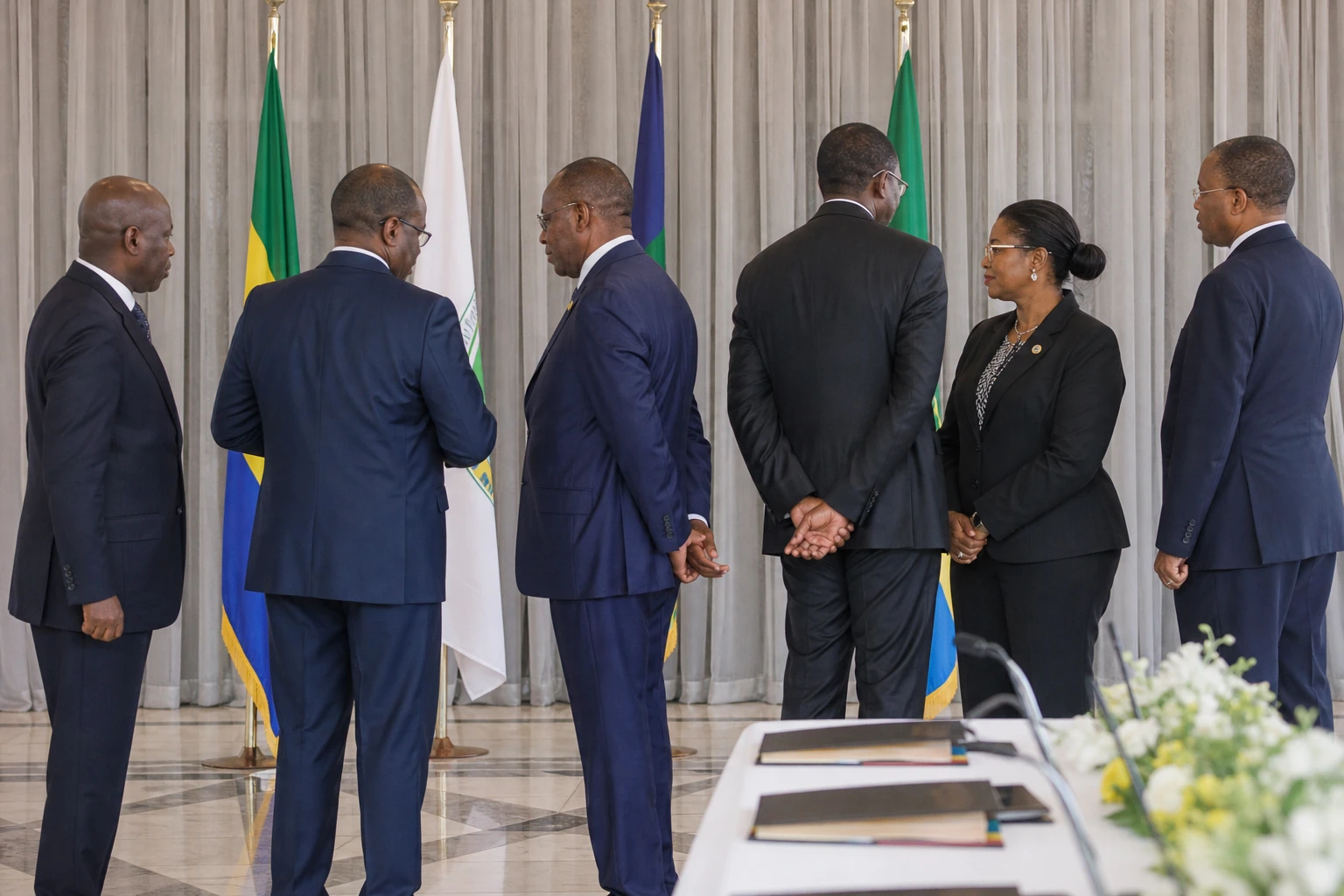
President Brice Clotaire Oligui Nguema began a state visit to France from 19 to 22 July 2026, the first of its kind since his election as head of the Gabonese Republic in April 2025. The two capitals presented the visit as a step towards consolidating a historic partnership, but within a framework that is more practical, more industrial and more secure for Gabon. Both the Gabonese presidency and the Quai d’Orsay prepared the visit around issues identified several months ago: local processing of manganese and the future of the Camp de Gaulle military base in Libreville, which has been a Franco-Gabonese joint training centre since 2024.
What the two states signed in Paris
On Monday 20 July, the two sides signed three agreements in Paris. The first concerns Camp de Gaulle, with a letter of intent aimed at transferring the site to the Gabonese side. The second concerns the transformation of Gabon’s manganese value chain. The third expands co-operation to infrastructure sectors with a direct bearing on daily life, particularly water and energy, according to information corroborated by several sources and by Gabonese and French institutional statements.
The Camp de Gaulle issue is significant. Since France reconfigured its presence in Africa, Paris has reduced its conventional military footprint in Gabon and turned the site into a shared training platform. France’s foreign ministry recently reiterated that the camp, legally owned by France, became a Franco-Gabonese joint facility in July 2024. The new step taken in Paris therefore confirms a shift already under way: less symbolic presence, more joint management, and the Gabonese army at the heart of the arrangement.
On manganese, the signal is even more clearly economic. Gabon is one of the world’s major producers of the ore. In 2024, it ranked as the world’s second-largest producer, accounting for about 25% of global output, according to the US Geological Survey. The country is also highly dependent on a small number of commodities: the World Bank estimates that oil, manganese and timber accounted for 97% of Gabonese exports.
Why Libreville is pushing for local processing
Gabon’s rationale is clear. Exporting raw ore generates revenue, but processing it locally creates more jobs, skills and tax receipts. The government in Libreville has, moreover, taken a tougher line, announcing a ban on raw manganese exports from 2029, with a transition period to establish or modernise local processing facilities. The decision, taken in 2025, has already been publicised by Gabon’s mining ministry and incorporated into the government’s economic policy.
The agreements signed with France are therefore part of a broader shift. Gabon no longer wants to be just a supplier of raw materials. It is seeking greater influence across the value chain, from ore to intermediate products. This is also how the Gabonese presidency frames the partnership: as a tool for asserting sovereignty over mining, rather than simply renewing longstanding ties. The approach reflects a broader trend in Central Africa, where several states want to capture more local value from their resources while retaining technical and financial partners able to support industrial upgrading.
For the population, the stakes are tangible. In a country where the capital, Libreville, is the centre of most decision-making, industrial processing promises, in theory, skilled jobs, better logistics and more visible returns for Gabonese businesses. In production areas, particularly around Moanda, the issues also include roads, rail and energy. The rehabilitation of the Trans-Gabon Railway, the country’s only railway, remains one of the levers cited by French diplomacy itself, which has referred to a €173 million loan from the AFD and an EU grant for this vital route for transporting manganese.
A test for Gabon’s new diplomacy
Since the transition that began in August 2023 and the presidential election of April 2025, Gabon has sought to redefine its partnerships without breaking with its traditional allies. France remains a central partner, but it is no longer the only one. Libreville is also stepping up exchanges with other African capitals and strengthening its position in regional frameworks, notably CEMAC, Central Africa’s economic organisation. In this context, the Paris visit serves to show that co-operation can continue while being renegotiated on terms that are clearer for the Gabonese state.
The military dimension illustrates this realignment. Across Africa, the French presence is now viewed through the lens of sovereignty, national military training and control of strategic sites. In Gabon, the shift towards a shared model at Camp de Gaulle reflects this new reality. The country is not closing the door on Paris. Rather, it is asking France to operate within a more balanced framework, one that is more useful to Gabonese forces and more politically acceptable in Libreville.
The manganese issue will have an impact beyond Gabonese-French relations. International markets for critical minerals are watching local-processing decisions closely, as they affect costs, timelines and supply chains. For the African Union, which is promoting local resource processing and the African Continental Free Trade Area, this type of agreement reinforces an idea that has become central: Africa no longer wants to export only volume; it wants to export value. In its own way, Gabon is trying to demonstrate this in Paris.
What happens next will depend on implementation. The timelines, financing for processing facilities, links with the railway and the legal form of the transfer of Camp de Gaulle will show whether this diplomatic sequence leads to a real transformation or merely updates the language of bilateral relations. In Libreville and Paris alike, progress on the ground will now be what counts.