Algeria
 Egypt
 Libya
 Morocco
 Sudan
 Tunisia
 Benin
 Burkina Faso
 Cabo Verde
 Côte d'Ivoire
 Ghana
 Guinea
 Guinea-Bissau
 Liberia
 Mali
 Mauritania
 Niger
 Nigeria
 Senegal
 Sierra Leone
 The Gambia
 Togo
 Cameroon
 Central African Republic
 Chad
 DR Congo
 Equatorial Guinea
 Republic of the Congo
 São Tomé and Príncipe
 Burundi
 Comoros
 Djibouti
 Eritrea
 Ethiopia
 Kenya
 Madagascar
 Malawi
 Mauritius
 Mozambique
 Rwanda
 Seychelles
 Somalia
 South Sudan
 Tanzania
 Uganda
 Angola
 Botswana
 Eswatini
 Lesotho
 Namibia
 South Africa
 Zambia
 Zimbabwe
In Gabon, the stakes surrounding manganese are no longer limited to the volume extracted. Libreville wants more ore to be processed in the country, while Eramet is seeking capital to repair its balance sheet. The timetable for these two ambitions is tightening around 2029.
A group needing recapitalisation, a sector under pressure
On 12 October 2026, Eramet confirmed its intention to launch a €500 million capital increase in the fourth quarter. The French state, already a shareholder through the State Shareholding Agency, plans to participate and is expected to become the group’s largest shareholder. The transaction remains subject to the necessary authorisations.
The group needs to strengthen its equity. At the end of the first half of 2026, its net debt stood at €1.868 billion. Its net loss attributable to the group, excluding Société Le Nickel (SLN), was €146 million. At the same time, Eramet announced that adjusted EBITDA had risen year on year to €276 million: the operational improvement therefore does not erase the fragility of its balance sheet.
For Paris, Eramet is also a player in the supply of metals deemed strategic. But in Gabon, the immediate question is different: what share of the new financial resources can support the industrial investment expected by the authorities? So far, no specific allocation of the recapitalisation to projects in Gabon has been announced.
Local processing, Gabon’s objective
On 30 May 2025, the Gabonese government announced a ban on exporting raw manganese from 1 January 2029. The Ministry of Mines presented the deadline as a lever for developing local processing and strengthening national skills. The General Secretariat of the Government subsequently brought together the relevant administrations to prepare for its implementation.
This direction reflects an economic policy choice: to capture more value before export, rather than rely mainly on sales of extracted ore. Processing it into alloys nevertheless requires plants, electricity available at a competitive cost and reliable transport routes. It can support industrial jobs, but its effects will depend on the investments actually made and the skills deployed in Gabon.
The country is not starting from zero. In Moanda, Eramet’s metallurgical complex already produces manganese alloys. In June 2025, the Ministry of Mines also said that a working group bringing together the state and Eramet was to examine ways of increasing local processing. The 2029 deadline now puts these discussions to a practical test: turning announced objectives into operational capacity.
Projects still under study
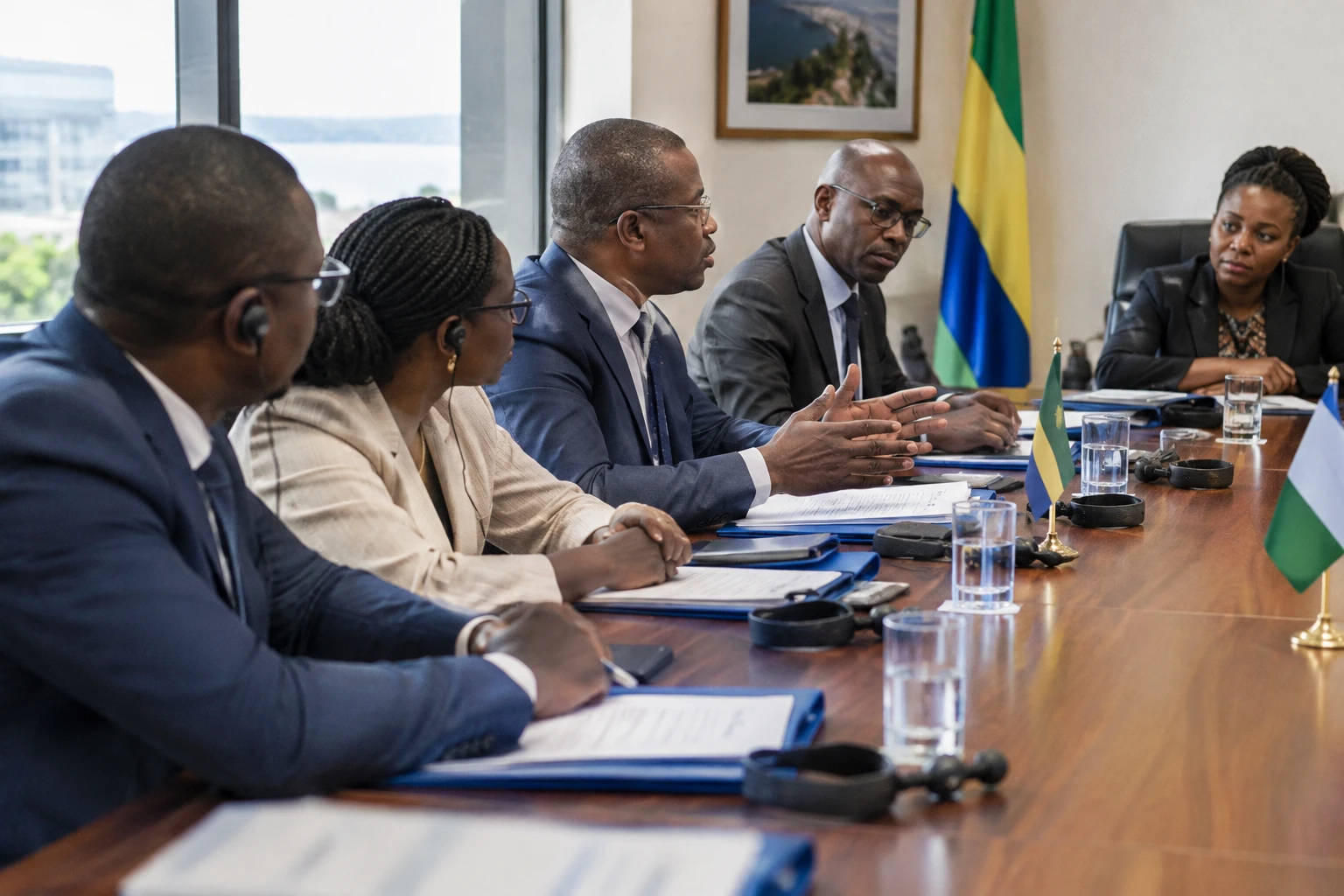
A memorandum of understanding signed on 20 July 2026 between Eramet and the Republic of Gabon provides for the study of three industrial scenarios. The stated aim is to process up to 700,000 tonnes of ore a year by the end of 2031. The document sets out a roadmap and studies, not facilities that have already been financed or built.
One option is to renovate the Moanda complex, with a planned capacity of 70,000 tonnes of alloys a year and a restart targeted for the end of 2029. A new coastal plant could produce 265,000 tonnes of alloys a year from 2031. A third scenario concerns a manganese oxide unit near Libreville. These options remain conditional on feasibility studies, financing, logistics and access to energy.
The gap between the timetables is central. The announced ban is due to take effect at the start of 2029, while some of the planned capacity would not be available until later. Success will therefore also depend on ramping up existing facilities and projects led by other operators in the sector. Gabon’s Ministry of Mines has said that several mining companies are taking part in discussions on local processing.
Rail and energy, prerequisites for industrialisation
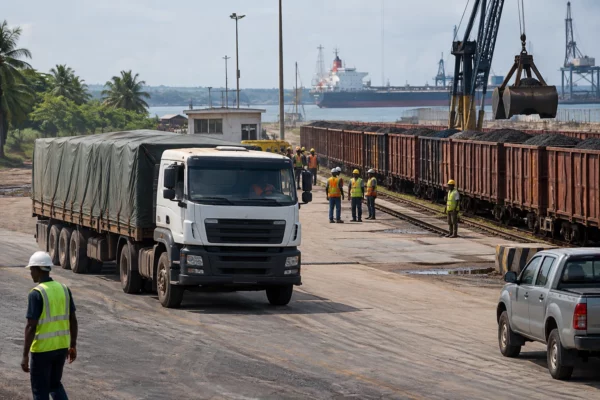
The sector also depends on the Transgabonais railway, which links mining areas to the port of Owendo, near Libreville. Eramet is banking on productivity gains in its Gabonese operations, particularly in rail transport. However, increased processing would require a logistics chain suited to flows of ore and processed products, as well as sufficient electricity for metallurgical facilities.
For workers and local businesses, industrialisation could create opportunities in maintenance, transport, services and alloy production. But the benefits are not automatic: they will depend on the jobs created, training, domestic procurement and the regularity of activity. For communities in mining areas, the stakes are therefore not measured only in tonnes processed, but also in how income and skills are shared.
An issue that extends beyond Gabon
A member of CEMAC, the Economic and Monetary Community of Central Africa, Gabon is advancing a strategy to add value to its resources that echoes continent-wide debates on mining value chains. The Eramet case illustrates a relationship subject to two pressures: the group needs to restore its financial capacity, while the Gabonese state intends to change the terms of extraction towards more processing at home.
The next steps will be investment decisions, securing the financing and confirming industrial timetables. The capital increase may strengthen Eramet, but it does not in itself guarantee that the projects in Gabon will go ahead. As 1 January 2029 approaches, Libreville will have to assess whether available capacity and work under way will allow the announced ban to be implemented without disrupting the sector.