Algeria
 Egypt
 Libya
 Morocco
 Sudan
 Tunisia
 Benin
 Burkina Faso
 Cabo Verde
 Côte d'Ivoire
 Ghana
 Guinea
 Guinea-Bissau
 Liberia
 Mali
 Mauritania
 Niger
 Nigeria
 Senegal
 Sierra Leone
 The Gambia
 Togo
 Cameroon
 Central African Republic
 Chad
 DR Congo
 Equatorial Guinea
 Republic of the Congo
 São Tomé and Príncipe
 Burundi
 Comoros
 Djibouti
 Eritrea
 Ethiopia
 Kenya
 Madagascar
 Malawi
 Mauritius
 Mozambique
 Rwanda
 Seychelles
 Somalia
 South Sudan
 Tanzania
 Uganda
 Angola
 Botswana
 Eswatini
 Lesotho
 Namibia
 South Africa
 Zambia
 Zimbabwe
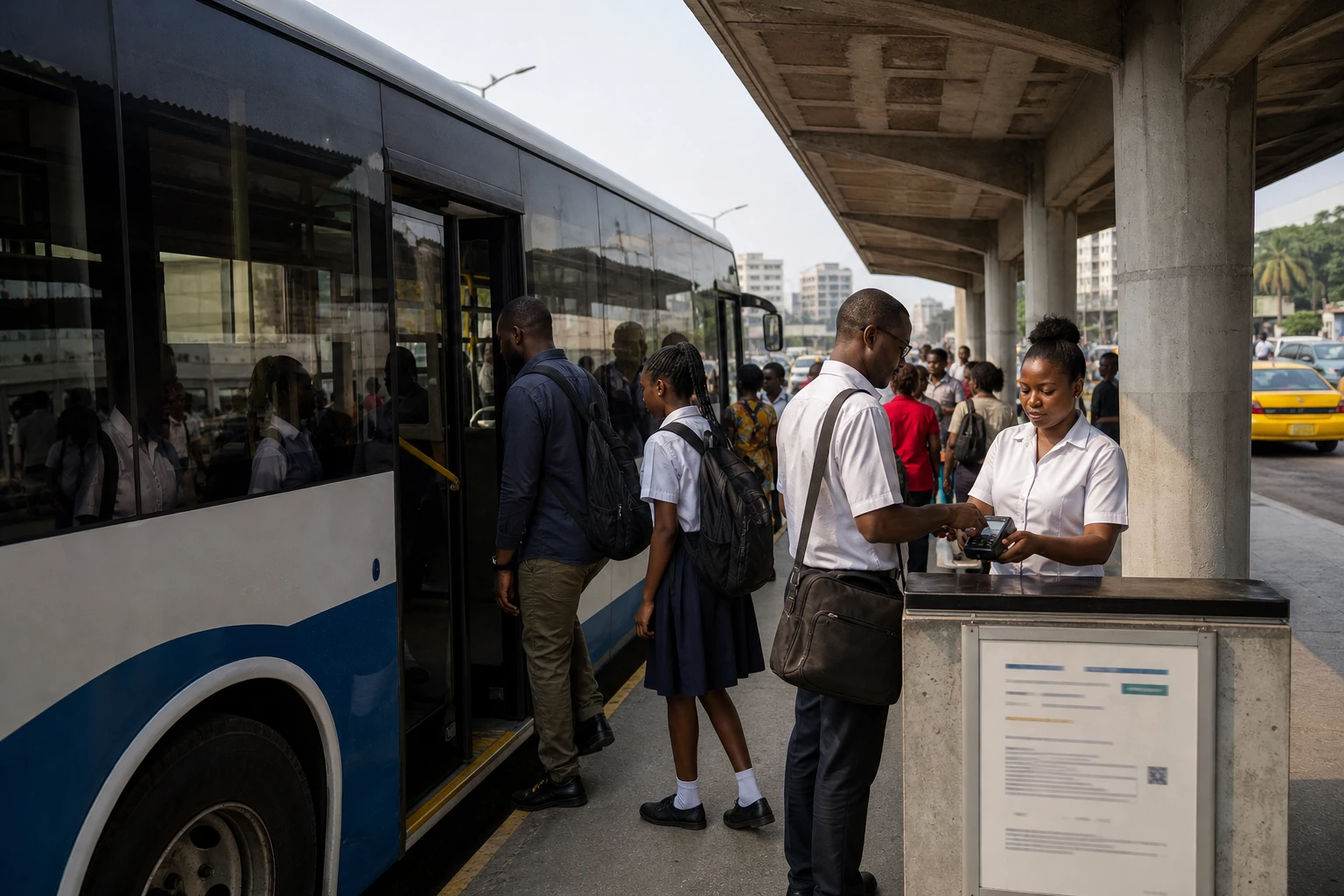
In Libreville, public transport is entering a decisive phase. After several years of free travel, Gabon now wants bus operations to be funded in part by passenger payments. The change directly affects daily journeys, as well as the way the state organises and finances an essential service.
A single operator to reorganise the network
The shift was formalised on 18 September 2026, at a Council of Ministers meeting in Port-Gentil. The Gabonese government confirmed the operational launch of the National Transport Company, the CNT, formed through the merger-absorption of the Gabonese Transport Company, SOGATRA, and Trans’Urb.
The new state-owned company will be under the technical supervision of the ministry responsible for transport. Its remit will extend beyond urban journeys. Its responsibilities also include intercity routes, freight transport, the management of bus stations and multimodal hubs, as well as equipment rental and training for transport-sector occupations.
The consolidation is intended to prevent resources from being spread too thinly. It should also make it possible to better coordinate staff, vehicles, workshops and financial resources. The government presents this structure as a way to build a more clearly defined public operator that is easier to manage.
At launch, the CNT will have 149 vehicles. The fleet comprises 100 Eicher buses, 25 SML buses, six Coaster-type vehicles, 12 tanker trucks, five semi-trailer trucks and one Canter truck. Jobs are to be maintained and employment contracts transferred without interruption, according to the official statement.
The network will be rolled out in two stages
The first phase will cover intercity routes. The announced routes will link Libreville with Lambaréné, Mouila, Lébamba, Tchibanga, Makokou, Oyem and Bitam, among other destinations. This gives the reform a national dimension: it is not simply about improving mobility in the capital.
The second phase will cover Greater Libreville. Nine routes are to operate initially. The plan also provides for 20 sales points for transport tickets and 300 stops. The success of this phase will, however, depend on bus services running regularly in practice, information being provided to passengers and the ability to serve neighbourhoods away from the main roads.
The reform also provides for digital management. Payments are to be cashless. Buses and trucks will be tracked in real time using the Gabon Mobilités solution. In theory, this tool could improve understanding of passenger flows, limit revenue losses and help measure the punctuality of the service.
In practice, technology alone will not be enough. It will need to be accompanied by a reliable mobile network, accessible payment methods and transparent monitoring of revenue. Passengers who still rely mainly on cash will also need straightforward alternatives.
Ending free travel shifts the social balance
The launch of the CNT marks the end of free public transport. The new system provides for several fare options. The Social, School, Student, Urban and Family passes are intended to cater to different groups. Single-use and daily tickets have also been announced.
For intercity journeys, fares will vary according to distance. This approach appears easier to apply on longer routes. It nevertheless raises a central question: what fare level will fund the service without putting it out of reach for lower-income households?
The answer will depend on the structure of season tickets and the discounts offered. Pupils, students and large families have different needs. Likewise, a salaried worker in Libreville, a trader travelling between two cities and a resident of a provincial area face different mobility constraints.
The reform could therefore reduce the state’s direct budgetary burden. However, it shifts part of the cost of funding the service to passengers. For households that use the bus several times a day, the cumulative cost will be an important measure of the new system’s accessibility.
Subsidies withdrawn, a financial equation still to prove
Gabon’s 2026 budget law confirms the change of course. It does not renew the CFA francs 3.57 billion allocation for free transport. Nor does it renew the CFA francs 6.96 billion earmarked for subsidies to transport operators.
These amounts have not necessarily disappeared from all public mobility policy. They are, however, no longer listed under these budget lines. The CNT will therefore have to demonstrate that its operating revenue can cover a significant share of its day-to-day expenses.
SOGATRA’s record is a reminder of the challenges to be overcome. An audit presented in 2023 indicated that 276 buses had been acquired in 2014 for about CFA francs 26 billion. Nine years later, only 29 were still in service. The same assessment recorded 118 wrecks, 19 accident-damaged vehicles and 96 buses deemed repairable.
The company’s debt then exceeded CFA francs 65 billion, according to information published at the time. These figures do not, on their own, sum up the causes of the difficulties, but they show the cost of a poorly maintained fleet and inadequately controlled governance.
The CNT will therefore need to track several indicators from its first months. The number of passengers carried, payment rate, fuel costs, maintenance costs and vehicle availability will be decisive. Revenue from logistics and intercity activities, which are intended to supplement urban transport income, will also need to be measured.
A test for Gabon’s reform and CEMAC
This reorganisation is part of the transformation path pursued in Gabon since the political transition that began in 2023. The authorities are seeking to strengthen the state’s role in essential services while scaling back arrangements considered too costly or too difficult to control.
The issue extends beyond the national context. Gabon belongs to the Central African Economic and Monetary Community, CEMAC, which brings together six states that share, among other things, the Central African CFA franc. In the region, urban and intercity transport remain linked to the growth of cities, the movement of workers and exchanges between provinces.
The CNT could therefore become a regional public-service test case. If it can keep fares affordable while maintaining its vehicles, its model could inform further discussion in Central Africa. Conversely, a fall in passenger numbers or renewed dependence on public aid would undermine its original objective.
The next challenge will be moving from announcements to day-to-day operations. Passengers will judge the reform by tangible criteria: an available bus, a route that runs as scheduled, a fare they can understand and a journey made in acceptable conditions. The CNT’s financial credibility will be built in this way, over the kilometres travelled and the revenue actually collected.