Algeria
 Egypt
 Libya
 Morocco
 Sudan
 Tunisia
 Benin
 Burkina Faso
 Cabo Verde
 Côte d'Ivoire
 Ghana
 Guinea
 Guinea-Bissau
 Liberia
 Mali
 Mauritania
 Niger
 Nigeria
 Senegal
 Sierra Leone
 The Gambia
 Togo
 Cameroon
 Central African Republic
 Chad
 DR Congo
 Equatorial Guinea
 Republic of the Congo
 São Tomé and Príncipe
 Burundi
 Comoros
 Djibouti
 Eritrea
 Ethiopia
 Kenya
 Madagascar
 Malawi
 Mauritius
 Mozambique
 Rwanda
 Seychelles
 Somalia
 South Sudan
 Tanzania
 Uganda
 Angola
 Botswana
 Eswatini
 Lesotho
 Namibia
 South Africa
 Zambia
 Zimbabwe
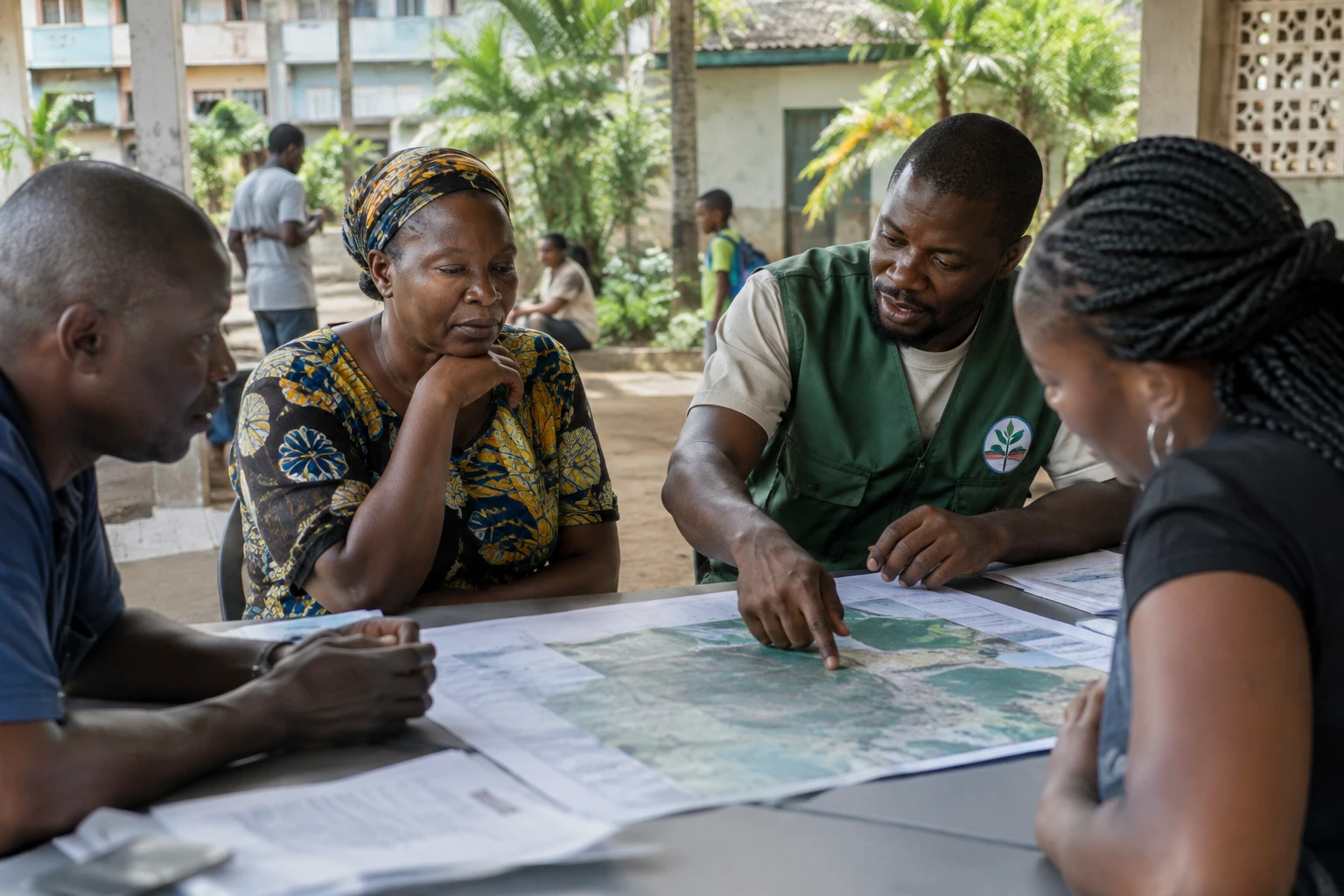
In Gabon, forests could become a new source of public revenue without being sold or transferred to a private operator. But several steps remain between signing an agreement and funding services or local projects: delivery of the credits, receipt of the revenue and rules for sharing it.
A sale agreement, not a transfer of forests
On 3 November 2026, the Gabonese state concluded agreements with SEFE, an energy company owned by the German state, covering around six million tonnes of carbon credits. The Gabonese Agency for the Development of the Green Economy (AGADEV) represents the state in this transaction. Gabonese media, including the Gabonese Press Agency, also reported the announcement.
A carbon credit corresponds to a reduction or removal of emissions measured using a given method. The units concerned are presented as certified under ART-TREES, a standard for monitoring forest-emissions reductions at country level. They are also said to be eligible for CORSIA, the international mechanism governing the offsetting of emissions from civil aviation.
The authorities stress that the agreement transfers neither land ownership nor forest management. It concerns the sale of credits associated with conservation efforts. The first deliveries are scheduled for the first quarter of 2027. The price and detailed financial terms have not been made public.
Potential revenue, not yet a budget receipt
The announced volume alone therefore does not reveal the expected revenue. The amount will depend in particular on the sale price, delivery schedule and contractual terms. Price estimates published on the market are not the price of this agreement and should not be confused with revenue already secured.
The regulatory timetable matters just as much. According to the announcement reported by the Gabonese press, the revenue must remain ring-fenced until a national framework specifying its management and sharing with local communities comes into force. Until those rules are published, it is impossible to determine what share could go to local authorities or people living near the forest areas concerned.
This point is central. A transaction concluded at state level does not automatically guarantee equitable benefits on the ground. Transparency over revenue, independent verification of environmental results and consultation with communities will be crucial to building trust in the scheme.
Diversification put to the test of public finances
The move comes as Gabon seeks to broaden its sources of revenue beyond oil and minerals. The World Bank notes that non-oil revenues remain limited and that budgetary pressures intensified in 2025. It recommends, in particular, strengthening tax mobilisation and public expenditure management.
Forests are an important asset in this strategy: they cover around 88% of Gabonese territory, according to figures cited by the African Development Bank. But putting a carbon value on forests cannot replace more effective taxation or the creation of sustainable businesses and jobs. Rather, it adds a potential source of funding, whose stability will depend on demand, market rules and credit quality.
Previous payments linked to forest results also shed light on what is at stake. Under a partnership with the Central African Forest Initiative, Gabon received a payment of $17 million in 2021 for earlier emissions reductions. This funding supported, among other things, community forestry activities, national parks and Gabonese climate research. The new transaction therefore marks a commercial scaling-up, but not the start of assigning financial value to forests.
A regional framework and credibility to strengthen
The issue also concerns CEMAC, the Economic and Monetary Community of Central Africa, of which Gabon is a member. Revenue diversification and debt management matter both for national finances and regional economic stability. Carbon credits do not in themselves alter these constraints; their contribution will depend on the sums actually received and how they are used.
Across the Congo Basin, the agreement will be watched by other forest countries seeking compensation for protecting their ecosystems. For them, the question is not just how to sell carbon units, but how to demonstrate that claimed reductions are measurable, durable and accounted for without being claimed twice. CORSIA eligibility may open up a market, but it does not remove the need for rigorous checks.
For Gabon, the next milestone will be the delivery scheduled for early 2027, followed by publication of the revenue-sharing framework. These two steps will show whether the agreement translates into net revenue for the state and tangible benefits for communities. Only then can forests contribute to economic diversification without their value being reduced to a mere carbon commodity.
Context sources: Gabonese Press Agency, GabonReview on the carbon agreements, World Bank on Gabon’s economic outlook in 2026, African Development Bank on Gabon’s natural capital and Central African Forest Initiative on results-based payments.