Algeria
 Egypt
 Libya
 Morocco
 Sudan
 Tunisia
 Benin
 Burkina Faso
 Cabo Verde
 Côte d'Ivoire
 Ghana
 Guinea
 Guinea-Bissau
 Liberia
 Mali
 Mauritania
 Niger
 Nigeria
 Senegal
 Sierra Leone
 The Gambia
 Togo
 Cameroon
 Central African Republic
 Chad
 DR Congo
 Equatorial Guinea
 Gabon
 Republic of the Congo
 São Tomé and Príncipe
 Burundi
 Comoros
 Djibouti
 Eritrea
 Ethiopia
 Madagascar
 Malawi
 Mauritius
 Mozambique
 Rwanda
 Seychelles
 Somalia
 South Sudan
 Tanzania
 Uganda
 Angola
 Botswana
 Eswatini
 Lesotho
 Namibia
 South Africa
 Zambia
 Zimbabwe
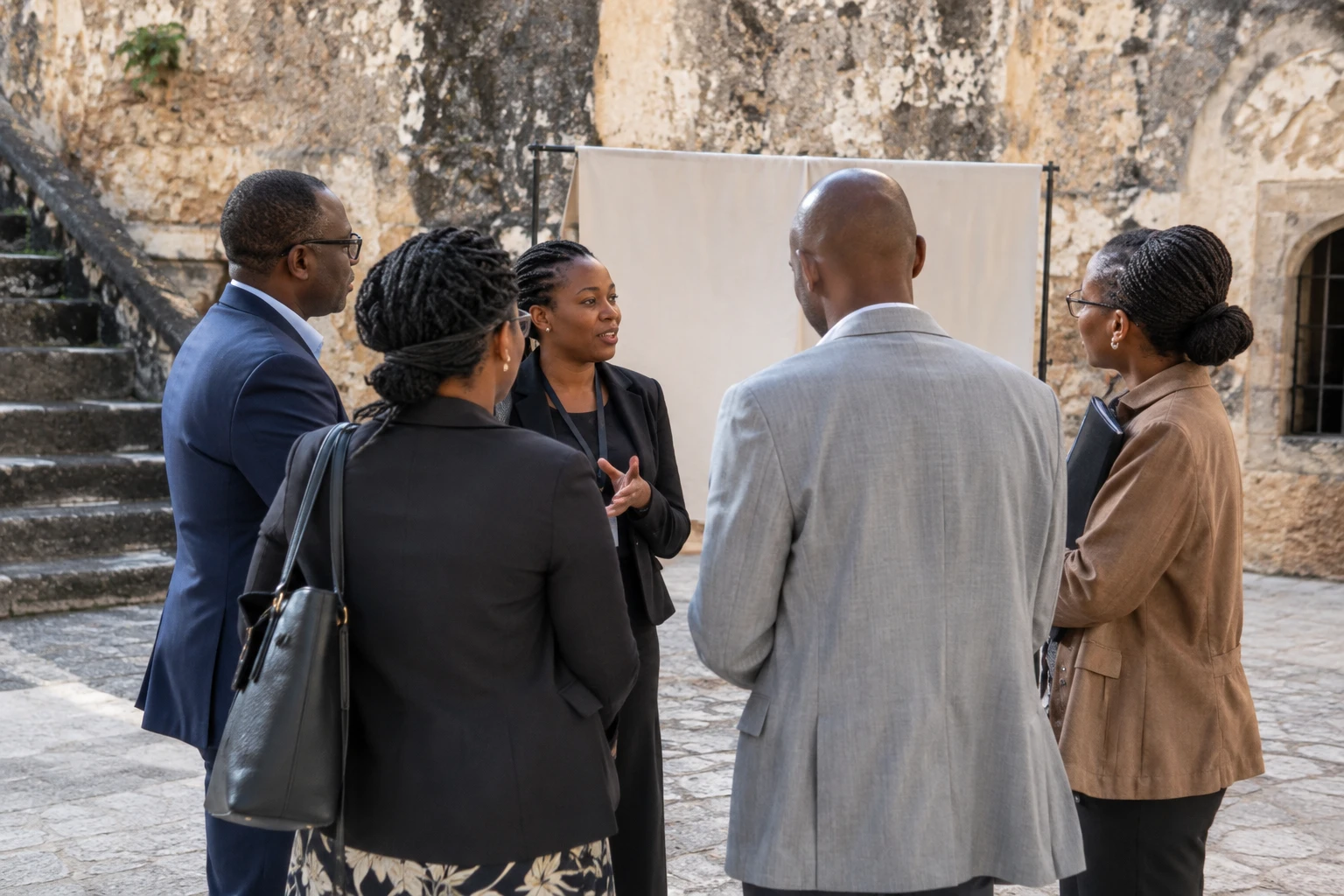
In Mombasa, a fortress is a reminder that the history of Kenya’s coast was not written in isolation from the wider world. Fort Jesus reveals rivalries over a port, as well as the exchanges that linked Swahili societies with the shores of the Indian Ocean.
A port at the heart of regional trade
Long before the fort was built, Mombasa was already an important port city. Its position on the Swahili coast connected it to maritime networks spanning East Africa, the Arabian Peninsula and Asia. Merchants, sailors and local communities took part in these exchanges, which shaped the region’s languages, practices and architecture.
This history cannot be reduced to the arrival of foreign powers. Swahili societies had their own cities, trading networks and authorities. The fort also bears witness to their changing relations with actors from elsewhere, in a region where controlling a port meant wielding influence over shipping routes and trade.
Today, Mombasa remains a major urban and port centre in Kenya, an East African country whose capital is Nairobi. The city lies in a region where maritime and land-based exchanges complement one another. It also highlights the role of coastlines in relations between the member countries of the East African Community, a regional organisation known by the acronym EAC.
A fortress, several powers
The Portuguese built Fort Jesus between 1593 and 1596 on a coral promontory at the entrance to the port. The fortification was intended to protect their presence and position on the Indian Ocean routes. The project is attributed to the Italian architect Giovanni Battista Cairati. Its design, shaped by the geometric principles of the Renaissance, includes five bastions and ramparts adapted for military defence.
Over the following centuries, the fort changed hands several times. Portuguese, Swahili authorities, Omanis and then the British controlled the site, transforming it to suit their needs. These successive occupations do not tell a simple story of one flag replacing another: they reveal struggles over local authority and control of a strategic port.
This perspective matters. Presenting the monument solely as a Portuguese military achievement would sideline the people who lived, traded and governed in the region. The walls preserve traces of several periods, but how they are interpreted also depends on the prominence given to African and Swahili experiences.
From monument to Kenyan museum
Fort Jesus became a museum in 1962. The collections displayed by the National Museums of Kenya include material on excavations carried out at the site and elsewhere along the coast. Visitors can explore the bastions, courtyards and rooms while learning about Mombasa’s maritime history. Nearby, the old town extends the visit through its streets and Swahili architectural heritage.
The site was inscribed on the UNESCO World Heritage List in 2011. The designation recognises its architecture and its testimony to exchanges between peoples from Africa, Arabia, Persia, Asia and Europe. It also places Kenya at the centre of an Indian Ocean history often told from the ports of other continents.
For Mombasa residents and professionals, heritage represents both local memory and a cultural resource. The museum also hosts exhibitions by Kenyan artists. Conservation can thus support activities related to interpretation, creativity and tourism without reducing the city to a backdrop for visitors.
Preserving and passing on a plural history
Protecting the fort requires ongoing work: maintaining the structures, documenting the collections and passing on accounts that reflect the complexity of its history. The National Museums of Kenya manages the site’s heritage. In October 2025, the public agency Kenya News Agency reported that Kenyan authorities had referred, among other things, to securing land tenure at heritage sites and involving young people in promoting them.
The issues are not the same for everyone. National institutions are responsible for conservation; residents of the old town live with the practical consequences of planning and management decisions. Artisans, artists and guides can benefit from cultural activity, while priorities around access, preservation and local returns require a lasting balance.
At the regional level, Fort Jesus is a reminder that Indian Ocean routes have long connected East African societies with their neighbours. Its history also sheds light on current debates over the restitution of objects, the representation of communities and local control of heritage. The challenge is to preserve the stones without freezing the story: the fort is a Kenyan monument, but also a living archive of the relationships that shaped the Swahili coast.