Algeria
 Egypt
 Libya
 Morocco
 Sudan
 Tunisia
 Benin
 Burkina Faso
 Cabo Verde
 Côte d'Ivoire
 Ghana
 Guinea
 Guinea-Bissau
 Liberia
 Mali
 Mauritania
 Niger
 Nigeria
 Senegal
 Sierra Leone
 The Gambia
 Togo
 Central African Republic
 Chad
 DR Congo
 Equatorial Guinea
 Gabon
 Republic of the Congo
 São Tomé and Príncipe
 Burundi
 Comoros
 Djibouti
 Eritrea
 Ethiopia
 Kenya
 Madagascar
 Malawi
 Mauritius
 Mozambique
 Rwanda
 Seychelles
 Somalia
 South Sudan
 Tanzania
 Uganda
 Angola
 Botswana
 Eswatini
 Lesotho
 Namibia
 South Africa
 Zambia
 Zimbabwe
Support that speaks as much about football as power dynamics
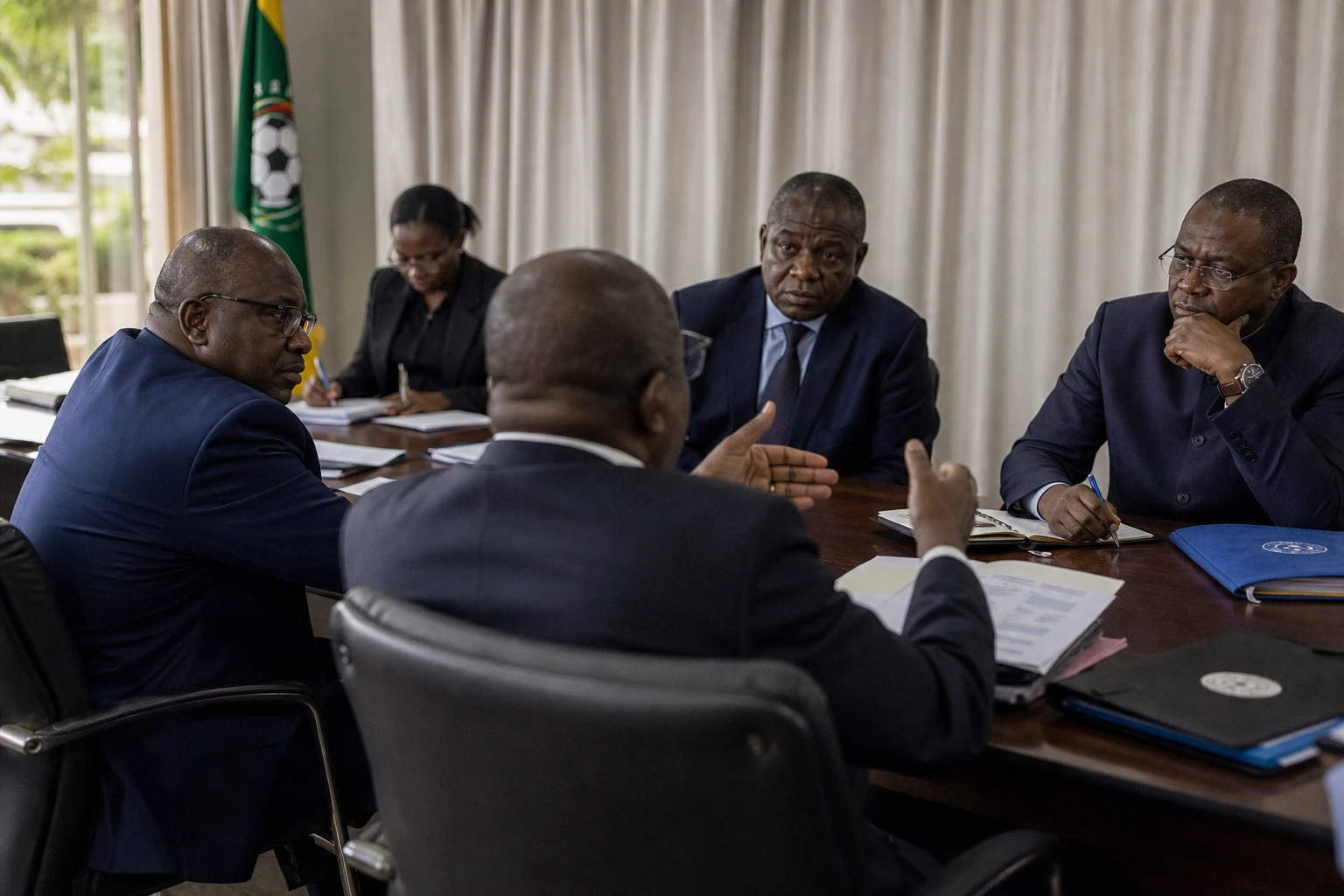
In African football, major decisions are not made only on the pitch. They are also made through the distribution of money, access to competitions and federations’ ability to influence global decision-making centres. Samuel Eto’o’s support for Gianni Infantino fits into this context: it touches on the governance of the game, but also on the resources available to the continent’s federations.
In Cameroon, where the Cameroon Football Federation is based in Yaoundé and debate over the management of football remains heated, the issue goes beyond a simple clash of egos. It raises a very practical question: how can leagues, technical centres, national teams and infrastructure be funded sustainably without relying on a system that some in the football world consider unequal?
The Infantino case, and why Africa matters
On 31 July 2026, Gianni Infantino abandoned his plan to bring private investors into the ownership of a new commercial entity linked to the World Cup. He said the project had created divisions that were no longer compatible with its original aim. A few days later, after a meeting in Rabat, FIFA’s leadership presented a united front around him and acknowledged procedural errors in handling the case.
The storm has not subsided, however. The affair reignited sharp criticism in Europe, North America and parts of Asia, while several African federations continued to support the FIFA president. On 6 August 2026, the executive committee of the Confederation of African Football unanimously approved the joint update on the case and reaffirmed its support for Gianni Infantino.
It was against this backdrop that Samuel Eto’o spoke out. In an interview with CNN Sports, carried by several media outlets, the FECAFOOT president said Gianni Infantino had done nothing wrong and had helped the continent by giving federations more resources. He went further, saying the abandoned project should be put back on the table if FIFA’s chief is re-elected in 2027.
Why Cameroon has a stake in the issue
Eto’o’s support is not merely a sign of personal loyalty. It also reflects the place African federations occupy in the global football economy. Many rely on financial transfers from FIFA to keep their competitions running, pay their technical staff and maintain facilities that are often inadequate. CAF itself noted in recent documents that an increase in funding per member association was planned from 2026, a sign that the battle over redistribution remains central.
In Cameroon, the issue carries particular weight. In May 2026, FECAFOOT’s new headquarters was inaugurated in Yaoundé, in the presence of Prime Minister Joseph Ngute, Patrice Motsepe and Samuel Eto’o. FIFA presented the building as a tool for professionalisation and recalled that the project had been supported by its post-Covid aid programme. In other words, the story of the tangible development of Cameroonian football remains closely linked to financial and political flows from Zurich and South Africa, where CAF is based.
But the case also comes amid a fraught domestic climate. In recent years, FECAFOOT and the Ministry of Sports have often had strained relations over governance, national teams and the chain of decision-making. Cameroonian football is not short of symbolic infrastructure; what it is seeking above all is institutional stability. In this context, Eto’o’s message can be read as a gamble: backing an influential FIFA partner to preserve funding leeway, even if that choice is divisive at home and beyond.
An African perspective on the FIFA crisis
The controversy around Infantino highlights a familiar divide in world football: on one side, wealthy confederations demanding greater consultation and transparency; on the other, African federations that see revenue redistribution as a matter of sporting survival. Both perspectives exist. The first focuses on governance. The second on access to resources, in a system where the gap between football powerhouses and less well-funded federations remains vast.
For Central Africa, the stakes are even broader. CEMAC, which structures the regional economic space, does not govern football, but its member states face the same constraints around public funding, infrastructure and the movement of talent. When a federation such as Cameroon’s argues for more favourable redistribution, it is also speaking on behalf of many countries where stadiums, academies and domestic leagues operate on tight budgets.
The next stage will play out globally. If a credible candidacy emerges against Gianni Infantino ahead of the 2027 election, the dividing line will be tested again, including in Africa. For now, Samuel Eto’o’s signal is clear: in the battle for control of world football, part of the continent still prefers to exert influence from within rather than break with FIFA’s centre of gravity.