Algeria
 Egypt
 Libya
 Morocco
 Sudan
 Tunisia
 Benin
 Burkina Faso
 Cabo Verde
 Côte d'Ivoire
 Ghana
 Guinea
 Guinea-Bissau
 Liberia
 Mali
 Mauritania
 Niger
 Nigeria
 Senegal
 Sierra Leone
 The Gambia
 Togo
 Cameroon
 Central African Republic
 Chad
 DR Congo
 Equatorial Guinea
 Gabon
 Republic of the Congo
 São Tomé and Príncipe
 Burundi
 Comoros
 Djibouti
 Eritrea
 Kenya
 Madagascar
 Malawi
 Mauritius
 Mozambique
 Rwanda
 Seychelles
 Somalia
 South Sudan
 Tanzania
 Uganda
 Angola
 Botswana
 Eswatini
 Lesotho
 Namibia
 South Africa
 Zambia
 Zimbabwe
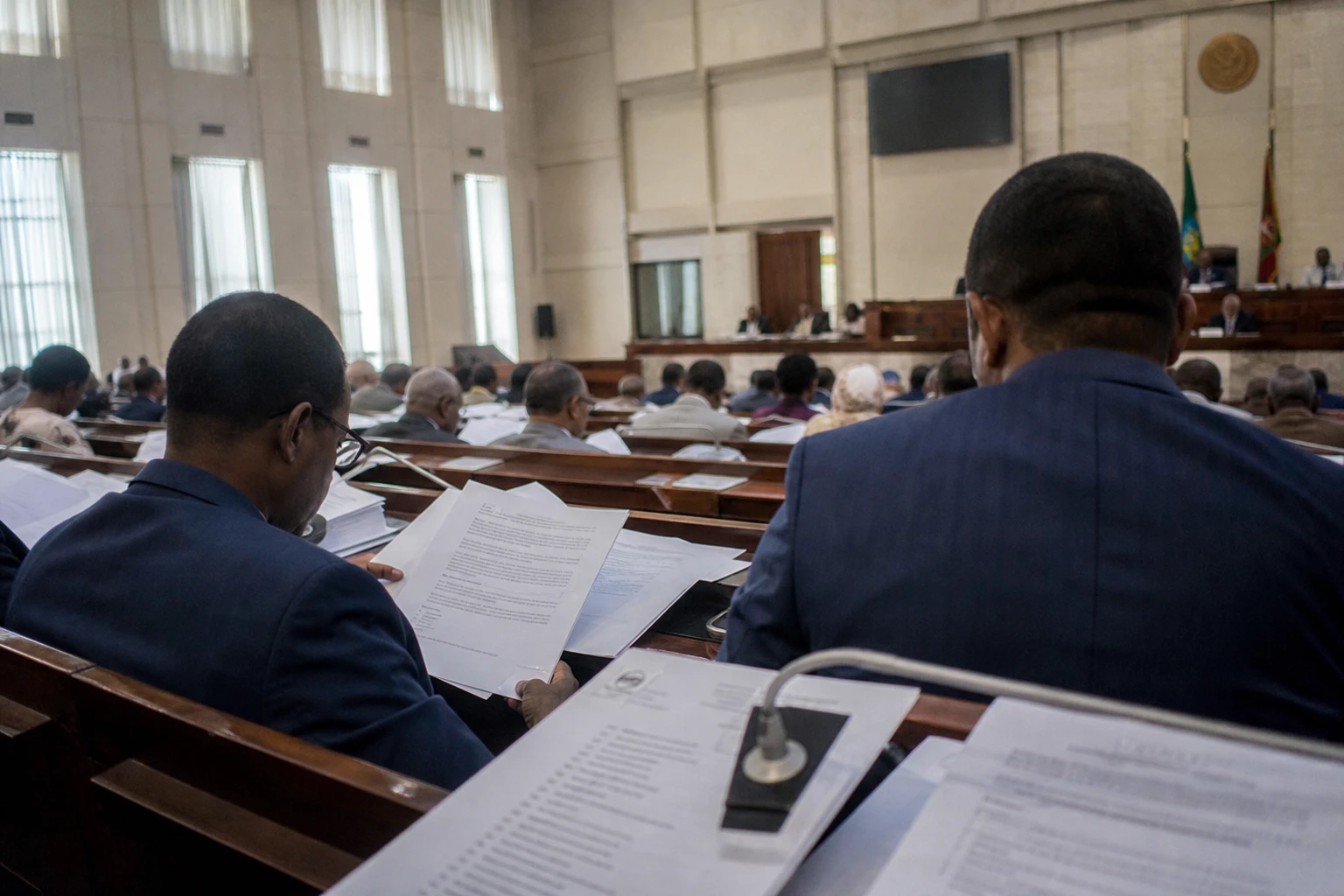
In Addis Ababa, an institutional debate that reaches beyond the corridors of power
In Ethiopia, constitutional reform is never simply a matter of changing a text. It affects how the state holds its balances together in a large, populous federal country crossed by deep political, linguistic and regional divides. The debate opened by the recent national dialogue concerns precisely this sensitive issue: who embodies the executive, and with what legitimacy?
The issue gained momentum in Addis Ababa, where the national dialogue conference concluded on 22 August 2026 after around 40 days of work and with nearly 4,000 delegates. Participants examined several subjects, including the structure of the state, the political system, governance and national reconciliation. According to accounts published by Ethiopian institutions, recommendations emerged on constitutional reform, including the idea of an executive presidency.
What the national dialogue proposes
The most debated proposal is clear: merge the roles of prime minister and president to create an executive presidency. Under the current system, Ethiopia is a federal parliamentary republic. The president is elected by parliament and has mainly ceremonial powers, while real executive authority rests with the prime minister. The Ethiopian embassy continues to describe this institutional arrangement in its public documents.
Participants also discussed another possibility: reducing funding for parties founded on an ethnic basis in favour of parties with a national outlook. Here, too, the political message is clear. The dialogue seeks to shift the centre of gravity in Ethiopian debate from a sum of identities towards an institutional structure intended to encourage broader loyalties. The dialogue’s official bodies said discussions had covered eight main areas, including the structure of government, rights, the rule of law, the fight against corruption and peace.
The timetable remains crucial. The recommendations must still go through the political process. Ethiopian sources have said they could be submitted to parliament when it resumes work in October. In other words, the dialogue has produced a political foundation, but not yet a new institutional system.
A debate that favours the government, but not only
On paper, supporters of change make the case for greater coherence. An executive presidency, they argue, would better represent all communities and clarify the chain of decision-making in a federal state often tested by governance crises. In practice, the political context gives the idea particular significance. Prime Minister Abiy Ahmed’s party holds a large majority in parliament, making any substantial reform politically accessible to the government in power.
This is where concerns arise. Opponents fear that an executive presidency would concentrate institutional levers even further in the hands of a single camp. This concern is not abstract. Since 2018, Abiy Ahmed has led a country where regional rivalries, identity tensions and armed conflicts have never completely disappeared from the national agenda. A reform that centralises the executive can therefore be seen, depending on the actors, either as a tool for stabilisation or as a further tightening of vertical power.
The dialogue itself remains contested. Several opposition parties boycotted it, and armed groups did not take part. Critics therefore argue that the discussion did not include all the actors capable of influencing peace on the ground. This absence matters, because institutional reform alone cannot resolve conflicts in Oromia or Amhara, or the more diffuse tensions running through the country.
The human and territorial context weighs heavily. Ethiopia had a population of around 135.9 million in 2025, according to the World Bank, making it Africa’s second most populous country. Such a large population makes any governance reform more sensitive, because it affects the distribution of power, resources and representation on a vast scale.
Oromia, Amhara, Tigray: reform tested against realities on the ground
The constitutional debate cannot be separated from the persistent centres of tension. In Oromia and Amhara, the two most populous regions, armed conflicts and insurgencies continue to undermine state authority. In Tigray, the memory of the 2020–2022 war remains vivid. The authorities and several international actors describe a conflict that left deep scars, although precise casualty figures remain disputed among sources.
In this context, the dialogue has a dual purpose. For the authorities, it is a way to show that political compromise can still be reached through discussion. For the population, the issues are more immediate: security, access to services, predictable rules and an end to cycles of confrontation. Institutional reform will have meaning only if it is accompanied by parallel engagement with excluded parties, local communities and armed actors. That is the only way to take the debate from paper to the ground.
The organisers themselves seem to be aware of this. The African Union welcomed Ethiopia’s national dialogue and encouraged member states to institutionalise permanent dialogue mechanisms bringing together governments, parties, civil society and the media to prevent conflicts. In Addis Ababa, the AU’s headquarters, this continental perspective is no mere footnote. It places Ethiopia’s experience within a broader movement to seek political solutions to governance crises.
A reform with continental implications
If the proposal goes ahead, Ethiopia will send a major signal to East Africa and the rest of the continent. A move towards an executive presidency in such a complex federal state would raise a simple question: how can unity be built without suppressing pluralism? The answer is of direct interest to the Horn of Africa, where IGAD is closely monitoring stability dynamics, as well as to the African Union, which is attentive to political transitions that avoid institutional violence.
The next milestone will therefore be political, not merely technical. Ethiopia’s parliament will have to consider the recommendations, followed by the test of drafting, voting and acceptance by actors absent from the dialogue. That is when it will become clear whether the reform opens a phase of consolidation or adds another layer to the crisis of confidence. In a country where the spoken word is often as important as the written rule, Addis Ababa is not merely going through an institutional process. It is testing its ability to turn a compromise reached in a room into lasting stability.