Algeria
 Egypt
 Libya
 Morocco
 Sudan
 Tunisia
 Benin
 Burkina Faso
 Cabo Verde
 Côte d'Ivoire
 Ghana
 Guinea
 Guinea-Bissau
 Liberia
 Mali
 Mauritania
 Niger
 Nigeria
 Senegal
 Sierra Leone
 The Gambia
 Togo
 Cameroon
 Central African Republic
 Chad
 DR Congo
 Equatorial Guinea
 Gabon
 Republic of the Congo
 São Tomé and Príncipe
 Burundi
 Comoros
 Djibouti
 Eritrea
 Kenya
 Madagascar
 Malawi
 Mauritius
 Mozambique
 Rwanda
 Seychelles
 Somalia
 South Sudan
 Tanzania
 Uganda
 Angola
 Botswana
 Eswatini
 Lesotho
 Namibia
 South Africa
 Zambia
 Zimbabwe

An alliance that changes the security equation
In Ethiopia, the war is no longer confined to a single front. For several months, the federal government in Addis Ababa has faced scattered armed conflicts linked by a common logic: putting pressure on a state already weakened by regional conflicts, political rivalries and an economy under strain. The announcement of a coalition between several armed groups has therefore revived a simple concern: how far could the reshaping of violence go in a country of more than 120 million people?
This latest development is part of a broader crisis at the heart of the Horn of Africa. Ethiopia remains a central player in the Intergovernmental Authority on Development (IGAD) and the African Union, which is headquartered in Addis Ababa. The country’s stability has a direct bearing on the balance of power in Sudan, Eritrea, Somalia and Djibouti. When tensions rise in Addis Ababa, the whole region feels it.
What the groups say they have built
On 21 September 2026, several media outlets reported that at least seven Ethiopian armed groups had announced an alliance against Abiy Ahmed’s federal government. They include the Tigray People’s Liberation Front, the Fano movement in Amhara and the Oromo Liberation Army, as well as other groups active in the Somali, Afar and Benishangul-Gumuz regions. The groups say they want to pave the way for a transitional administration.
The coalition, as presented, does not erase tensions between its members. Several of these actors have fought one another, accused each other of collusion, or pursued territorial goals that do not align. That is the alliance’s weakness: a coalition can bring forces together, but it does not eliminate underlying disputes. In Ethiopia, fault lines are also political, identity-based and local.
The Fano leader had already suggested in mid-August that a broader framework was under discussion with armed groups from several regions. The announcement was subsequently repeated and amplified as contacts between anti-government factions became visible. Details remain in flux, but the political signal is clear: former adversaries are now testing tactical convergence against the central government.
Why Tigray, Amhara and Oromia remain the country’s barometers
Tigray remains the most potent symbol of this crisis. The war between federal forces and their allies and TPLF fighters, which lasted from 2020 to 2022, ended with the signing of the Cessation of Hostilities Agreement in Pretoria, under the auspices of the African Union. But peace did not dispel all suspicions or resolve every military and political issue. The UN and IGAD continued to call for dialogue, while new tensions resurfaced in the north of the country.
In Amhara, the Fano mobilisation turned into open conflict with the federal government from April 2023. In Oromia, the Oromo Liberation Army continues a low- to medium-intensity insurgency. These two regions account for a decisive share of Ethiopia’s population and remain vital to the economy, trade routes and administrative control. In other words, the unrest there is not only military; it also affects access to markets, schools and healthcare, as well as people’s freedom of movement.
The federal government, for its part, is seeking to maintain the image of a state capable of containing several crises at once. But the multiplication of fronts makes this more costly. It forces the army to spread its resources, complicates local governance and fuels a stream of accusations between authorities, armed groups and regional actors. In this kind of context, the line between security and governance becomes very thin.
A precedent that shapes how the coalition is viewed
The memory of the Tigray conflict still dominates interpretations. Estimates of the death toll vary, but several authoritative sources have cited a figure that could reach about 600,000 over the course of the war. The range remains disputed, but it is enough to convey the scale of the trauma. It also explains why any rumour of rapprochement between former enemies is being closely watched, both in the country and abroad.
In recent months, the Ethiopian government has repeatedly denounced what it considers dangerous convergences between some armed forces and external actors. The authorities have notably accused the TPLF of maintaining ties with other groups, and even with Eritrea. The TPLF, for its part, has rejected the accusations and called for the full implementation of the Pretoria agreement. In a country where institutional trust has already been eroded, this clash of narratives fuels a constant framing of events in terms of betrayal or survival.
What this says about Ethiopia and the region
If confirmed in its current form, the coalition says more than simply that the centre is weak. It also points to the exhaustion of purely military solutions. When movements from different regions seek to coordinate their positions, it is often because they see an opening in the balance of power that they have not found in ordinary political processes. This guarantees neither a common strategy nor a swift victory. But it signals a hardening of the landscape.
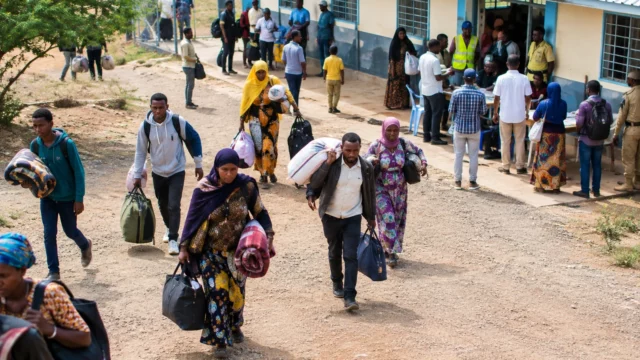
For the Horn of Africa, the stakes are immediate. A deterioration in Ethiopia could affect refugee flows, border security, trade corridors and the balance between Addis Ababa, Asmara, Khartoum and Mogadishu. For the African Union, headquartered in Addis Ababa, the issue is also symbolic: the organisation backed the Pretoria agreement and continues to champion the logic of “silencing the guns” across the continent. If armed unrest spreads, one of the most sensitive issues in African diplomacy will be reopened.
What happens next will depend on two factors: the alliance’s ability to overcome its internal divisions, and the federal government’s response, between political openness and a security crackdown. In Ethiopia, the question is no longer only who controls which territory. It is whether the country can still contain its divisions without turning them into a new, all-out war.