Algeria
 Egypt
 Libya
 Morocco
 Sudan
 Tunisia
 Benin
 Burkina Faso
 Cabo Verde
 Côte d'Ivoire
 Ghana
 Guinea
 Guinea-Bissau
 Liberia
 Mali
 Mauritania
 Niger
 Nigeria
 Senegal
 Sierra Leone
 The Gambia
 Togo
 Cameroon
 Central African Republic
 Chad
 DR Congo
 Equatorial Guinea
 Gabon
 Republic of the Congo
 São Tomé and Príncipe
 Burundi
 Comoros
 Djibouti
 Eritrea
 Kenya
 Madagascar
 Malawi
 Mauritius
 Mozambique
 Rwanda
 Seychelles
 Somalia
 South Sudan
 Tanzania
 Uganda
 Angola
 Botswana
 Eswatini
 Lesotho
 Namibia
 South Africa
 Zambia
 Zimbabwe
A growing market, but not at the same pace everywhere
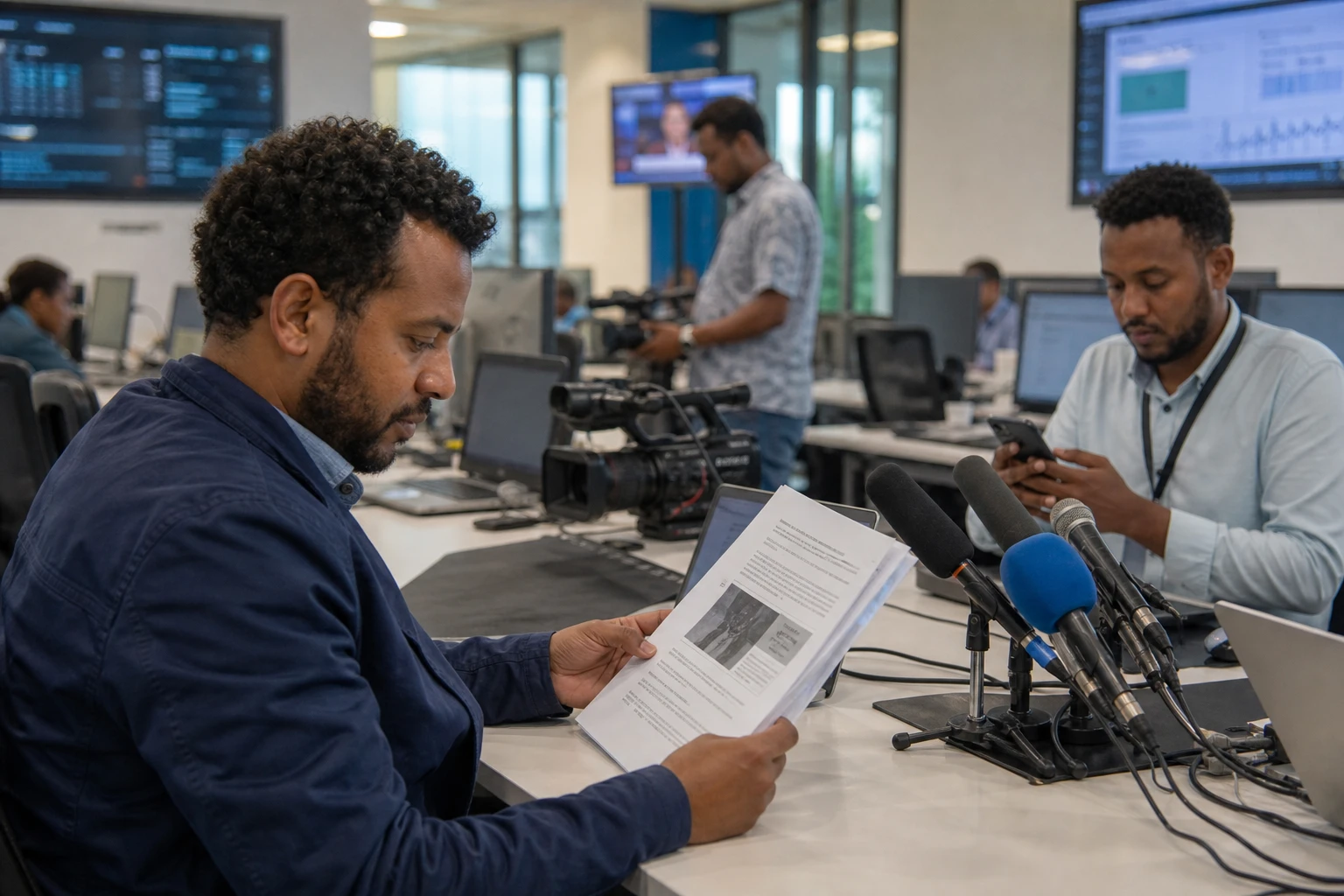
In Ethiopia, the telecoms battle is no longer being fought solely over the number of active lines. It is now about network quality, data speeds, mobile payments and the ability to serve businesses, the state and areas far from Addis Ababa. In a country where 4G coverage is expanding but remains uneven, every kilowatt of data-centre capacity, every kilometre of fibre and every new mobile site has an impact on the real economy.
It is against this backdrop that Ethio Telecom has presented its “Next Horizon: Digital & Beyond 2028” strategy, a three-year plan targeting 100 million telecoms users by 2028, alongside growth in revenue, mobile money and digital services. The state-owned company also wants to strengthen its status as national infrastructure at a time when competition is intensifying with Safaricom Ethiopia, which entered the market in 2022.
2026/2027 target: revenue growth and increased capacity
For the 2026/2027 financial year, Ethio Telecom is targeting revenue of 295 billion birrs, or about $1.8 billion at the exchange rate used in published estimates. The target falls in the second year of implementation of the strategic plan launched in August 2025. The operator is following a roadmap focused on three levers: expanding networks, promoting digital use and broadening revenue sources beyond traditional telephony.
Network investment remains the most visible element. Ethio Telecom wants to increase its 4G sites from 6,924 to 11,014, and the associated population coverage from 82.2% to 95%. For 5G, the company is targeting almost a doubling of its stations, from 340 to 648, and an expansion of service to 73 cities, compared with 33 today. The company also plans 1,685 new mobile sites, including 605 in rural areas. This matters in Ethiopia, where the digital divide remains pronounced between the capital, major urban centres and more remote regions.
Fibre-optic infrastructure is set to expand in step. Ethio Telecom’s national network would grow from 23,442 to 25,642 kilometres, while the capacity of its international gateway is to be strengthened. The operator also plans to increase the capacity of its modular data centre from 5 to 6.24 MW, and expand its resources dedicated to artificial intelligence. In other words, the priority is no longer simply to connect more customers, but to support more intensive use of data, cloud services and business applications.
Telebirr, cloud and AI: the search for a new growth engine
Diversification is at the heart of Ethio Telecom’s business plan. The operator is targeting 77.45 billion birrs in revenue from digital and adjacent activities. These include cloud, business solutions, the internet of things, AI, financial services and e-commerce. This direction reflects a broader trend across the continent: telecoms operators are now seeking to monetise usage, not just call minutes.
Mobile money service telebirr remains a central pillar. Ethio Telecom wants to reach 67.69 million customers on the service and process nearly 4.9 billion transactions during the financial year. The World Bank’s report on Ethiopia’s digital sector notes that telebirr has already transformed the mobile payments market, which has grown from zero to more than 53 million users in the subscriber base. The same document notes that the country’s mobile subscriptions nearly doubled between 2018 and 2024, from 44.2 million to 87.6 million, highlighting the scale of demand to be captured.
This shift towards financial and digital services is significant. For urban users, it means greater speed and more payment options. For businesses, it opens the door to more structured use of cloud, secure connectivity and management services. For the state, it strengthens infrastructure that is useful for identification, transactions and public services. Ethio Telecom says it has also integrated a large number of citizens into the national identification system, a sign that the operator is becoming an administrative and economic intermediary too.
Safaricom is forcing Ethio Telecom to speed up
Ethio Telecom’s ramp-up is also explained by the arrival of a competitor capable of disrupting the market’s established order. Safaricom Ethiopia announced on 3 September 2026 that it had passed 15 million active subscribers over 90 days, less than four years after the commercial launch of its operations. In May 2026, the operator had already reported 13.6 million active customers over 90 days, 5.2 million M-PESA customers and 15.9 billion birrs in service revenue for the financial year ended 31 March 2026.
The comparison is nevertheless asymmetric. Ethio Telecom retains a far larger subscriber base and network footprint. But Safaricom is making rapid gains in the most profitable segments of the future: mobile data, financial services and digital offerings. The World Bank notes that Safaricom’s entry even helped accelerate the rollout of 4G and then 5G, while pointing out that large parts of the country remain beyond the reach of reliable broadband. The challenge for both operators is therefore not just commercial. It is also geographical.
In practice, competition is beginning to reshape priorities. In cities, customers want a more stable network, smoother mobile payments and better-integrated services. In rural areas, expectations remain more basic: getting a signal, accessing data and being able to make payments without travelling. That is where the 605 new rural sites announced by Ethio Telecom take on significance. The group is not only defending its dominant position. It is also trying to meet national demand that extends well beyond Addis Ababa’s main thoroughfares.
A signal for East Africa and IGAD
Ethiopia’s trajectory matters beyond its borders. Ethiopia is one of East Africa’s most closely watched telecoms markets, in a region where IGAD, the region’s intergovernmental organisation, regards connectivity and digital integration as drivers of growth. If Ethio Telecom succeeds in expanding capacity, the country could strengthen Addis Ababa’s position as a regional digital hub, with effects on business, logistics, financial services and cross-border use.
The next focus will be on how these targets translate into annual results: subscribers, coverage, digital revenue, telebirr’s growth and the execution of network investment. The plan is ambitious. But in a market that is now competitive, what will matter less is the announcements than the speed at which fibre, 4G, 5G and digital services reach the country’s households, businesses and public administrations.