Algeria
 Egypt
 Libya
 Morocco
 Sudan
 Tunisia
 Benin
 Burkina Faso
 Cabo Verde
 Côte d'Ivoire
 Ghana
 Guinea
 Guinea-Bissau
 Liberia
 Mali
 Mauritania
 Niger
 Nigeria
 Senegal
 Sierra Leone
 The Gambia
 Togo
 Cameroon
 Central African Republic
 Chad
 DR Congo
 Equatorial Guinea
 Gabon
 Republic of the Congo
 São Tomé and Príncipe
 Burundi
 Comoros
 Djibouti
 Eritrea
 Ethiopia
 Kenya
 Madagascar
 Malawi
 Mauritius
 Mozambique
 Rwanda
 Seychelles
 Somalia
 South Sudan
 Tanzania
 Uganda
 Angola
 Botswana
 Lesotho
 Namibia
 South Africa
 Zambia
 Zimbabwe
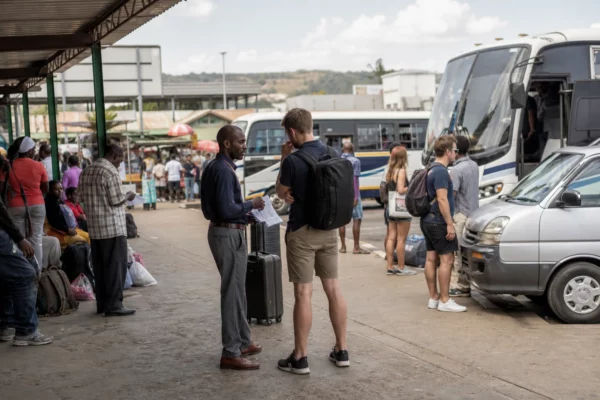
In Johannesburg, Phone Chomsavanh was still waiting for his travel documents on 5 October 2026. A few days earlier, he had left Matsapha high-security prison in Eswatini. He had spent more than a year there, without facing any new conviction in the kingdom. Now heading to Laos, he is due to begin a life in a country he barely knows.
Detention at the heart of a controversial agreement
Phone Chomsavanh, 45, was one of five people deported from the United States to Eswatini on 16 July 2025. They had already served their sentences on US soil. Yet on arrival, they were taken to the Matsapha Correctional Complex, a high-security prison near Mbabane, the capital.
US authorities described them as people convicted of serious offences. But their transfer to a country with which they had no known ties raised another question: the legal basis for their detention in southern Africa.
Amnesty International said the five men had been detained at Matsapha after their deportation. The organisation also denounced difficulties in accessing their lawyers and called for guarantees of their fundamental rights. In April 2026, the Supreme Court of Eswatini recognised several detainees’ right to receive visits from a local lawyer.
The Eswatini government, for its part, says it agreed to host the nationals under an arrangement with Washington. Mbabane maintains that the people transferred do not fall under the jurisdiction of Eswatini’s justice system, but are being temporarily housed pending their resettlement or return to their country of nationality.
US-raised man sent back to a country he does not know
Phone Chomsavanh’s story illustrates the distance between administrative nationality and personal history. Born in a refugee camp in Thailand, he moved to the United States with his family at the age of seven. He grew up there and spent most of his life there.
He says he agreed as early as 2015 to the idea of returning to Laos. According to his account, US immigration services did not pursue that option. He was eventually sent to Eswatini, a country he says he did not know and whose place in his migration journey he could not understand.
His lawyer, Tin Thanh Nguyen, announced his release in early October 2026. According to the information available, Phone Chomsavanh was then due to travel to Laos after a stop in South Africa.
But returning does not mean a return to normality. “I’m no longer sure of anything now,” he said after his release. He must find accommodation, understand local procedures and look for a job. He is counting in particular on help from an uncle he has never met.
The case shows the tangible impact of deportations to third countries. For governments, such agreements can facilitate the removal of people a deporting country no longer wishes to host. For those affected, they can create a sudden break with family, social ties and familiar support systems.
Eswatini caught between cooperation and responsibility
For Mbabane, the agreement with Washington is part of a broader diplomatic and security relationship. Eswatini is also seeking to strengthen its migration controls and border management. However, hosting people with no ties to the kingdom exposes the country directly to criticism over detention, transparency and respect for due process.
The Matsapha Correctional Complex is not a migrant reception centre. It is a high-security prison. The choice of facility has therefore fuelled concerns among lawyers and human rights organisations. The central question remains: can a person be held in a national prison when they have committed no offence in the country detaining them?
The debate also concerns Eswatini’s citizens. On the one hand, the government may hope to secure resources and strengthen cooperation with a major power. On the other, the opacity of the agreement may fuel criticism over national sovereignty. People in Mbabane and other regions may also question the consequences of a policy decided at diplomatic level but implemented in local prison facilities.
The kingdom is a member of the Southern African Development Community, SADC, a regional organisation comprising several countries in the sub-region. This membership places the case within a region where the movement of people, border controls and security cooperation are already closely intertwined. It does not, however, in itself create an automatic mechanism to regulate US deportations to southern Africa.
A precedent that reaches beyond Eswatini’s borders
The Chomsavanh case comes amid the expansion of a US practice: transferring some deportees to third countries when direct repatriation is difficult or refused. Similar agreements have been reported with several African countries, including South Sudan, Rwanda, Uganda, Ghana and Equatorial Guinea.
For the countries concerned, these arrangements can represent a source of political or financial cooperation. But they also shift responsibility. The country ordering the deportation no longer has full control over detention conditions. The country receiving the person must answer for the treatment applied on its territory, even when those transferred have no ties to its population.
The United Nations and several human rights organisations have warned of the risks associated with deportations to third countries. They stress that the transfer of a person must not lead to their rights being circumvented, including access to a lawyer, judicial review of detention and protection from inhuman treatment.
The next steps will therefore be legal and diplomatic. The status of those still detained in Eswatini, the terms of their departure and the guarantees offered by destination countries will need to be established. Phone Chomsavanh’s case has already shown that deportation can extend far beyond US territory and turn a migration measure into a prolonged period of uncertainty.