
 Algeria
 Egypt
 Libya
 Morocco
 Sudan
 Tunisia
 Benin
 Burkina Faso
 Cabo Verde
 Côte d'Ivoire
 Ghana
 Guinea
 Guinea-Bissau
 Liberia
 Mali
 Mauritania
 Niger
 Nigeria
 Senegal
 Sierra Leone
 The Gambia
 Togo
 Central African Republic
 Chad
 DR Congo
 Equatorial Guinea
 Gabon
 Republic of the Congo
 São Tomé and Príncipe
 Burundi
 Comoros
 Djibouti
 Eritrea
 Ethiopia
 Kenya
 Madagascar
 Malawi
 Mauritius
 Mozambique
 Rwanda
 Seychelles
 Somalia
 South Sudan
 Tanzania
 Uganda
 Angola
 Botswana
 Eswatini
 Lesotho
 Namibia
 South Africa
 Zambia
 Zimbabwe
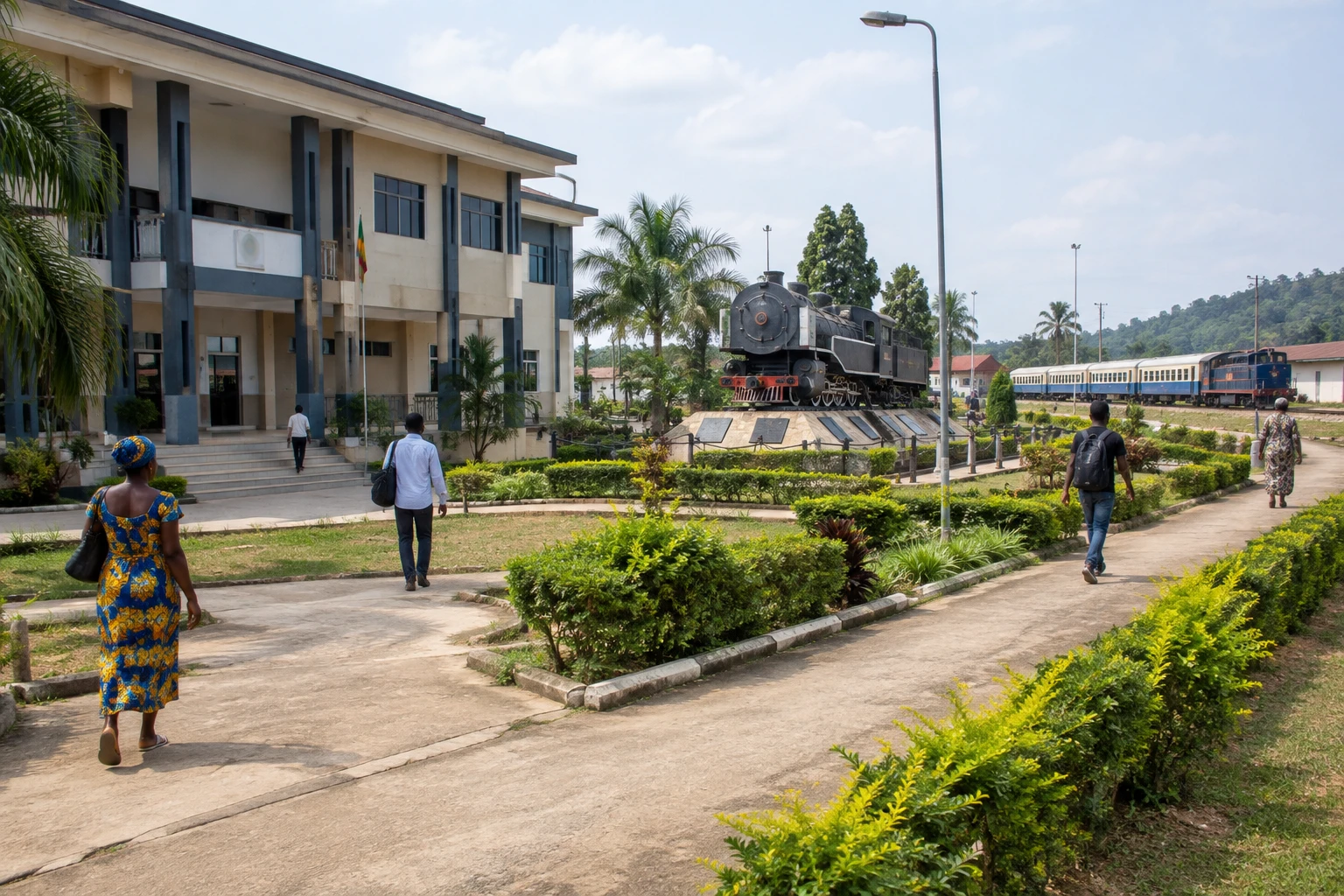
Trains are running again in Éséka. Yet the passage of carriages is not enough to close the chapter on what the disaster left behind: bereaved families, injured survivors and a town still waiting for public commitments to take shape.
Tomorrow, 21 October 2026, will mark ten years since train 152 derailed on the Yaoundé–Douala line. In Éséka, in the Centre Region, the debate is therefore not only about remembrance. It also concerns rail safety, access to healthcare and the place given to residents after a national tragedy.
A disaster whose causes have been documented
On 21 October 2016, a train operated by Camrail derailed near Éséka station while travelling from Yaoundé to Douala. The official toll most often cited is 79 dead. The number of injured varied across statements: the Ministry of Health reported 590 in its provisional tally of 22 October 2016, while later documents put the figure at more than 600, or higher. These discrepancies highlight the difficulties of counting in the hours and days that followed.
The commission of inquiry established by the presidency on 25 October 2016 assigned primary responsibility for the accident to Camrail. According to its findings, the train was travelling at 96 kilometres per hour on a section where the limit was 40. The report also noted that the train was overloaded and had been lengthened, that there had been braking failures, and that the driver’s concerns had allegedly not been taken into account. It also said that the organisation of public emergency services needed to be strengthened. The official statement presenting the inquiry’s findings details these observations and the measures announced.
The human toll cannot be reduced to the people officially recorded as dead and injured. Relatives also reported missing people, and survivors continue to live with lasting effects. In 2019, at the handover of aid, the authorities cited 79 dead, six people reported missing and more than 800 injured. As categories and counts were not always compiled in the same way, these figures are best attributed rather than presented as an undisputed toll.
The memorial, between remembrance and day-to-day management
The Éséka memorial was built in response to a decision taken after the accident to create a place of commemoration. Inaugurated in 2022, the site has nonetheless faced difficulties with maintenance and operation. Residents interviewed in the original report describe a monument that is closed or run-down, and say its presence does not address the municipality’s practical needs. These are local testimonies, not a general assessment of all residents.
Management arrangements have recently evolved. Cameroon’s Ministry of Arts and Culture and the municipality of Éséka signed an agreement in Yaoundé on 6 August 2026 to organise the memorial’s operation and promotion. According to published information, the municipality is to handle routine maintenance, security and the organisation of commemorations. The ministry is to provide technical support and help include the site in heritage itineraries. This division of responsibilities clarifies who is responsible, but its effectiveness will depend on the resources available and whether the public can in practice access the site.
For residents, however, remembrance cannot be confined to a monument. On the day of the accident, local health facilities had to cope with a sudden influx of injured people. Expectations surrounding Éséka hospital therefore concern its ability to receive emergency cases, its equipment and medical transport resources. Available information notes that an ambulance was handed over, but that alone is not enough to assess the full range of health services today.
Aid payments have not settled every question
After the disaster, the state announced an additional one billion CFA francs in aid for victims and their dependants. A substantial part of this sum was distributed in several stages. In August 2019, the state-owned daily Cameroon Tribune reported the handover of 666.8 million CFA francs, described as the remaining balance of this assistance. This humanitarian aid should not be confused with full compensation for losses or with the resolution of all legal proceedings.
The official report also announced an audit of the railway concession and measures to strengthen the state’s role in managing the network. Subsequent court rulings recognised responsibility for the accident. But the passage of time alone does not establish that all safety recommendations have been implemented or that every victim has received redress. The report by Cameroon’s Ministry of Justice records, among other things, the legal proceedings reported in the case.
This distinction matters for families as well as for public finances. Aid addresses an immediate need. Redress recognises harm and established responsibility. Investment in tracks, trains, braking systems and emergency services, meanwhile, is intended to reduce the risk of another accident. These are different responses and cannot substitute for one another.
A local issue tied to travel across the sub-region
The Yaoundé–Douala line links Cameroon’s political capital with its main economic metropolis. Its reliability affects passenger journeys and the organisation of national transport. More broadly, Cameroon’s railway network forms part of corridors that matter for trade with neighbouring countries, notably Chad and the Central African Republic. CEMAC, the Economic and Monetary Community of Central Africa, regards regional connectivity as a shared concern for its member states.
Plans to modernise rail and road routes are a reminder that safety is not determined only at the moment of an accident. It also depends on regular infrastructure maintenance, oversight of operations and the authorities’ ability to respond to warnings. The regional support for the Cameroon–Chad corridor highlights the link between transport quality, safety and economic integration.
In Éséka, the tenth anniversary will bring these questions back to the fore. The agreement on memorial management, resources allocated to the hospital and follow-up on safety commitments will provide concrete benchmarks for assessing progress. For Cameroonians, the issue goes beyond the ceremony: ensuring that remembrance of the victims is accompanied by accessible services and verifiable guarantees for travellers.



