Algeria
 Egypt
 Libya
 Morocco
 Tunisia
 Benin
 Burkina Faso
 Cabo Verde
 Côte d'Ivoire
 Ghana
 Guinea
 Guinea-Bissau
 Liberia
 Mali
 Mauritania
 Niger
 Nigeria
 Senegal
 Sierra Leone
 The Gambia
 Togo
 Cameroon
 Central African Republic
 Chad
 DR Congo
 Equatorial Guinea
 Gabon
 Republic of the Congo
 São Tomé and Príncipe
 Burundi
 Comoros
 Djibouti
 Eritrea
 Ethiopia
 Kenya
 Madagascar
 Malawi
 Mauritius
 Mozambique
 Rwanda
 Seychelles
 Somalia
 South Sudan
 Tanzania
 Uganda
 Angola
 Botswana
 Eswatini
 Lesotho
 Namibia
 South Africa
 Zambia
 Zimbabwe
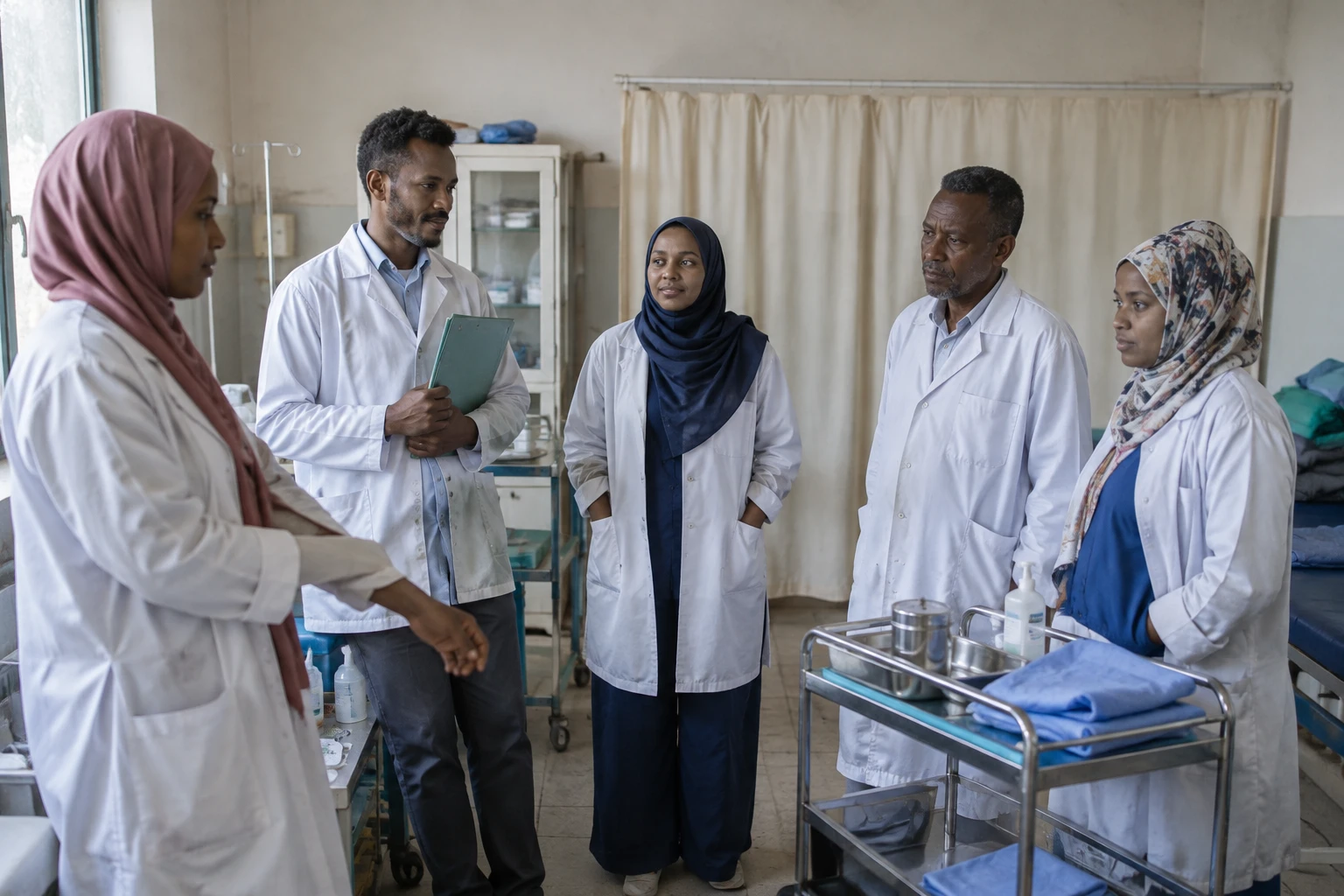
When a hospital closes in a besieged city, the consequences reach far beyond its walls. The wounded lose a place to receive care, pregnant women lose access to emergency services, and families lose the chance to stay. In El-Fasher, Darfur, repeated attacks on medical facilities accompanied the gradual collapse of healthcare during the siege.
An investigation published on 24 October 2026 records at least 43 separate attacks on hospitals and other health sites between May 2024 and October 2025. Some facilities were reportedly struck several times. These events took place against the backdrop of the war that began in April 2023 between the Sudanese Armed Forces and the Rapid Support Forces (RSF), two forces that were once allies. The conflict has shifted front lines and fragmented control of the territory. El-Fasher, the capital of North Darfur, was the army’s last major stronghold in the region before it was taken by the RSF in October 2025.
Care relocated, then struck again
At the start of the war, El-Fasher Teaching Hospital ceased operating. Some of its services were transferred to South Hospital, which was later subjected to bombardment and a raid on 8 June 2024. Staff fled while patients and surgical equipment were still on the premises, according to accounts collected from healthcare workers. The facility closed.
Doctors then moved services to the Saudi Maternity Hospital, which became one of the last places able to treat the wounded and carry out surgery. Strikes nevertheless continued to hit this hospital and other medical sites. Paediatric facilities and a dialysis centre also had to relocate after being attacked. Moving therefore did not guarantee the safety of patients or staff.
Figures on casualties must be attributed. The investigation reports that 55 medical staff were killed, 120 injured and 10 forcibly disappeared or abducted between April 2023 and October 2025. These figures illustrate the human cost for those providing care, as well as for residents deprived of essential services.
Doctors’ accounts describe teams putting up makeshift protection, setting up places of refuge and continuing to operate despite the damage. One surgeon said a temporary operating theatre had been hit several times. A pharmacist described staff fleeing during the raid on South Hospital. These accounts shed light on working conditions, but are not, on their own, enough to establish who was responsible for each strike or the intent behind each attack.
Contested allegations, a clear legal framework
UN High Commissioner for Human Rights Volker Türk described the reported evidence as “deeply disturbing”. He said repeated attacks on civilian infrastructure, including health facilities, constituted serious violations of international humanitarian law and could amount to war crimes. This remains a legal assessment to be considered in light of the established facts and responsibilities.
The RSF reject the allegations. Alaa Eldin Nugud, health minister in the civil administration affiliated with them, said South Hospital had served as a military base and that weapons had been installed there. Doctors interviewed dispute this account. The investigation says it found no independent evidence to confirm the minister’s claims. Under humanitarian law, a hospital is afforded special protection; this may be withdrawn if it is used to commit an act harmful to the enemy, subject to specific conditions. Such an allegation does not automatically make an attack lawful: the rules of precaution and proportionality still apply.
The picture is not limited to El-Fasher or to one side. Both parties to the conflict have been accused of attacking health facilities. Médecins Sans Frontières says that when fighting intensified in May 2024, facilities it supported came under fire and bombardment attributed to both sides and allied forces. This does not automatically make the incidents equivalent: each must be documented separately, with its circumstances and suspected perpetrators.
The fragility of Sudan’s medical network makes every closure more consequential. MSF had already identified the Saudi Hospital as a crucial facility for surgical care. In January 2025, the organisation also reported that an ambulance carrying a woman in labour had come under fire in El-Fasher; responsibility had not then been established. These incidents show that access to healthcare depends not only on buildings, but also on the safety of roads, ambulances, medicines and staff.
A local crisis with regional consequences
For residents, the loss of available healthcare has different effects depending on their needs. Injured people must travel along dangerous routes; pregnant patients may lose access to urgent intervention; people with chronic illnesses, including those needing dialysis, depend on scarce facilities. Healthcare workers risk being killed, injured or abducted, or being forced to work under threat. Families displaced to other areas often have to seek services that are already under pressure.
The capture of El-Fasher has also changed the balance of the conflict in Darfur. Control of roads and cities determines civilian movements and the delivery of aid. For neighbouring states, particularly those linked to Sudan through population movements and cross-border trade, the deterioration in humanitarian access adds regional pressure. IGAD, the East African regional organisation, and the African Union are involved in diplomatic efforts and the protection of civilians, even though the war remains first and foremost a Sudanese crisis.
What happens next will depend on the ability to document attacks, preserve evidence and guarantee independent access to the facilities concerned. The data attributed to the investigation provide a useful timeline, but do not replace a judicial investigation or the establishment of responsibility for each incident. In Sudan, protecting medical facilities and staff remains an immediate condition for civilians to receive care, whatever territory the warring parties control.
For context, Médecins Sans Frontières documents the collapse of access to healthcare in El-Fasher. The World Health Organization condemned violence reported at the Saudi Hospital in October 2025. The UN High Commissioner for Human Rights called for alleged violations around El-Fasher to be examined.