Algeria
 Egypt
 Libya
 Morocco
 Sudan
 Tunisia
 Benin
 Burkina Faso
 Cabo Verde
 Côte d'Ivoire
 Ghana
 Guinea
 Guinea-Bissau
 Liberia
 Mali
 Mauritania
 Niger
 Nigeria
 Senegal
 Sierra Leone
 The Gambia
 Togo
 Cameroon
 Central African Republic
 Chad
 DR Congo
 Equatorial Guinea
 Gabon
 Republic of the Congo
 São Tomé and Príncipe
 Burundi
 Comoros
 Djibouti
 Eritrea
 Ethiopia
 Kenya
 Madagascar
 Malawi
 Mauritius
 Mozambique
 Rwanda
 Seychelles
 Somalia
 South Sudan
 Tanzania
 Uganda
 Angola
 Botswana
 Eswatini
 Lesotho
 Namibia
 Zambia
 Zimbabwe
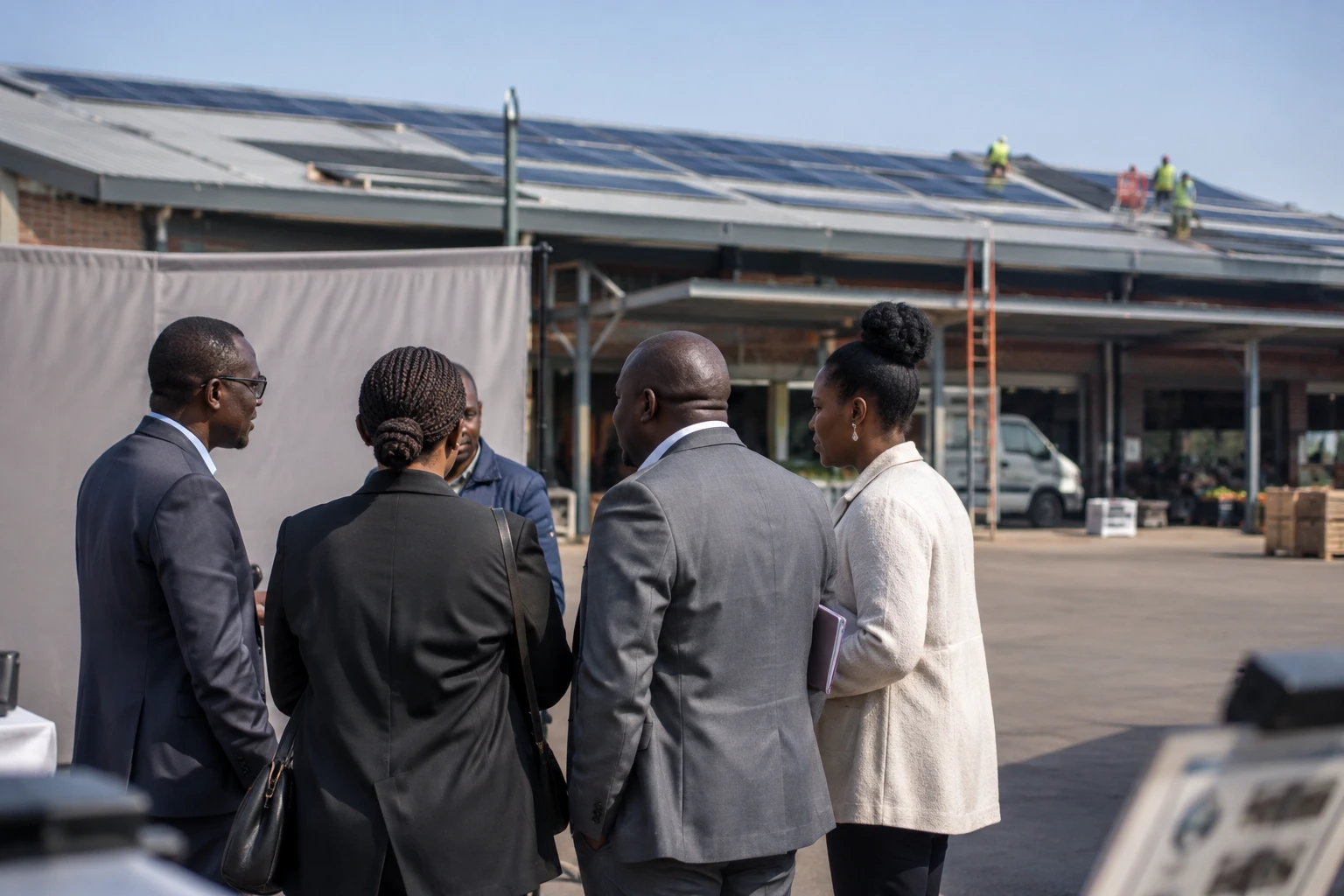
At Springs, electricity generated on the roofs of a municipal market is soon due to join the city’s grid. The stakes go beyond this site: Ekurhuleni is seeking to diversify its suppliers without financing the construction of every new power plant itself.
A local project financed by an independent producer
BluEnergy, a subsidiary of South African group Blu Label Unlimited, and its partner IBS Crafts are developing a 25.6 MWp solar plant at the Springs Fresh Produce Market. The site is in the Ekurhuleni metropolitan municipality, in Gauteng province. Construction began on 22 October 2026, according to information published about the project.
The announced investment totals 360 million rand, financed by the independent power producer. The plant will use the market’s rooftops and vacant land. Once operational, it is expected to generate about 40 GWh a year, equivalent to the annual consumption of around 6,000 households, according to the project developers.
Ekurhuleni will buy this electricity under a 20-year supply agreement. It will be fed into the municipal grid. This arrangement does not mean that the market or nearby households will receive all the power generated directly: the electricity will feed into the city’s grid, which will distribute it according to its operating system.
The municipality will not pay the construction costs upfront. However, it is committing to buy the electricity for the duration of the contract. The model therefore shifts part of the initial financing burden to the private sector, while creating a long-term purchasing obligation for the city. Tariffs, performance clauses and connection terms will be crucial in determining the project’s actual cost.
Broader approval, but not yet 2,400 MW available
The Springs project is part of a much larger municipal programme. On 19 October, South African Minister of Electricity and Energy Kgosientsho Ramokgopa announced that Ekurhuleni had been authorised to procure up to 2,400 MW from independent power producers. This regulatory decision removes an obstacle to concluding contracts, but does not mean that this capacity has already been built or connected to the grid.
The announced allocation comprises 1,237 MW of solar, 780 MW of gas-fired generation, 183 MW from waste-to-energy and 200 MW for innovative technologies. A large share of the solar capacity, 1,137 MW, is to be located within the municipal boundaries. The projects will still have to clear the financing, construction and grid-connection stages.
Two independent South African sources report the approval and its composition: Eyewitness News and Engineering News via Polity. The latter says the city had selected 75 producers in two tender processes, but ministerial approval was required to move the proposed contracts forward.
For residents and businesses, delivery will be decisive
The municipality’s aim is to reduce its dependence on national supplier Eskom and diversify its power supply. Generation located nearby could also contribute to local economic activity. The Springs project is expected to create temporary jobs, followed by a few positions related to operation and maintenance. The benefits will depend, however, on the timetable, recruitment and purchases made in the region.
Benefits for consumers are not automatic. The impact on tariffs will depend in particular on the agreed price, the plant’s reliability and the municipal grid’s capacity to integrate this generation. It will also be important to monitor how the city passes its purchasing costs on to bills and protects its revenue, which funds other essential services.
The municipality had begun selecting producers before the October approval, but the regulatory and financial framework still needed to enable projects to reach financial close. In May 2026, Ekurhuleni presented an escrow account mechanism intended to facilitate financing for the installations. The municipality said at the time that selected producers could use the mechanism to move towards implementation.
A test for South African cities and the region
This development accompanies the reform of South Africa’s electricity sector. The country wants to open up generation and trading to more players while maintaining an interconnected grid. For Ekurhuleni, a major urban and industrial area in Gauteng, the experience will test a practical question: can a municipality secure new energy sources without undermining its finances or continuity of service?
The Springs precedent will be watched by other South African cities, as municipalities such as Cape Town and eThekwini have also secured authorisation to diversify their purchases. At regional level, the Southern African Development Community (SADC) is seeking to strengthen electricity exchanges between its members. But a South African municipal contract does not, by itself, resolve cross-border constraints on generation and transmission.
The next steps are therefore more telling than capacity announcements: financing close, construction, grid connection and the actual delivery of the first megawatt-hours. For Ekurhuleni, the Springs plant will provide an initial measure of the public-private partnership’s ability to turn regulatory approval into electricity that benefits the grid.