Algeria
 Libya
 Morocco
 Sudan
 Tunisia
 Benin
 Burkina Faso
 Cabo Verde
 Côte d'Ivoire
 Ghana
 Guinea
 Guinea-Bissau
 Liberia
 Mali
 Mauritania
 Niger
 Nigeria
 Senegal
 Sierra Leone
 The Gambia
 Togo
 Cameroon
 Central African Republic
 Chad
 DR Congo
 Equatorial Guinea
 Gabon
 Republic of the Congo
 São Tomé and Príncipe
 Burundi
 Comoros
 Djibouti
 Eritrea
 Ethiopia
 Kenya
 Madagascar
 Malawi
 Mauritius
 Mozambique
 Rwanda
 Seychelles
 Somalia
 South Sudan
 Tanzania
 Uganda
 Angola
 Botswana
 Eswatini
 Lesotho
 Namibia
 South Africa
 Zambia
 Zimbabwe
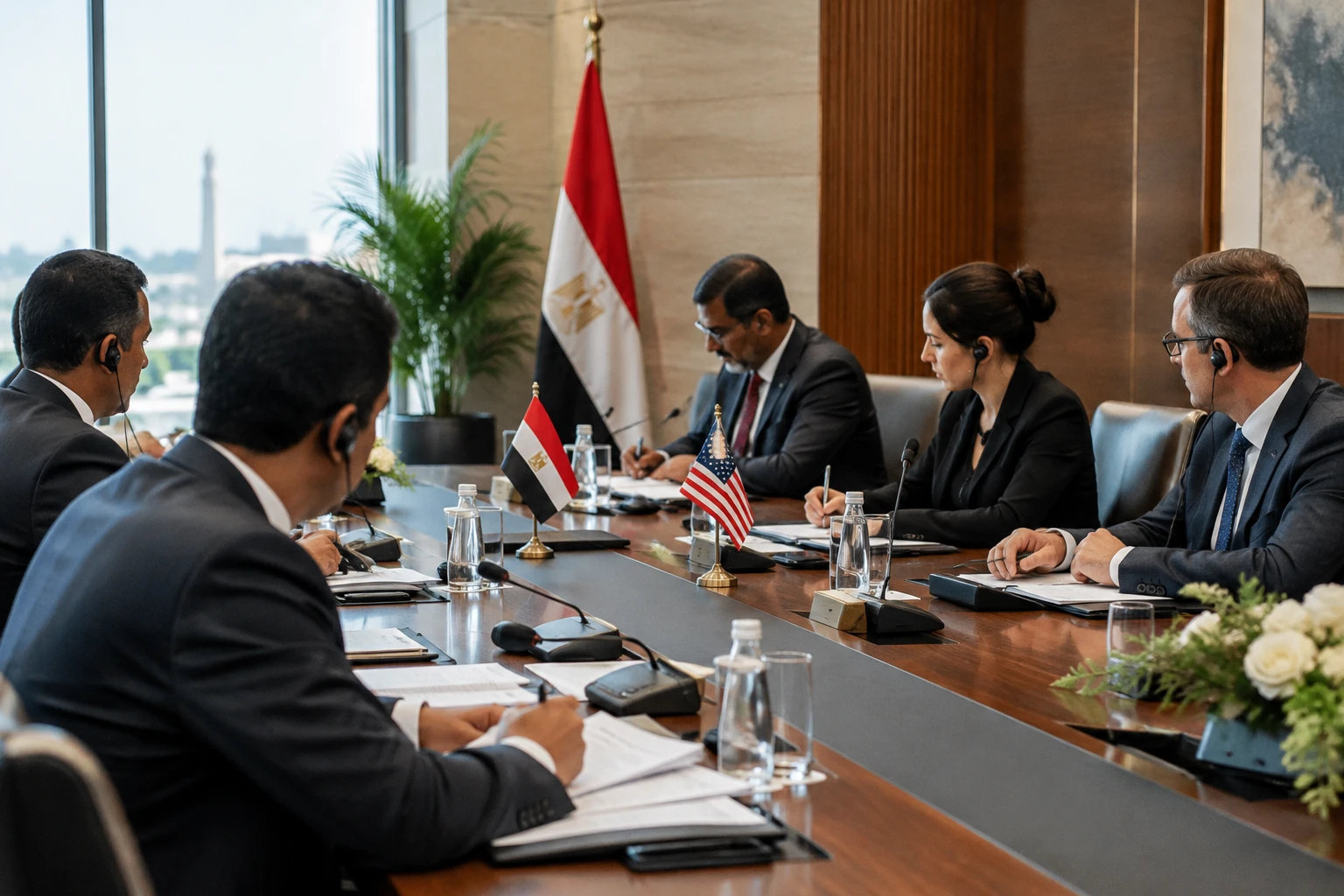
An economic partnership is measured less by its announced value than by the projects it actually delivers. For Egypt, the agreement signed with the United States on 4 November opens a new phase of cooperation in water, energy and technology. But the available information does not confirm the same funding total: the Egyptian authorities and several independent media outlets report $125 million, not $625 million over five years.
$125 million in funding announced
Signed at the Ministry of Foreign Affairs in the New Administrative Capital, the framework agreement aims to support growth and expand business opportunities for US companies in Egypt. The ceremony was attended by Egypt’s foreign minister, Badr Abdelatty, as well as officials responsible for finance, procurement and higher education.
The document was signed by Samar el-Ahdal, Egypt’s deputy minister for international cooperation, and Robert Silverman, chargé d’affaires at the US embassy. Egypt’s Ministry of Foreign Affairs says the agreement provides for $125 million in US funding. The official Egyptian news agency SIS and Egyptian daily Ahram Online report the same amount. The official Egyptian statement on the agreement and Ahram Online’s report make no mention of a $625 million commitment spread over five years.
A discrepancy therefore needs to be noted. Reports published in the Egyptian press cite a framework of $625 million over five years, or $125 million a year. The official US announcement, however, reported by several media outlets, presents $125 million as the funding associated with this agreement. At this stage, there is no basis for treating the $625 million as a sum already guaranteed for five years. The distinction matters: a framework agreement sets priorities, but does not necessarily mean that an entire multi-year funding package is immediately available.
From water to artificial intelligence
The sectors cited include water management, energy infrastructure, agriculture, food security, education, health and public services. The agreement also mentions artificial intelligence, vocational training and skills development. The Egyptian government presents the partnership as a way to improve services and support job creation.
These priorities address very practical challenges. Water is strategic for a country whose cities, farmland and economic activity depend heavily on the Nile. In energy, the efficiency of networks and the ability to diversify production affect both businesses and households. In agriculture, improving yields and food security have a direct bearing on rural incomes and the prices paid in cities.
It remains to be seen how the funds will be allocated. Available announcements describe areas of cooperation, but do not yet detail the projects selected, their timetable, the selection criteria or the outcomes that will be used to assess them. The benefits for the population will depend on these choices. A training programme, for example, will have a different impact depending on whether it leads to local jobs or mainly meets the needs of foreign suppliers.
An economic partnership within a broader relationship
Ties between Cairo and Washington extend beyond this funding package. They encompass economic cooperation, trade and security co-operation. The new agreement emphasises development and business, but does not replace military programmes, which fall under separate funding lines. The figures should therefore not be confused: the $125 million announced for this economic initiative is not military aid.
The text also highlights opportunities for the US private sector. This focus could bring Egypt equipment, expertise and investment. It could also open markets to US companies. The challenge for the Egyptian authorities will be to ensure that partnerships strengthen local capacity over the long term through skills transfer, local maintenance, the involvement of Egyptian companies and access to technology.
The benefits could vary between regions and activities. Large companies and central government bodies are often better placed to respond to calls for projects. Small businesses, farmers and workers in governorates far from Cairo risk being left out if programmes do not provide for local outreach. Publishing details of funded projects and their beneficiaries would help measure how the benefits are distributed.
A regional issue to watch
Egypt is a major North African player and a member of the African Union. It also belongs to the Arab League and the Common Market for Eastern and Southern Africa, COMESA, a trade co-operation organisation for countries in the region. Projects linked to water, energy and agricultural supply chains could therefore have an impact beyond Egypt, even though the announced agreement is bilateral.
The management of the Nile is a reminder, however, that Egypt’s water choices are made within a basin shared by several countries. Technological co-operation can improve the efficiency of networks and irrigation, but it cannot by itself resolve regional disagreements over the sharing and development of the resource. Egyptian officials will therefore have to reconcile development projects with discussions among the riparian states.
The next step will be less about repeating the announced figure than publishing verifiable results: projects launched, funds actually disbursed, jobs created and beneficiaries reached. This monitoring will also make it possible to clarify whether the $125 million is the full commitment announced to date or the first tranche of a larger programme. For now, accessible official sources confirm the first figure, not a guarantee of $625 million over five years.