Algeria
 Libya
 Morocco
 Sudan
 Tunisia
 Benin
 Burkina Faso
 Cabo Verde
 Côte d'Ivoire
 Ghana
 Guinea
 Guinea-Bissau
 Liberia
 Mali
 Mauritania
 Niger
 Nigeria
 Senegal
 Sierra Leone
 The Gambia
 Togo
 Cameroon
 Central African Republic
 Chad
 DR Congo
 Equatorial Guinea
 Gabon
 Republic of the Congo
 São Tomé and Príncipe
 Burundi
 Comoros
 Djibouti
 Eritrea
 Ethiopia
 Kenya
 Madagascar
 Malawi
 Mauritius
 Mozambique
 Rwanda
 Seychelles
 Somalia
 South Sudan
 Tanzania
 Uganda
 Angola
 Botswana
 Eswatini
 Lesotho
 Namibia
 South Africa
 Zambia
 Zimbabwe
As the Red Sea calms, Egypt can breathe easier
In Cairo, every recovery in traffic through the Suez Canal is felt well beyond the quays. It affects dollar revenues, shipowners’ confidence and, ultimately, the room for manoeuvre of a state that still depends heavily on foreign currency linked to maritime trade. The current recovery does not change that reality: a busier route remains a vulnerable one.
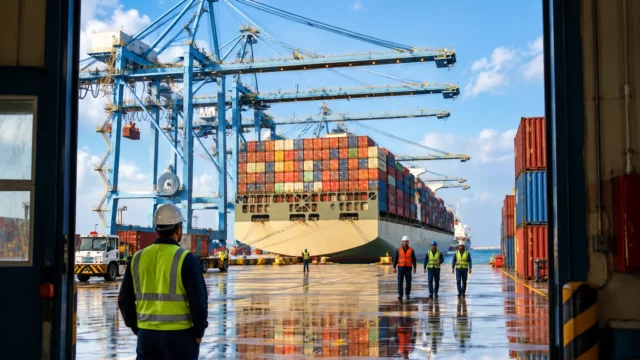
The Suez Canal remains one of Egypt’s strategic assets. The Canal Authority, established in 1956, oversees a passage linking the Mediterranean to the Red Sea and carrying a decisive share of trade flows between Asia, Europe and East Africa. When traffic contracts, the entire Egyptian economy feels the impact, from public revenues to foreign currency reserves. When it picks up again, the effect is quickly visible in the accounts.
A genuine but still fragile recovery
The latest indicators point in the right direction. According to data from Lloyd’s List Intelligence, 1,088 transits were recorded between 20 July and 16 August 2026, compared with 1,070 in the previous four weeks. However, the figure remains about 41% below the level before the Red Sea crisis. This partial recovery shows that shipping companies are returning, but at their own pace and subject to security conditions.
Figures from the Canal Authority confirm the improvement, although they remain far from a full return to normal. In the first half of the 2025/2026 financial year, the authority reported a 5.8% rise in the number of vessels and a 16% increase in net tonnage, with 1,315 vessels and 56 million tonnes since the start of 2026. Revenues for the period reached $449 million, up 18.5% year on year.
For the second quarter of 2026, specialist sources and financial media reported revenues of $1.26 billion, a 13% increase on the previous quarter. This rebound should not obscure the fragility of the recovery. It still depends on the decisions of major shipping companies and the perceived level of risk along the Red Sea-Bab el-Mandeb route.
Oil tankers return, followed by container ships
The recovery is not affecting all segments equally. Oil tankers led the way, accounting for 1,526 of the 3,580 transits in the second quarter of 2026, or nearly 43% of the total. Their numbers rose by 22.3% year on year. This reflects the reshaping of energy flows in a region still beset by tensions, particularly around the straits and Red Sea terminals.
Container ships are also returning, but more cautiously. Maersk says it reinstated its WAF6 route in July, linking the Middle East, the Mediterranean and West Africa, while stressing that other transits will depend on security. This caution says it all: shipping companies are not returning out of absolute confidence, but because they are once again testing the shortest route between Asia and Europe.
For Egypt, the stakes are tangible. The canal does more than provide a passage for ships. It also generates foreign currency revenues that support the budget, imports and macroeconomic stability. The traffic recovery therefore benefits the central government, as well as ports, logistics services and maritime jobs across the transit chain.
Somali piracy highlights the corridor’s vulnerability
The picture is nevertheless clouded by rising risks off the Horn of Africa. The attack on the oil tanker Sibu 1 in the western Indian Ocean was a reminder that rerouting ships around southern Africa does not always neutralise the threat. Meanwhile, European forces in Operation Atalanta have continued to monitor several recent incidents off Somalia.
The issue is not new, but it is resurfacing in a more sensitive context. The International Maritime Organization notes that the Djibouti Code of Conduct, adopted in 2009, provides a framework for co-operation against piracy and armed robbery in the western Indian Ocean and the Gulf of Aden. The Jeddah Amendment, adopted later, broadened the framework to include other illicit maritime activities. Egypt is a signatory, giving this architecture a regional reach that extends far beyond the canal itself.
The latest assessments confirm the tension. In 2026, several specialist sources reported a rise in incidents linked to Somali piracy, describing the level as the highest in ten years, although still far below the peak of 2009-2011. The danger is therefore not a mechanical repeat of the past, but the gradual weakening of the maritime corridor linking Asia, the Red Sea and the Mediterranean.
What this means for Egypt and the region
For Egypt, there are two sides to the issue. On the one hand, the traffic recovery supports public revenues and improves economic visibility. On the other, it requires the state to maintain a high level of maritime vigilance, military co-ordination and diplomatic co-operation. The canal is not merely a waterway; it has become a regional barometer of security.
Across Africa, the issue is a reminder that the continent’s trade routes depend on the stability of several maritime areas at once: the Red Sea, the Gulf of Aden and the western Indian Ocean, as well as the Gulf of Guinea for other flows. The African Union is not alone on the front line, but coastal states, regional navies and mechanisms such as the Djibouti Code of Conduct play an essential part in the response. The joint naval force discussed by the signatory countries shows that maritime security is now seen as a regional public good, not simply a matter of occasional patrols.
The next benchmark will be easy to read: if transits remain above the level seen in the middle of the year, the recovery can be considered more robust. If attacks off Somalia increase or tensions in the Red Sea flare up again, shipping companies could once more lengthen their routes. For Egypt, the equation remains the same: secure the canal, reassure operators and turn a recovery in traffic into lasting revenue.