
 Algeria
 Libya
 Morocco
 Sudan
 Tunisia
 Benin
 Burkina Faso
 Cabo Verde
 Côte d'Ivoire
 Ghana
 Guinea
 Guinea-Bissau
 Liberia
 Mali
 Mauritania
 Niger
 Nigeria
 Senegal
 Sierra Leone
 The Gambia
 Togo
 Cameroon
 Central African Republic
 Chad
 DR Congo
 Equatorial Guinea
 Gabon
 Republic of the Congo
 São Tomé and Príncipe
 Burundi
 Comoros
 Djibouti
 Eritrea
 Ethiopia
 Kenya
 Madagascar
 Malawi
 Mauritius
 Mozambique
 Rwanda
 Seychelles
 Somalia
 South Sudan
 Tanzania
 Uganda
 Angola
 Botswana
 Eswatini
 Lesotho
 Namibia
 South Africa
 Zambia
 Zimbabwe
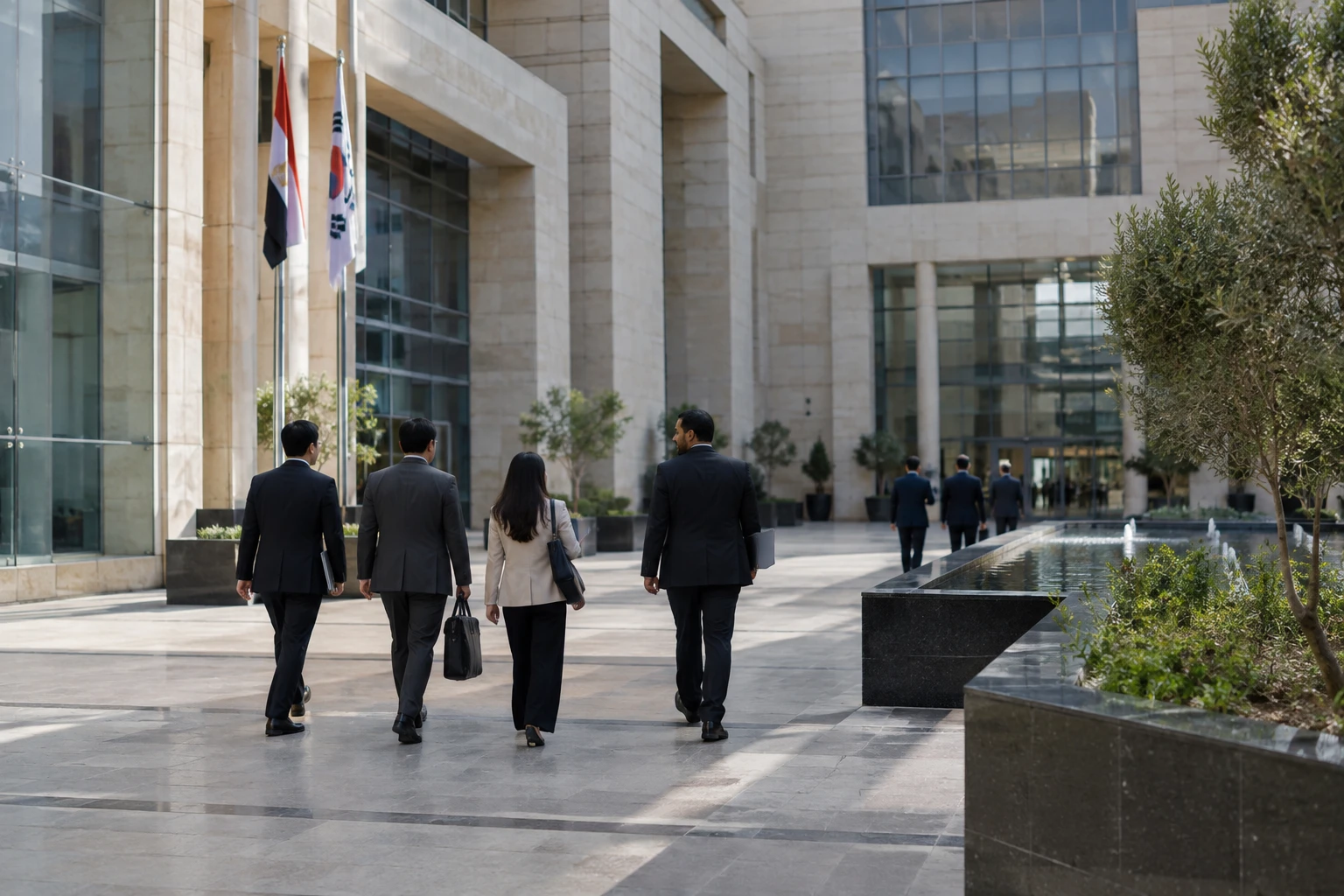
For Egypt, the agreements reached with South Korea amount to more than a handful of memorandums. They open up trade negotiations set to affect exchanges, investment and production chains. But their impact will depend on implementation: announcements alone do not create jobs or markets.
From diplomatic rapprochement to trade negotiations
Egyptian President Abdel Fattah al-Sisi visited South Korea from 7 to 9 October 2026. On 8 October, in Seoul, he met his counterpart Lee Jae Myung. The two leaders elevated relations to a strategic partnership and announced the launch of negotiations for a comprehensive economic partnership agreement, or CEPA. This type of agreement can cover trade, services and economic co-operation, going beyond tariffs alone.
The step follows the South Korean president’s visit to Egypt in November 2025 for the 30th anniversary of diplomatic relations. The two governments then agreed to pursue an economic agreement. The joint declaration of 8 October formalises the start of discussions. South Korean authorities say a first round of negotiations is planned for the first half of 2027; the agreement has yet to be drawn up and negotiated.
The timetable matters as much as the announcement. Negotiators will need to specify the sectors covered, market-access conditions and the rules that will apply to investment. The joint declaration also refers to industrial co-operation, infrastructure, advanced technologies and the strengthening of the Suez Canal Economic Zone. In other words, the issue is where production takes place and how businesses are connected, not just the volume of trade.
Labour, digital technology and energy: the areas covered
The meeting also resulted in agreements and memorandums in several areas. The text on social security is intended in particular to cover workers posted to the other country. According to the South Korean side, it is meant to prevent the double payment of contributions and make it easier to take periods of insurance into account when calculating certain entitlements. Its practical effect will depend on how it is implemented and on the information provided to employees and employers.
In telecommunications and digital technology, the two countries have planned co-operation covering information technology, artificial intelligence, cybersecurity and digital transformation, among other areas. Other texts concern clean energy, electricity infrastructure and shipbuilding. These fields address very different needs: modernising services and networks, supporting an energy transition, or developing industrial activity linked to ports and maritime transport.
The South Korean statement lists 12 co-operation documents signed or revised at the summit. This total includes texts of varying types and scope; it does not mean that 12 projects are already funded or operational. Framework agreements set out areas for work, while contracts, budgets, schedules and local partners are still needed to deliver results.
Benefits will depend on their roots in Egypt
For Cairo, closer economic ties with Seoul could support industrialisation, attract investment and diversify external partnerships. The joint declaration cites manufacturing, electric vehicles, shipbuilding and advanced technologies in particular. It also refers to industrial localisation: producing or assembling more goods locally rather than relying solely on imports.
That is where part of the balance will be decided. Investment can increase production capacity, but its benefit to the Egyptian economy will depend on the role given to local suppliers, training, skills transfers and the jobs created. Companies already integrated into formal business networks will be better placed to respond to tenders. Smaller firms and less-skilled workers, meanwhile, risk being left out if training programmes and access to markets do not keep pace.
Social security illustrates a more directly human concern: common rules can simplify professional mobility between the two countries. For workers to benefit, administrations will need to clarify procedures, which contribution periods will be recognised and which officials to contact. Announcements on digital technology and energy will, for their part, require identifiable projects, funding and public deadlines.
An opening towards Africa, without shortcuts
Egypt occupies a crossroads between Africa, the Middle East and Europe. The bilateral declaration presents the country as a gateway to the continent and refers to the possibility of co-operation between Egypt, South Korea and other African countries. The Suez Canal Economic Zone is central to this ambition: it can link industrial investment with trade routes, provided projects move beyond the stage of intentions.
This regional dimension does not automatically turn a bilateral agreement into a benefit for the continent. For businesses in other African countries to benefit, there will need to be open supply chains, transport infrastructure and rules compatible with regional trade. Egypt is a member of the African Continental Free Trade Area, which aims to facilitate trade between countries on the continent. The CEPA, by contrast, will be negotiated between Cairo and Seoul: how it aligns with African commitments will therefore need to be closely monitored.
The next step will be the start of trade negotiations announced for the first half of 2027. Their content will show whether the rapprochement leads to specific commitments on market access, investment and industrial co-operation. For now, the two governments have set a direction. The economic and social impact will be measured by what is funded, produced and effectively accessible to Egyptian businesses and workers.
The agreements and the date of the visit are corroborated by statements from the Egyptian and South Korean presidencies, as well as by Egypt’s MENA news agency. The Egypt-South Korea joint declaration, the official South Korean account of the summit and Egypt’s MENA news agency confirm the launch of discussions and the main areas of co-operation.



