Algeria
 Libya
 Morocco
 Sudan
 Tunisia
 Benin
 Burkina Faso
 Cabo Verde
 Côte d'Ivoire
 Ghana
 Guinea
 Guinea-Bissau
 Liberia
 Mali
 Mauritania
 Niger
 Nigeria
 Senegal
 Sierra Leone
 The Gambia
 Togo
 Cameroon
 Central African Republic
 Chad
 DR Congo
 Equatorial Guinea
 Gabon
 Republic of the Congo
 São Tomé and Príncipe
 Burundi
 Comoros
 Djibouti
 Eritrea
 Ethiopia
 Kenya
 Madagascar
 Malawi
 Mauritius
 Mozambique
 Rwanda
 Seychelles
 Somalia
 South Sudan
 Tanzania
 Uganda
 Angola
 Botswana
 Eswatini
 Lesotho
 Namibia
 South Africa
 Zambia
 Zimbabwe

When the grid becomes as strategic as power plants
In Egypt, the energy transition is no longer taking place only in solar fields or wind farms. It is also happening in the workshops where equipment is made to connect this new capacity to the grid. This is where the pace of electricity modernisation, the reliability of supply and the share of value retained in the country are determined in very practical terms.
For several years, the country has pursued a strategy to move up the industrial value chain in energy. Egypt’s Ministry of Electricity and Renewable Energy says it wants to strengthen local manufacturing of grid equipment, substations and control systems, while developing markets in the Arab world and Africa. This approach is part of a broader trajectory: Egypt wants to make the electricity grid an instrument of technical sovereignty, not merely a conduit for transmitting megawatts.
In the region, this approach also matters for integrating electricity exchanges, securing investment and enabling the movement of technologies. Through its ambitions for continental integration, the African Union is pushing for better interconnection between markets. For Egypt, located at the junction of North Africa, the Middle East and the Mediterranean, mastery of grid technologies is therefore an industrial issue, but also a geopolitical one.
What the factory inaugurated east of Cairo changes
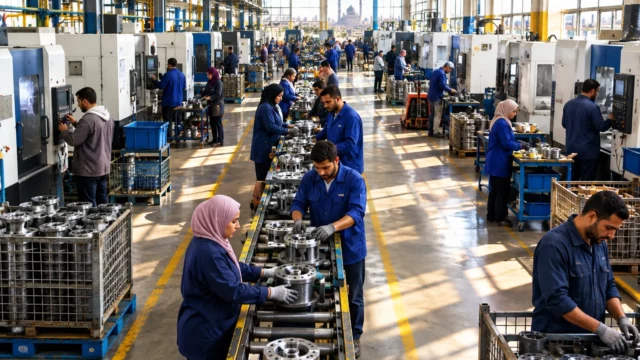
On Tuesday 28 July 2026, Siemens inaugurated a factory in Egypt producing electrical components and automation solutions for industry and infrastructure. According to information published by Egyptian media and repeated in the available official material, the site produces electrical equipment, protection panels, distribution boards, low-voltage circuit breakers, and control, communications and digitalisation solutions. The authorities say the initial focus is the local market, before an announced expansion into the Middle East and the rest of Africa.
The inauguration follows a memorandum of understanding signed in August 2024 between Siemens and the Egyptian Industrial Development Authority. It provided for the local manufacture of low- and medium-voltage equipment, including medium-voltage switchgear, distribution boards and low-voltage circuit breakers. In other words, the aim is not simply to assemble products locally. It is to establish entire segments of the electrical value chain in Egypt.
So far, the Egyptian government has not disclosed official figures for the investment, annual capacity or jobs created. This absence of data matters. It makes it impossible to overstate the site’s immediate impact, but does not diminish its strategic importance. In a country where electricity demand is rising with urbanisation, industrialisation and new generation projects, having a local base for grid equipment reduces lead times, limits some imports and makes maintenance easier.
The project is part of a major investment drive. In June 2026, the European Investment Bank and the European Union announced a package of up to €690 million to modernise and expand Egypt’s electricity grid. The stated objective is clear: to better integrate solar and wind power, improve system reliability and support the country’s role as a regional clean-energy hub.
The Egyptian government, for its part, has set out ambitions to scale up renewables by the end of 2029. Official and semi-official sources cite installed capacity of 9,516 MW and a target of 30,705 MW by 2029, with a significant expansion of solar, wind and storage projects. This leap will require stronger grids, new substations and control systems capable of handling more variable flows.
An industrial signal for Egypt and the continent
For Egypt, the rationale is twofold. First, it supports the state’s industrial localisation strategy, pursued for several years. Second, it gives greater depth to an energy policy that can no longer be limited to producing more. Electricity must now be transmitted, protected, measured and controlled more precisely. In this equation, low- and medium-voltage equipment is becoming as important as power plants themselves.
This development could also benefit local industry, if pledges on skills transfer, technical training and local sourcing are reflected in contracts and factories. Egypt’s Ministry of Electricity highlights a programme to manufacture grid equipment locally, with the aim of developing components that can be exported to Arab and African markets. This is key: value is no longer confined to electricity generation; it is shifting towards engineering, software and control systems.
However, households and businesses will not feel the benefits immediately. Consumers’ day-to-day experience will depend above all on how quickly lines, substations and control equipment are upgraded. For industry, by contrast, every improvement to the grid can reduce outages, improve service quality and secure production sites. In a country where energy is becoming a factor in economic attractiveness, grid reliability matters as much as the cost of a kilowatt-hour.
Across the continent, the project points to a broader trend: African countries accelerating their use of renewables are also seeking to take control of intermediate infrastructure, which is often overlooked in public debate. Cables, transformers, protection systems and automation determine whether the transition succeeds or fails. For Egypt, which is targeting both its domestic market and regional opportunities, the next step will be less striking than an inauguration, but more decisive still: whether this industrialisation of the grid translates into a lasting capacity to connect, store and distribute cleaner electricity.