Algeria
 Libya
 Morocco
 Sudan
 Tunisia
 Benin
 Burkina Faso
 Cabo Verde
 Côte d'Ivoire
 Ghana
 Guinea
 Guinea-Bissau
 Liberia
 Mali
 Mauritania
 Niger
 Nigeria
 Senegal
 Sierra Leone
 The Gambia
 Togo
 Cameroon
 Central African Republic
 Chad
 DR Congo
 Equatorial Guinea
 Gabon
 Republic of the Congo
 São Tomé and Príncipe
 Burundi
 Comoros
 Djibouti
 Eritrea
 Ethiopia
 Kenya
 Madagascar
 Malawi
 Mauritius
 Mozambique
 Rwanda
 Seychelles
 Somalia
 South Sudan
 Tanzania
 Uganda
 Angola
 Botswana
 Eswatini
 Lesotho
 Namibia
 South Africa
 Zambia
 Zimbabwe
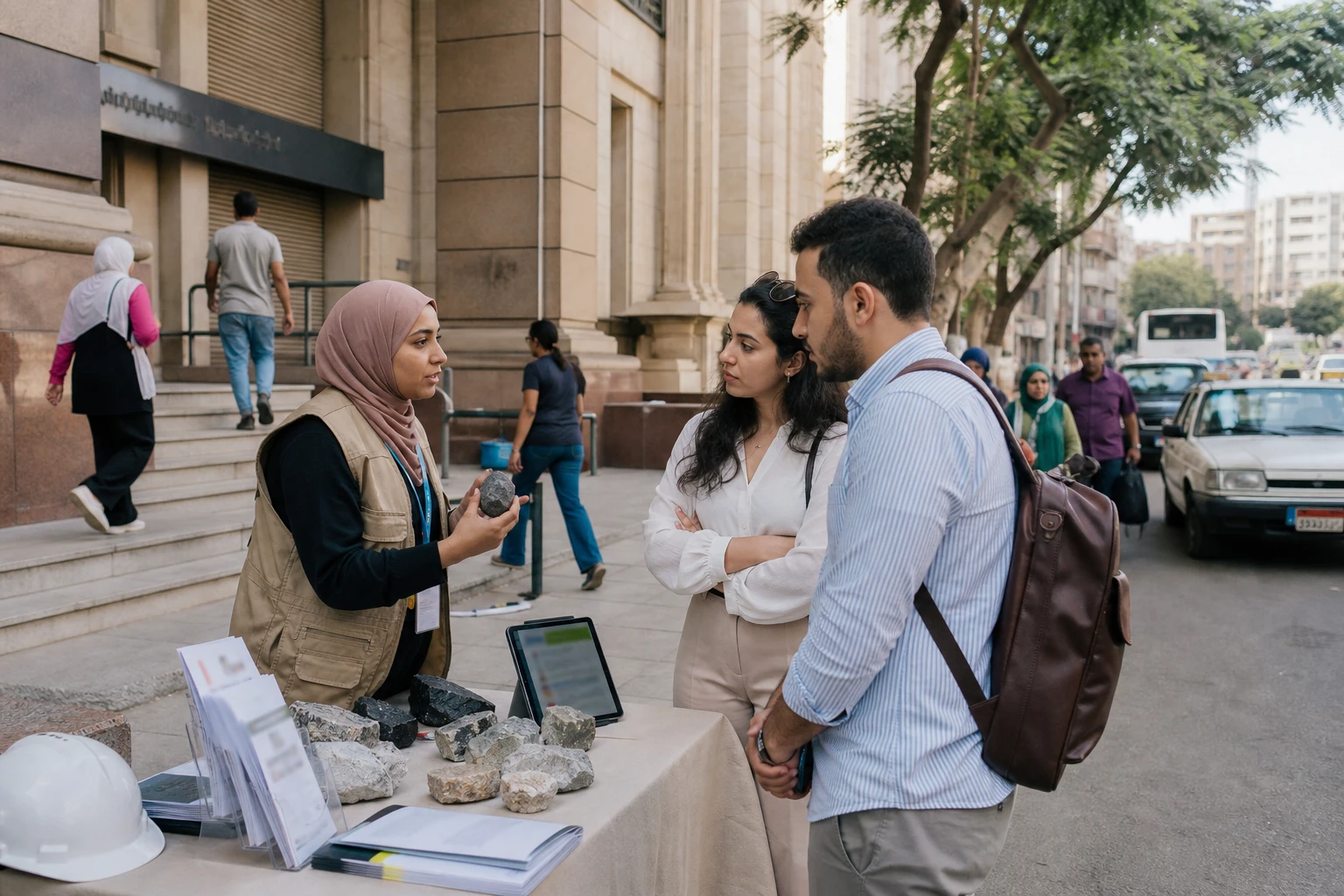
In the Eastern Desert, Egypt is seeking to turn its mineral wealth into a genuine industrial driver. The effort is financial, but also strategic: attracting investment, producing more locally and better connecting extraction with processing.
The most visible signal currently comes from gold. Yet the Egyptian authorities are not limiting their ambitions to the precious metal. Phosphate, iron, copper, silver and manganese are also among the resources Cairo wants to develop more fully.
The Eastern Desert at the heart of the mining revival
The fifth edition of the Egypt Mining Forum was held in Cairo on 28 and 29 September 2026. The event brought together public officials, mining companies, investors and financial institutions. More than 6,000 participants from over 50 countries were expected, according to the organisers.
The Egyptian government confirmed a major target at the forum: to increase mining’s contribution to gross domestic product to about 6% by 2030, from less than 1% today. The Minister of Petroleum and Mineral Resources, Karim Badawy, described this target as the expected outcome of a reform designed to improve exploration, financing and private-sector participation.
This strategy forms part of Egypt’s recent economic trajectory. After several years marked by pressure on foreign currency, inflation and the need to attract productive investment, Cairo is seeking to diversify its sources of revenue. The aim is therefore not simply to extract more. It is also to develop mining services, skilled employment, industrial processing and exports.
Regionally, Egypt is not part of an economic community such as ECOWAS or SADC. It belongs to North Africa and maintains links with the Arab Maghreb Union, while also playing an important role in the African Union. Its position between the Red Sea, the Mediterranean and the Middle East also gives it a distinctive logistical role for minerals destined for African, Arab and Asian markets.
Gold draws the first concrete announcements
AngloGold Ashanti, which operates the Sukari mine, announced at the forum that it had submitted applications for 19 gold exploration areas in the Eastern Desert. These areas would cover more than 3,000 square kilometres, according to information reported by Arab Finance and confirmed by the Egyptian Mineral Resources Authority.
Sukari is already the leading reference point for Egypt’s gold industry. The mine, near Marsa Alam, has been operating since 2009. It is equally owned by an AngloGold Ashanti subsidiary and the Egyptian Mineral Resources and Mining Industries Authority. The South African group took control of the asset after acquiring Centamin in November 2024.
The company also plans to spend several million dollars exploring areas that have yet to be studied in depth from 2027. The announcement builds on work already under way around Sukari. AngloGold Ashanti describes the Eastern Desert as a promising geological area, but one that remains largely underexplored using modern methods.
Interest is not coming solely from a group already established in the country. Saudi Gold Refinery, a Riyadh-based company, said it had applied for seven gold licences in Egypt. It is considering an investment of more than $200 million if the permits are granted. This remains contingent on the licences being awarded and does not yet represent an investment made.
Other companies, including Afaq Mining, have also expressed interest in the sector. These projects show that Egypt’s reform is beginning to attract attention. They do not, however, guarantee the discovery of commercially viable reserves or the start of production in the areas concerned.
Known resources, but little processing so far
Egypt’s gold potential is regularly estimated at about 7.3 million ounces, or nearly 226 tonnes. This figure represents an estimate of resources, not a stock that can be immediately recovered. It must therefore be distinguished from economically viable reserves and actual recorded production.
According to data cited from the United States Geological Survey, Egypt produced about 17 tonnes of gold in 2024. Sukari is estimated to have supplied 14.1 tonnes. The mine therefore remains a decisive contributor to national production, reinforcing both its economic importance and the sector’s dependence on a limited number of major assets.
Rising gold prices since 2024 have made exploration more attractive. They increase the potential value of new deposits and, in theory, make it easier to secure financing. However, costs remain high. Funding is needed for geological studies, roads, energy, water, processing facilities and the management of mining waste.
For Egypt, the challenge is to turn its geological advantage into a value chain. Increased production will not be enough if revenues remain concentrated in extraction and equipment, technical services and processing are largely imported. Training Egyptian engineers, geologists and technicians is therefore a central priority.
Phosphate and industrial processing in focus
Gold dominated the forum’s announcements, but phosphate plays an important role in the national strategy. The World Bank discussed financing mechanisms, support for private projects and skills development in the mining sector with the Egyptian authorities.
Phosphate is of particular interest because it can supply downstream industry. It is used, among other things, to produce fertilisers, a sector directly linked to agriculture and food security. Its development could therefore have a different impact from that of gold, by supporting industrial and agricultural activities closer to the domestic market.
The plan’s success will also depend on the regulatory framework. Cairo wants to offer investors conditions it considers more competitive, while retaining a role in overseeing resources. Revenue sharing, taxation, permit transparency, worker protection and environmental management will be closely scrutinised.
The benefits will not be the same for every area. Cairo concentrates decision-making and financial services, while mining areas are in remote desert regions. Local communities will therefore expect jobs, infrastructure and lasting services, not just temporary extraction activity.
An ambition to be tested on the ground
The Egypt Mining Forum chiefly confirmed a clear direction: Egypt wants to make mining an additional pillar of its economy. The announcements concerning AngloGold Ashanti and Saudi Gold Refinery have raised the country’s profile. However, they remain at the exploration, permit application or investment-intention stage.
The next steps will therefore be practical: issue licences, confirm resources, secure financing and build processing capacity. The government will also have to show that reforms can deliver a steady stream of projects beyond the single example of Sukari.
North Africa and the African Union will have reason to watch Egypt’s experience. It raises a question shared by many countries across the continent: how can rich mineral resources be turned into an industry that creates value, skills and predictable public revenues? The answer will be measured less by the number of announcements than by production volumes, jobs created and the share processed locally by 2030.