Algeria
 Libya
 Morocco
 Sudan
 Tunisia
 Benin
 Burkina Faso
 Cabo Verde
 Côte d'Ivoire
 Ghana
 Guinea
 Guinea-Bissau
 Liberia
 Mali
 Mauritania
 Niger
 Nigeria
 Senegal
 Sierra Leone
 The Gambia
 Togo
 Cameroon
 Central African Republic
 Chad
 DR Congo
 Equatorial Guinea
 Gabon
 Republic of the Congo
 São Tomé and Príncipe
 Burundi
 Comoros
 Djibouti
 Eritrea
 Ethiopia
 Kenya
 Madagascar
 Malawi
 Mauritius
 Mozambique
 Rwanda
 Seychelles
 Somalia
 South Sudan
 Tanzania
 Uganda
 Angola
 Botswana
 Eswatini
 Lesotho
 Namibia
 South Africa
 Zambia
 Zimbabwe
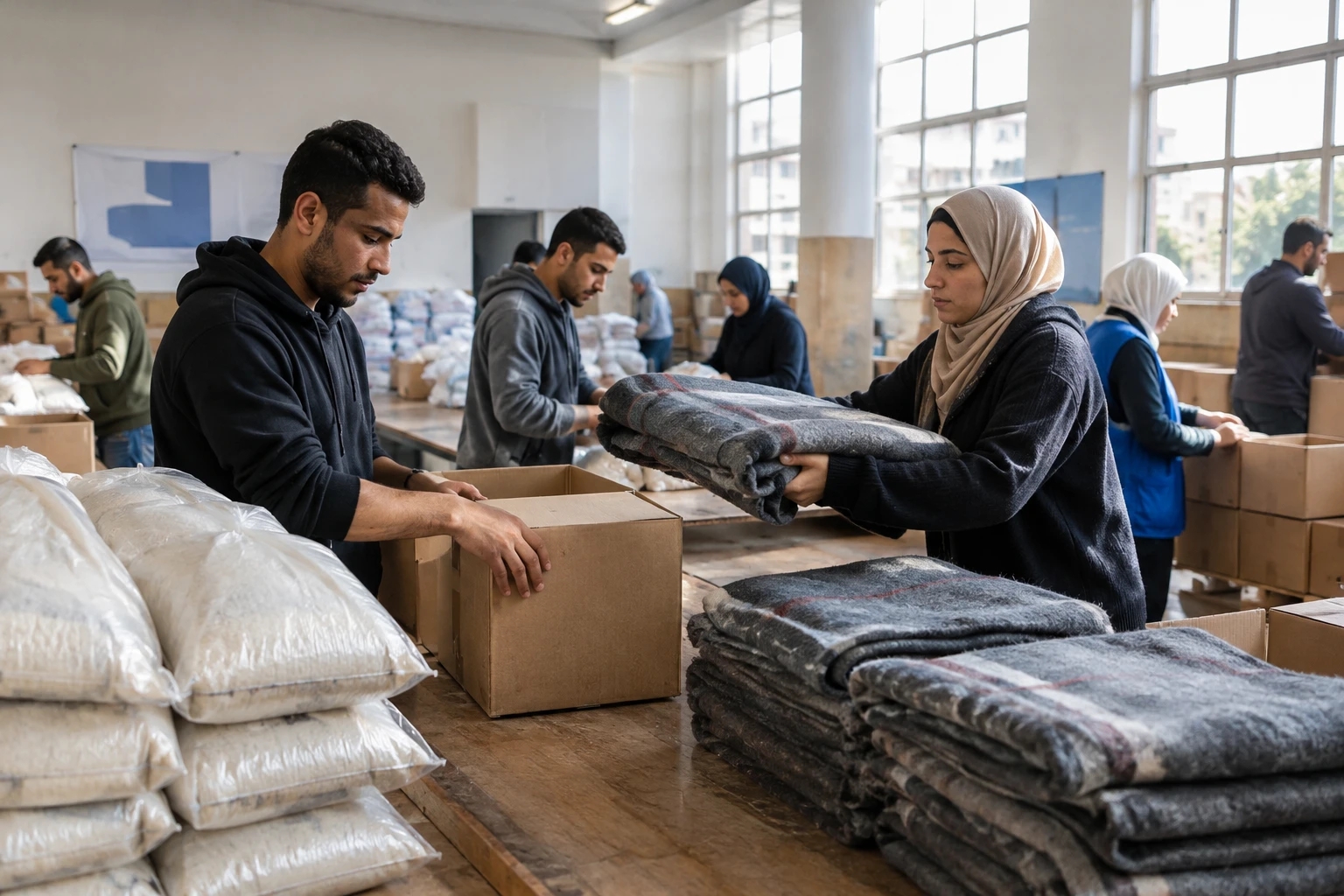
As winter approaches, aid sent from Egypt to Gaza is addressing immediate needs: flour for bakeries, warm clothing and essential supplies. But the arrival of a convoy at the border alone does not guarantee that its cargo will quickly reach the families who need it.
A logistical effort at Egypt’s border
The Tahya Misr Fund has announced the dispatch of 62 trucks carrying more than 780 tonnes of aid to Gaza. The cargo includes flour and winter clothing for children and adults. The Fund presents the operation as a mobilisation bringing together public authorities, civil society and the private sector. The convoy’s size and contents were also reported by Egypt Today and by the Egyptian Gazette, which reported about 800 tonnes.
This initiative is part of a broader operation. The Egyptian Red Crescent coordinates several relief operations to the enclave. It has said it delivered more than 1,620 tonnes of flour and food baskets as part of its “Sanabel Al-Ataa” campaign. Another convoy, named “Zad Al-Izzah: From Egypt to Gaza”, reportedly transported more than 3,380 tonnes of supplies, including medicines, fuel and relief equipment. The winter cargo mentioned also includes 1,328 tents and 3,200 blankets.
These figures are attributed to the Egyptian Red Crescent and reported by the Egyptian press. They describe announced shipments, but do not in themselves provide an independent measure of the aid actually distributed in Gaza. These convoys should also be distinguished from the cumulative totals cited by the organisation: the Red Crescent says it has delivered more than one million tonnes since the start of the war and mobilised more than 75,000 volunteers. These figures have not been confirmed here by a second independent source in the same terms.
Flour, fuel and shelter: interconnected needs
Flour is a central issue because access to bread also depends on bakeries being able to operate. Production and distribution require fuel, functioning equipment and accessible supply routes. The Red Crescent says its shipments include fuel for bakeries, hospitals and other essential services. In a territory where infrastructure has been severely disrupted by the war, these elements are interconnected: delivering flour is not enough if ovens cannot operate.
Clothing, blankets and tents address another practical need: protection from the cold and bad weather. Displaced families are particularly affected, but needs and the ability to receive aid vary according to location and conditions of movement. The presence of these items in a convoy does not show how many people will receive them or when. These questions depend on access to different areas and on local storage and distribution capacity.
Humanitarian organisations alone do not control all the stages between preparing a shipment and handing it to beneficiaries. Authorisations, inspections, the opening of crossing points, security conditions and the state of roads can slow or halt deliveries. In its monitoring of humanitarian access from January to June 2025, the UN Office for the Coordination of Humanitarian Affairs (OCHA) documented significant restrictions and periods when supplies were completely blocked. This finding relates to that specific period; it should not be presented as an account of current conditions. Further details are available in OCHA’s review of humanitarian access to Gaza.
Egypt’s role, between proximity and constraints
Cairo occupies a particular position in the delivery of aid: Egypt shares a border with Gaza and hosts organisations involved in relief operations. The Rafah crossing is often associated with this route, but the entry of goods depends on decisions and mechanisms beyond Egypt’s sole control. Access can change, and announcements of convoys setting off do not, without further monitoring, establish that trucks have crossed the border or that all their cargo has been distributed.
Egyptian authorities must also manage security and domestic political concerns in Sinai. This reality explains why movement at the border is regulated, without diminishing the difficulties faced by Gaza’s residents. The distinction matters: Egypt has a real capacity to mobilise donations and trucks, but this does not give it sole control over the conditions for aid entering, moving through and being distributed in the territory.
The solidarity mobilised around these operations brings together institutions, volunteers and donors. It highlights the role of Egyptian humanitarian organisations in regional logistics. However, it cannot replace regular humanitarian access or the actual delivery of relief to the population. For families, the difference is measured in the availability of bread, medicines, fuel and adequate shelter, not just in the tonnage announced at departure.
A regional impact to watch
For North Africa, the delivery of aid to Gaza is a reminder that the humanitarian response depends on corridors, agreements and coordination among actors far beyond any one country. Egypt is a member of the African Union and the Arab Maghreb Union, a regional organisation bringing together countries in North Africa. These frameworks provide diplomatic context for Cairo’s role, but the sources consulted do not make it possible to attribute coordination of these specific convoys to either organisation.
The pan-African dimension also lies in the question of coordination: how can financial and material contributions be matched with identified needs and available access routes? Organisations’ figures are useful for tracking the scale of operations, provided announced tonnages are distinguished from goods authorised to enter and aid actually distributed. The next decisive step is therefore not so much a truck’s departure as the continuity of its journey to the people concerned.
For now, announcements by the Tahya Misr Fund and the Egyptian Red Crescent attest to a substantial relief effort, whose impact will depend on conditions of access to Gaza. Flour can support bread production; fuel can keep essential services running; tents and blankets can protect displaced families. But each shipment becomes a practical response only if it crosses the checkpoints, moves through the territory and reaches its destination.