Algeria
 Libya
 Morocco
 Sudan
 Tunisia
 Benin
 Burkina Faso
 Cabo Verde
 Côte d'Ivoire
 Ghana
 Guinea
 Guinea-Bissau
 Liberia
 Mali
 Mauritania
 Niger
 Nigeria
 Senegal
 Sierra Leone
 The Gambia
 Togo
 Cameroon
 Central African Republic
 Chad
 DR Congo
 Equatorial Guinea
 Gabon
 Republic of the Congo
 São Tomé and Príncipe
 Burundi
 Comoros
 Djibouti
 Eritrea
 Ethiopia
 Kenya
 Madagascar
 Malawi
 Mauritius
 Mozambique
 Rwanda
 Seychelles
 Somalia
 South Sudan
 Tanzania
 Uganda
 Angola
 Botswana
 Eswatini
 Lesotho
 Namibia
 South Africa
 Zambia
 Zimbabwe
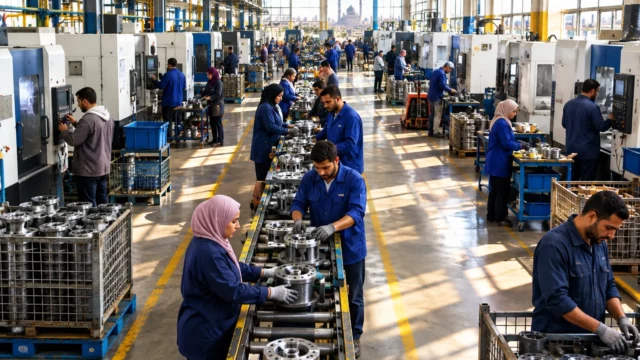
For a factory, renewable electricity is no longer just a contribution to climate goals. In Egypt, it is also becoming a choice about supply and competitiveness. Direct contracts between producers and industrial firms could therefore complement a market long organised around state purchases.
A new outlet for solar electricity
On 1 November 2026, cement producer TITAN Egypt and developer SolarizEgypt announced the addition of 10 megawatts (MW) to their solar project for the Beni Suef plant. The planned installation will reach 21.45 MW. A 25-year power purchase agreement is to govern the supply; SolarizEgypt is responsible for developing, financing and operating the project. The announcement was reported by Egypt’s state news agency SIS and confirmed in a statement by TITAN Egypt.
The contract is part of a broader shift. In May 2025, the Egyptian authorities authorised four solar and wind projects, totalling 400 MW, to sell their output directly to industrial customers. The mechanism, known as “peer-to-peer” (P2P), allows a private producer to supply a company through the national grid, in return for grid-use fees. The European Union for Reconstruction and Development (EBRD) says it provided technical support for the design of these rules. Egyptian media outlet Daily News Egypt also reported the approval of the projects and their combined capacity.
The reform opens a breach in the historical model. Until now, many large private power plants sold their electricity to the Egyptian Electricity Transmission Company (EETC), the state-owned transmission company, which feeds it into the national grid. The new arrangement does not remove this role; rather, it allows some producers and consumers to reach a direct agreement while using shared infrastructure.
Projects of different sizes and profiles
Industrial demand is also attracting large-scale projects. On 28 October 2026, Norwegian developer Scatec announced that it had secured financing for the first phase of the Dandara project, intended for Egypt Aluminium, and had begun construction. The project will combine 569 MW of solar power with a 100-megawatt-hour (MWh) battery. Scatec plans a 25-year supply contract, guaranteed by the Egyptian state. Specialist outlet pv magazine has corroborated the project’s dimensions and the announced financing.
In Beni Suef, the project meets the needs of a cement plant; Dandara is aimed at a major state-owned aluminium producer. These agreements therefore differ in more than just scale. They show how renewable electricity can serve large, steady industrial loads while giving developers an identified buyer over the long term.
Meanwhile, the model of sales to the EETC continues to deliver major infrastructure. The Obelisk solar plant, with an announced capacity of 1.1 gigawatts (GW) and storage, reached full commercial operation in August 2026, according to Scatec. The Red Sea Wind Energy wind farm, with a capacity of 650 MW, also supplies electricity to the grid under a contract with the EETC. These plants feed the national system rather than a single industrial customer.
Competitiveness at the heart of the contracts
For an industrial company, signing a long-term contract can make part of its supply more predictable. Solar power alone cannot meet all needs, and a battery does not guarantee an unlimited supply. But combining contracts, the grid and storage can help some companies plan their costs and consumption more effectively.
Exports are also at stake. As overseas markets increasingly factor in the carbon footprint of products, Egyptian manufacturers selling internationally have an incentive to document the energy used in their processes. The European Commission says its Carbon Border Adjustment Mechanism entered its definitive phase on 1 January 2026. It covers certain imported products, including aluminium, cement, iron and steel. This does not mean that every renewable energy contract automatically guarantees a commercial advantage: measurement and traceability requirements, as well as the terms of implementation, also matter.
Financing remains another point of tension. Projects require substantial investment, while contracts must clearly allocate risks among the producer, customer, grid and, in some cases, a public guarantor. For Egypt Aluminium, the sovereign guarantee announced by Scatec underlines that direct sales to industry can still depend on state support. Opening the market does not therefore mean the state is withdrawing.
A reform to watch beyond the first signatures
Egypt’s energy trajectory thus combines two channels: power plants selling to the public purchaser and bilateral contracts for certain consumers. The P2P mechanism is a first step towards greater participation by companies, but its reach will depend on how it works in practice: grid access, metering rules, transmission costs and buyers’ ability to honour long-term commitments.
The effects will not be uniform for workers and local communities. Large industrial sites are the first able to negotiate contracts and finance adaptations. Small businesses, which buy electricity under different conditions, may not benefit from these options as quickly. In Beni Suef and in areas hosting power plants, deployment also raises practical questions about grid connections, jobs and the distribution of economic benefits.
At the regional level, this shift echoes debates over industrialisation and energy security in North Africa. Egypt is not part of a regional economic community comparable to ECOWAS or SADC; the Arab Maghreb Union exists, but energy cooperation in North Africa is also shaped by bilateral agreements and interconnection projects. Egypt’s experience is therefore of interest to the continent less as a unique model than as a test: can rules allowing companies to buy clean energy directly accelerate investment without transferring all the risks to the public sector?
The next steps will be decisive: commissioning the announced facilities, meeting construction schedules and ensuring the first P2P contracts work in practice. If the projects meet their commitments, industrial firms could become an additional driver of Egypt’s renewable energy sector, without replacing the state or contracts serving the national grid.