Algeria
 Egypt
 Libya
 Morocco
 Sudan
 Tunisia
 Benin
 Burkina Faso
 Cabo Verde
 Ghana
 Guinea
 Guinea-Bissau
 Liberia
 Mali
 Mauritania
 Niger
 Nigeria
 Senegal
 Sierra Leone
 The Gambia
 Togo
 Cameroon
 Central African Republic
 Chad
 DR Congo
 Equatorial Guinea
 Gabon
 Republic of the Congo
 São Tomé and Príncipe
 Burundi
 Comoros
 Djibouti
 Eritrea
 Ethiopia
 Kenya
 Madagascar
 Malawi
 Mauritius
 Mozambique
 Rwanda
 Seychelles
 Somalia
 South Sudan
 Tanzania
 Uganda
 Angola
 Botswana
 Eswatini
 Lesotho
 Namibia
 South Africa
 Zambia
 Zimbabwe
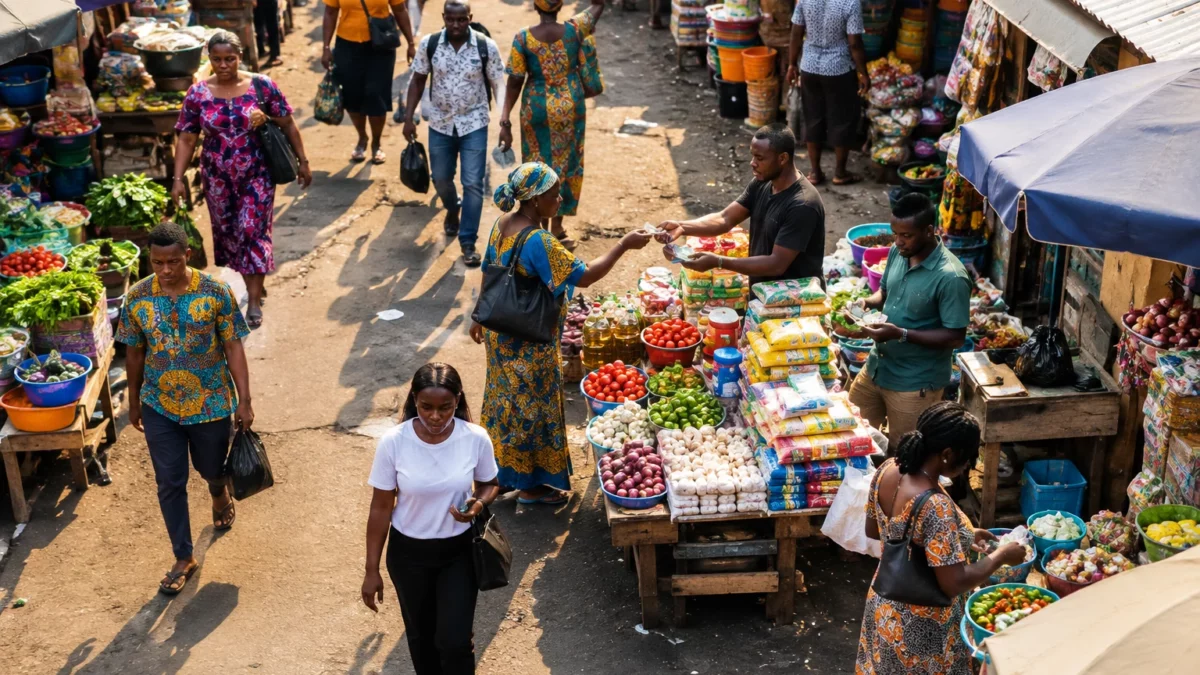
For households and businesses in West Africa, a common currency could make cross-border payments easier. But it will not eliminate price differences, economic difficulties or monetary policy choices. In Abidjan, discussions now focus as much on the institutions to be built as on the launch date that has been announced.
A deadline, several monetary systems
ECOWAS, the Economic Community of West African States, has pursued the project of a monetary union for decades. Its ambition is to facilitate trade and investment between countries in the region. The undertaking remains complex, as not all states use the same currency or monetary institutions.
Côte d’Ivoire belongs to WAEMU, the West African Economic and Monetary Union, whose eight countries share the CFA franc and the Central Bank of West African States (BCEAO). Other ECOWAS members have national currencies, such as the naira in Nigeria and the cedi in Ghana. The ECO would therefore bring together frameworks that currently operate differently.
The region’s political geography has also changed. The withdrawal of Mali, Burkina Faso and Niger from ECOWAS, which took effect in January 2025, has altered the composition of the bloc. The establishment of a common currency therefore depends on economic decisions, but also on the states’ ability to maintain regional cooperation.
Preparations focus on rules and institutions
On 20 November 2026, in Abidjan, the Ministerial Committee of the ECOWAS Presidential Task Force reviewed preparations for a gradual introduction of the ECO from 2027. The meeting was chaired by Adama Coulibaly, Côte d’Ivoire’s Minister of Economy, Finance and Budget. The Ivorian Press Agency and the ECOWAS Commission reported on the meeting and its timetable. The Ivorian Press Agency details the Abidjan meeting.
The minister called on states to accelerate reforms and better coordinate their economic policies. He cited inflation, high international interest rates, geopolitical tensions and regional insecurity among the pressures facing West African economies. In his view, deeper monetary integration can help the region better withstand external shocks. This prospect nevertheless remains tied to the strength of economies and compliance with convergence criteria.
Convergence criteria are shared targets intended to bring countries’ economic performance closer together, particularly in terms of price stability and public finances. The challenge is to determine which states can participate in the first phase without making the union so demanding that it would permanently exclude part of the region. In July 2026, ECOWAS leaders confirmed a gradual approach: countries meeting the conditions could start, while the others would be supported in joining later.
The ministers also considered the 2027-2030 Agenda and specific institutional questions: the headquarters and governance of the future regional central bank, the components of the payment and settlement system, and the Solidarity and Stabilisation Fund. These matters will determine where decisions are made and how payments between countries are organised. The meeting’s conclusions are to be submitted to the Presidential Task Force for consideration. The ECOWAS Commission sets out the institutional workstreams identified.
What a common currency would — and would not — change
For traders who buy or sell in several countries, a common currency could reduce some conversion fees and make prices easier to compare. Businesses operating in multiple markets could also plan their payments more effectively. These benefits will not, however, be automatic or the same for everyone: they will depend on exchange-rate rules, the reliability of payments and access to financial services.
For the population, the practical impact will be measured in everyday transactions, regional transfers and the cost of imported goods. A new monetary unit does not, by itself, guarantee lower prices or greater purchasing power. Low-income households, small businesses and informal-sector operators could benefit from cheaper payments, but could also be affected by a poorly prepared transition or rules that are difficult to understand.
Governance choices will therefore matter as much as the timetable. A common central bank will have to balance the needs of countries whose economic structures and priorities are not identical. A stabilisation fund could help cushion some shocks, but its effectiveness will depend on its resources, its rules for intervention and trust between states.
2027 remains a target, not yet a currency in circulation
The 2027 date was reaffirmed at the ECOWAS summit on 19 July 2026 in Sierra Leone. In September, the organisation’s Convergence Council still considered the target achievable, while calling for preparations to be accelerated. The milestone is therefore both political and operational: the announced meetings do not mean that the ECO is already in circulation, or that all members will adopt it simultaneously. Côte d’Ivoire’s Treasury outlined the option of a launch limited to ready states.
For Côte d’Ivoire, whose political capital is Yamoussoukro and whose city of Abidjan regularly hosts regional economic meetings, the issue directly affects the future of WAEMU and the CFA franc. The relationship between existing institutions and the future West African framework will need to be clarified, without assuming that their mandates will simply be interchangeable.
Across the continent, the ECO puts a broader ambition to the test: turning economic integration into mechanisms that businesses and citizens can use. The next step will be to see what decisions the Presidential Task Force takes on governance, entry criteria and payment systems. That is where it will become clear whether the 2027 deadline opens a credible first phase, or remains a target date vulnerable to the delays that have already dogged the project.