Algeria
 Egypt
 Libya
 Morocco
 Sudan
 Tunisia
 Benin
 Cabo Verde
 Côte d'Ivoire
 Ghana
 Guinea
 Guinea-Bissau
 Liberia
 Mali
 Mauritania
 Niger
 Nigeria
 Senegal
 Sierra Leone
 The Gambia
 Togo
 Cameroon
 Central African Republic
 Chad
 DR Congo
 Equatorial Guinea
 Gabon
 Republic of the Congo
 São Tomé and Príncipe
 Burundi
 Comoros
 Djibouti
 Eritrea
 Ethiopia
 Kenya
 Madagascar
 Malawi
 Mauritius
 Mozambique
 Rwanda
 Seychelles
 Somalia
 South Sudan
 Tanzania
 Uganda
 Angola
 Botswana
 Eswatini
 Lesotho
 Namibia
 South Africa
 Zambia
 Zimbabwe
A political border does not make roads, markets or the families who cross them disappear. Since Burkina Faso, Mali and Niger left the Economic Community of West African States (ECOWAS), the question has been practical: how can exchanges between neighbours be maintained without restoring the institutional ties that have been severed?
In Dakar, representatives of ECOWAS and the Confederation of Sahel States (AES) have begun to formulate an initial response. But dialogue has only just started. The rules that emerge will matter as much as the intentions expressed.
Political separation, economies still linked
Burkina Faso, Mali and Niger officially left ECOWAS on 29 January 2025. The regional organisation then announced a transition period and asked its members to continue provisionally facilitating the movement of citizens and the exchange of goods and services with the three countries. The measure was intended to prevent an immediate rupture for people and businesses.
The three Sahelian states, governed by military authorities, formed the AES. Their departure opened a political dispute with ECOWAS, whose leaders champion, among other things, regional integration and free movement. The AES authorities, for their part, have criticised the organisation’s response to military transitions and called for cooperation based on their priorities and sovereignty. These opposing interpretations do not erase shared practical interests.
Burkina Faso, Mali and Niger are landlocked. A significant share of their imports and exports depends on road corridors crossing coastal countries, notably Senegal, Côte d’Ivoire, Ghana, Togo and Benin. These routes connect Sahelian markets to ports, but also link producers, transporters and traders in transit countries with customers inland.
Geography therefore creates an interdependence that changes in institutional membership cannot abolish. Border delays, additional charges or customs uncertainty can affect both formal businesses and small traders. Consumers may also feel the consequences, particularly when transport costs feed through into prices.
Working groups in Dakar, not an agreement already reached
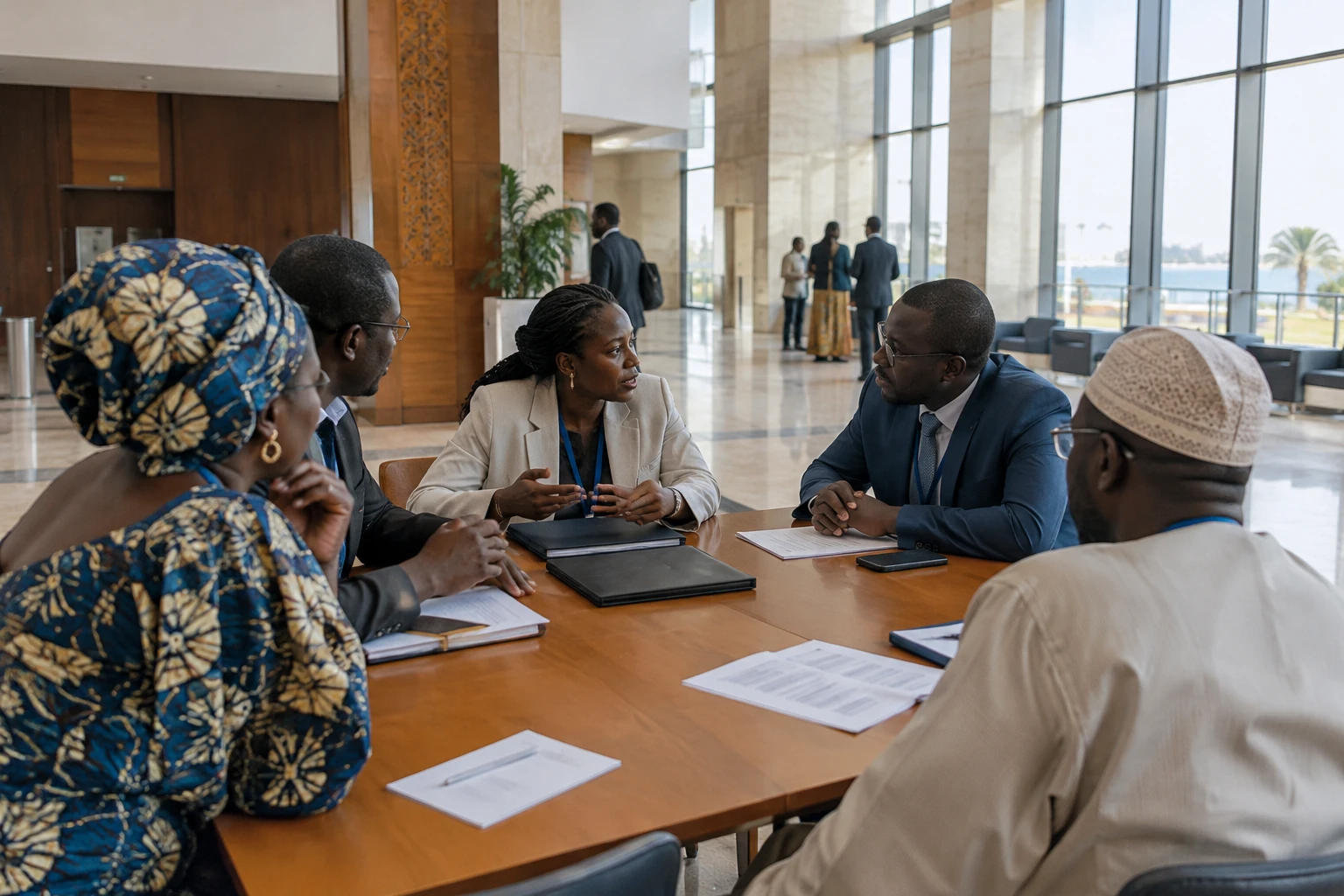
On 17 October 2026, in Dakar, the first ministerial session devoted to dialogue between the two organisations agreed to set up joint working groups. Their task is to prepare a framework cooperation agreement, with their conclusions to be presented at a future ministerial meeting. No date for that meeting has been announced.
The discussions were co-chaired by Cheikh Niang, Senegal’s Minister responsible for African Integration and Foreign Affairs, and Karamoko Jean-Marie Traoré, Burkina Faso’s Minister of Foreign Affairs and chair of the AES ministerial steering committee. The joint communiqué described the aim as building a “balanced” and “realistic” framework that safeguards the interests of the populations.
The meeting follows consultations held in Bamako on 22 May 2025. It does not bring the three countries back into ECOWAS or resolve political disagreements. Rather, it creates a channel for dialogue between two groupings that must manage shared issues despite their institutional separation.
Senegal’s foreign ministry presented the approach as gradual, intended to identify each side’s priorities before defining a partnership. The African Union Mission for Mali and the Sahel (MISAHEL) also said that the African Union was ready to facilitate future meetings. This supporting role could provide a framework for follow-up, without replacing decisions by the governments concerned.
Trade, mobility and security: practical issues
The first test is likely to be economic. An agreement will need to specify the treatment of goods, customs procedures and transit conditions. It will also need to clarify the status of travellers, workers and transporters. Without predictable rules, costs and delays risk varying from one border post to another.
Leaving ECOWAS does not automatically mean the end of all trade or monetary arrangements concerning these countries. Mali, Burkina Faso and Niger remain members of the West African Economic and Monetary Union (WAEMU), which shares a currency and economic rules, among other things, with several coastal states. This separate membership makes technical negotiations more complex: new provisions will have to align with regional commitments that have not all disappeared.
Security is also a shared interest. Armed violence and cross-border trafficking affect the central Sahel and can have an impact on coastal countries. Better information flows or coordination at borders could benefit both blocs. However, the Dakar communiqué sets out neither an operational mechanism nor intelligence-sharing arrangements. It would therefore be premature to present the meeting as the launch of an already defined security cooperation initiative.
The context is stark. According to figures from OCHA cited by the United Nations Office for West Africa and the Sahel, more than 5,800 security incidents were recorded across the region in 2025, causing nearly 16,000 deaths. These figures describe a regional situation and should not be attributed to any one country or a single cause. They nevertheless serve as a reminder that decisions taken in Dakar also affect civilian protection and access to transport routes.
The effects of any agreement would be uneven. Large companies can sometimes absorb delays or organise alternative routes. Independent transporters and cross-border vendors often have less room to manoeuvre. In regions far from the capitals, a closure or a new formality can restrict access to markets, services and income. The working groups will therefore need to examine not only the rules, but also how they are applied on the ground.
A test for West African integration
The significance of the dialogue extends beyond relations between ECOWAS and the AES. It tests the ability of African regional organisations to preserve useful mechanisms when their members disagree over governance, security or sanctions. For coastal countries, the challenge is to maintain reliable trade and corridors. For Sahelian states, it is to defend their political choices without isolating themselves from neighbouring markets.
The next step will be for ministers to examine the working groups’ proposals. The issues to watch are specific: the continuation of movement arrangements, the rules applying to goods, the treatment of transporters and possible arrangements for security cooperation. Until these points are set out in detail, the framework agreement will remain a negotiating objective, not a guarantee for traders and travellers.
The dialogue launched in Dakar recognises a simple reality: economic and human ties cross political borders. Its success will now depend on concrete rules, accepted by both sides and understandable to those who make their living from regional trade.