Algeria
 Egypt
 Libya
 Morocco
 Sudan
 Tunisia
 Benin
 Burkina Faso
 Cabo Verde
 Côte d'Ivoire
 Ghana
 Guinea
 Guinea-Bissau
 Liberia
 Mali
 Mauritania
 Niger
 Nigeria
 Senegal
 Sierra Leone
 The Gambia
 Togo
 Cameroon
 Central African Republic
 Chad
 DR Congo
 Equatorial Guinea
 Gabon
 Republic of the Congo
 São Tomé and Príncipe
 Burundi
 Comoros
 Djibouti
 Eritrea
 Ethiopia
 Kenya
 Madagascar
 Malawi
 Mauritius
 Mozambique
 Rwanda
 Seychelles
 Somalia
 South Sudan
 Tanzania
 Uganda
 Botswana
 Eswatini
 Lesotho
 Namibia
 South Africa
 Zambia
 Zimbabwe
Congolese rail at the heart of a strategic choice
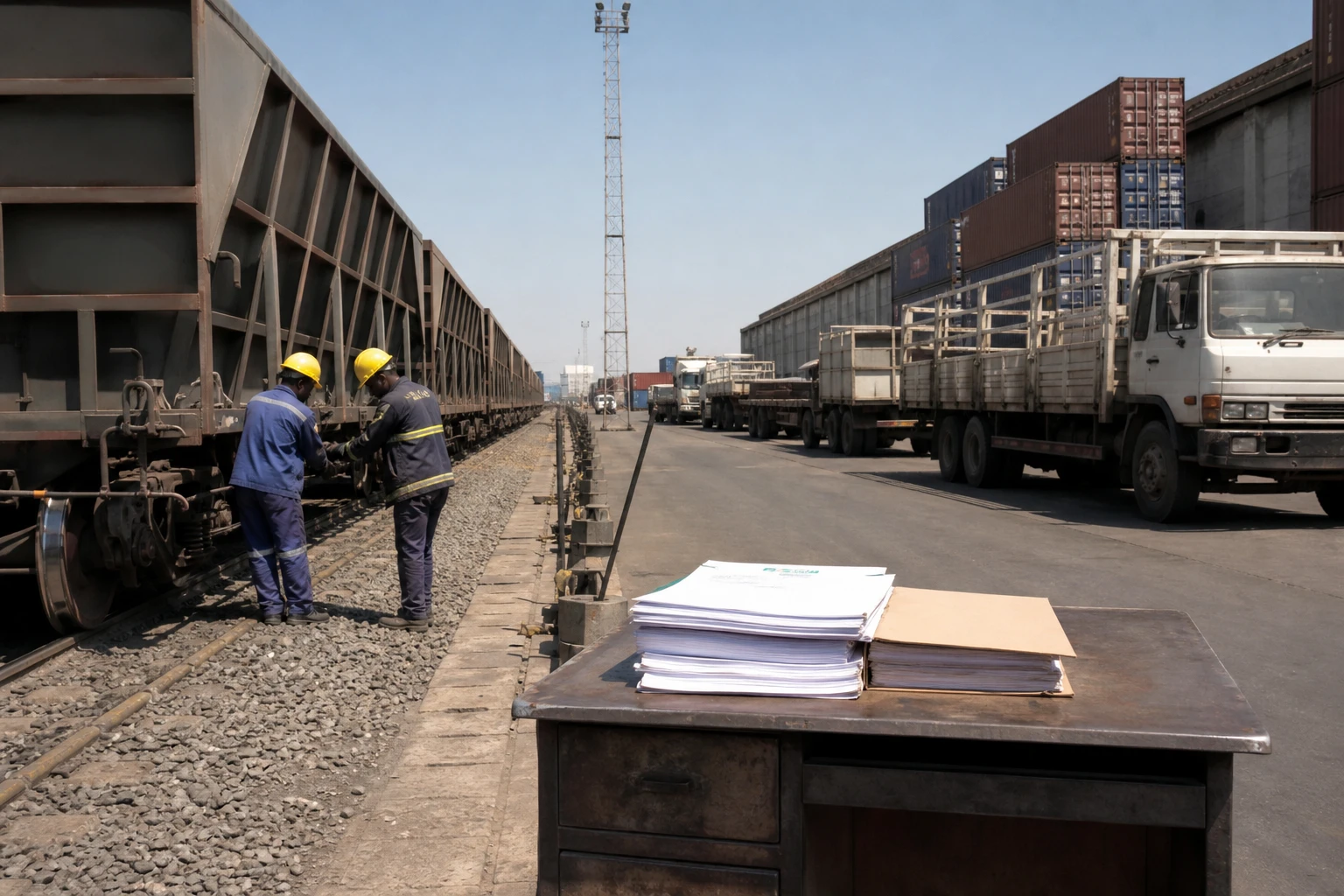
For the Democratic Republic of the Congo, the question is no longer just how to extract its minerals from the ground. It is also a matter of which routes they take out of the country, at what cost and under whose control. In the south-east, the Lobito corridor has become one of the few projects capable of directly linking Congolese production to the Atlantic Ocean, without using the continent’s longest routes.
This logistics choice has political significance. Kinshasa is seeking to make rail a tool of economic sovereignty, as the Congolese economy remains heavily dependent on mineral exports and transport costs. The government now presents the corridor as a lever for industrialisation, not merely as an export route.
What the agreement signed in Kinshasa provides for
On 26 August 2026 in Kinshasa, Presidents Félix-Antoine Tshisekedi Tshilombo and João Manuel Gonçalves Lourenço attended the signing of the concession contract for the Dilolo–Sakania railway line between the Congolese state and Mota-Engil Africa. The line spans 1,004.5 kilometres and serves Kolwezi, Tenke and Lubumbashi, among other places, before joining the Angolan network leading to the port of Lobito. The indicative investment amount is nearly US$1.258 billion.
The concession runs for 30 years. At its end, the infrastructure is to revert to the Congolese state. The contract also provides for the DRC to hold at least a 10% stake in the company responsible for the project, as well as a royalty equivalent to 7.5% of annual gross turnover. According to the Congolese presidency, the concessionaire will bear the financing and traffic risks, with no sovereign guarantee or state operating subsidy.
The Portuguese group is no stranger to the project. It is already involved in the Angolan section of the Lobito corridor through Lobito Atlantic Railway, a consortium formed with Trafigura and Vecturis. Meanwhile, the African Development Bank confirmed support in early August for the Zambian phase of the same corridor, a sign that the route is now progressing through coordinated national segments.
Why this corridor changes the picture for south-eastern Congo
The main issue is not symbolic. It is practical. The Congolese government wants to reduce the delays and costs weighing on copper and cobalt exports. In its communications, Kinshasa says the corridor is also intended to serve agricultural products, industrial inputs, hydrocarbons, consumer goods and passengers. The project therefore extends beyond the mines of Lualaba and Haut-Katanga.
The Congolese authorities have already laid out the political framework for this ambition. In April 2026, Prime Minister Judith Suminwa Tuluka said the corridor should “benefit the population”, create jobs and be based on public-private partnerships. She also noted that the project had entered an operational phase, with several works launched on strategic sections on both the Congolese and Angolan sides.
The corridor also addresses a familiar constraint for mining operators in south-eastern Congo: dependence on long and costly logistics chains. The Congolese Ministry of the Budget estimates that the Lobito route extends for 1,081 kilometres within the country, with branches such as Grae Munana–Kipushi and Kiala–Kamoa. The difference in scope compared with the main line is explained by the addition of branch lines and feeder routes.
The authorities also cite time and cost savings, pointing to faster transport to the Atlantic and a significant reduction in logistics costs. These projections remain working estimates, dependent on the network’s actual capacity, interoperability with Angola and the quality of maintenance. The main challenge will be turning the announcement into a regular service.
A regional project, but also a test of governance
The Lobito corridor forms part of a broader framework. It links Angola, the DRC and Zambia, in the heart of central and southern Africa. The African Development Bank describes it as an integrated regional initiative intended to connect transport, trade, agriculture, energy and institutional capacity. At continental level, this kind of infrastructure also aligns with the logic of the African Continental Free Trade Area, which requires genuinely functional corridors to give substance to African trade.
But a corridor is only as strong as its weakest links. Rail interoperability between the DRC and Angola, the harmonisation of standards, smooth passage at the Dilolo–Luau border post and tariff transparency will be decisive. The Congolese presidency has also announced a joint monitoring mechanism to coordinate railway maintenance and operations. Without it, transhipment delays could absorb some of the expected gains.
Mining operators already tied to other logistics routes will also need to be convinced. In the south-east, several players have built their practices around established networks, sometimes oriented towards other regional interests. Lobito will therefore have to offer more than a political promise: measurable reliability, regularity and competitiveness. The project’s economic credibility will be decided there.
For Kinshasa, the stakes go beyond rail. The government wants to show that it can negotiate major contracts without relinquishing strategic control of infrastructure. The message to the rest of the continent is clear: African corridors must no longer serve only raw-material exports, but should structure value chains, jobs and local revenues. The Lobito corridor is thus as much a test of governance as a railway project.