Algeria
 Egypt
 Libya
 Morocco
 Sudan
 Tunisia
 Benin
 Burkina Faso
 Cabo Verde
 Côte d'Ivoire
 Ghana
 Guinea
 Guinea-Bissau
 Liberia
 Mali
 Mauritania
 Niger
 Nigeria
 Senegal
 Sierra Leone
 The Gambia
 Togo
 Cameroon
 Central African Republic
 Chad
 DR Congo
 Equatorial Guinea
 Gabon
 Republic of the Congo
 São Tomé and Príncipe
 Burundi
 Comoros
 Djibouti
 Eritrea
 Ethiopia
 Kenya
 Madagascar
 Malawi
 Mauritius
 Mozambique
 Rwanda
 Seychelles
 Somalia
 South Sudan
 Tanzania
 Angola
 Botswana
 Eswatini
 Lesotho
 Namibia
 South Africa
 Zambia
 Zimbabwe
When the response must outrun the virus
In eastern Democratic Republic of the Congo, every hour counts. When an outbreak spreads in hard-to-reach areas, one question outweighs all others: can scientific tools arrive soon enough to save lives, even as transmission continues? The Ebola disease outbreak caused by the Bundibugyo virus, active since 15 May 2026, has put this urgency back at the heart of the Congolese health response.
The picture extends beyond Ituri province alone. North Kivu, South Kivu, Haut-Uélé and Tshopo provinces are also affected, in an environment marked by insecurity, population displacement and cross-border movement with Uganda and South Sudan. At continental level, Africa CDC has classified the outbreak as a continental public health emergency, while the WHO has declared it a public health emergency of international concern.
Trials begin before the scientific verdict
Research is advancing on two fronts. On prevention, the University of Oxford launched the first phase I trial of a Bundibugyo vaccine in Oxford on 13 July, to assess safety and the immune response in 50 healthy adults aged 18 to 55. The trial has already vaccinated its first volunteer, on 24 July.
The work under way in the UK is part of a wider effort, accelerated by advance preparation. The WHO recommended the evaluation of vaccine and treatment candidates as early as late May, noting that no licensed vaccine or specific treatment existed for this strain. It then identified a single-dose rVSV Bundibugyo vaccine among the priority options and stressed that it would still be months before a candidate was ready for broader clinical evaluation.
Meanwhile, information published in Canada and reported by Reuters indicates that a second vaccine candidate from Moderna has entered phase I in the country. On 4 August, the company announced that the first participants had been vaccinated in a Canadian trial of its mRNA-1469 candidate against Bundibugyo. Phase I trials do not yet show whether a vaccine really protects people: they first assess tolerability, dosage and the immune response.
In DR Congo, treatments are being tested at patients’ bedsides
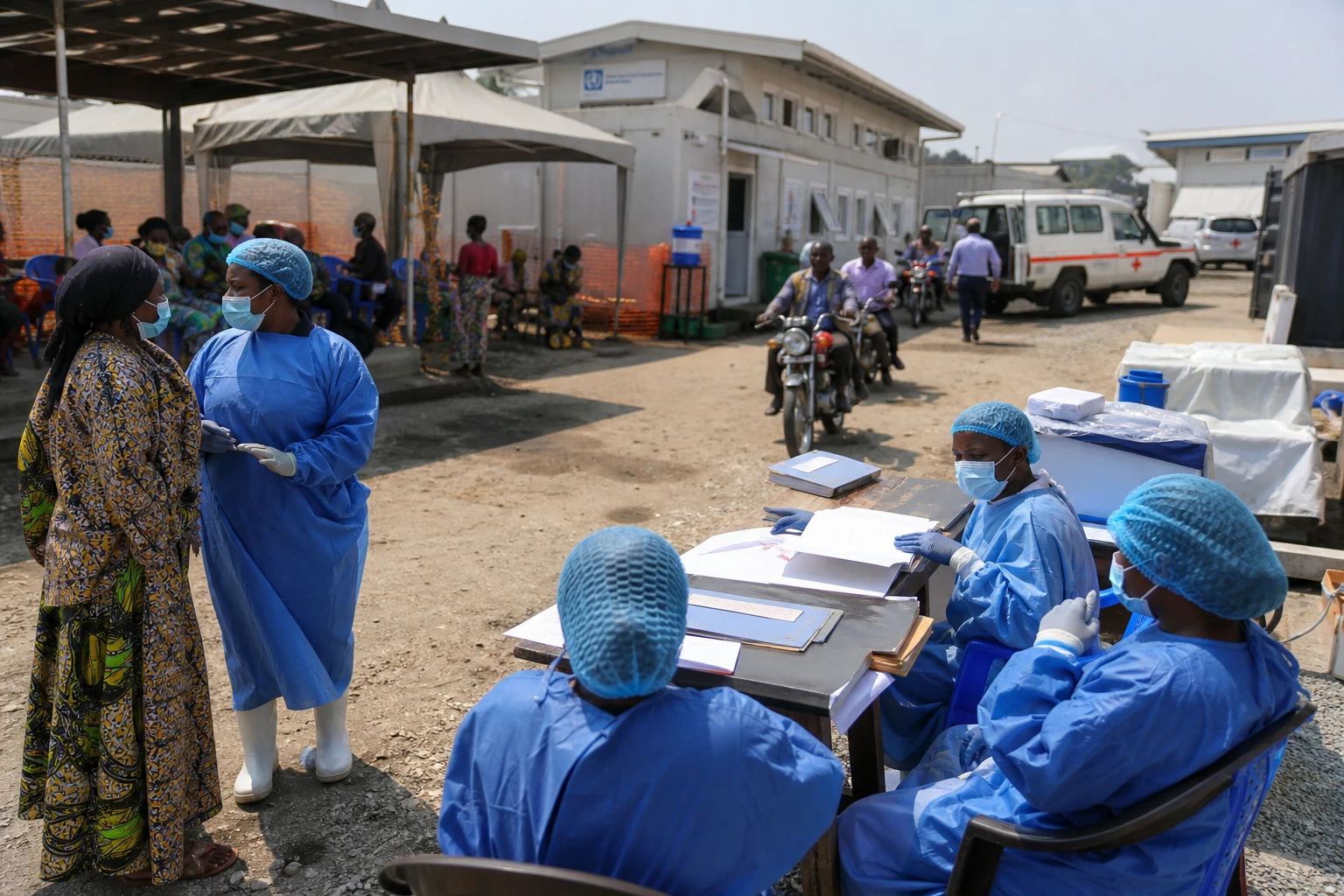
The most decisive work is taking place in the DRC, close to patients. On 2 July, the WHO confirmed that enrolment of patients had begun in the PARTNERS trial, conducted at Congolese facilities. The trial compares two antivirals, the monoclonal antibody MBP134 and remdesivir, to establish whether they improve survival among people diagnosed with the disease.
This approach is essential because the disease continues to affect patients who arrive late at healthcare facilities. In several response alerts, health authorities have reported a high proportion of deaths in the community before patients receive care. In other words, the later the diagnosis, the faster the window for enrolling a patient in a treatment protocol closes.
The main obstacle is not only scientific. It is logistical. To enrol a patient in a trial, the diagnosis must be confirmed, a trained team must be available, clinical follow-up must be provided and data must be collected. The WHO says the limited number of centres able to implement the protocol remains a major challenge on the ground.
Another trial concerns post-exposure prophylaxis, a treatment given after probable exposure to the virus to reduce the risk of disease. The WHO said obeldesivir, an oral antiviral, had been selected as a priority candidate for this strategy. This approach nevertheless depends on effective contact tracing, which remains difficult in some affected areas of eastern Congo.
The figures show the pressure on the ground
The response depends first and foremost on speed. Yet monitoring indicators show gaps in the net. As of 3 August, health authorities had recorded 18,243 contacts in the five affected provinces, but only 14,300 had been followed up, or 78.4%. This remains well below the operational threshold of 95% cited by response teams. Coverage varies by province, and is lower in Haut-Uélé than in Ituri or Tshopo.
Geography makes the response even more difficult. The WHO situation reports show the outbreak continuing to spread in July, with 46 health zones affected across five provinces. Ituri accounts for most cases, while North Kivu, Haut-Uélé, Tshopo and South Kivu remain affected. The WHO says transmission remains high and the risk of regional spread is still elevated because of movement corridors.
The operational response therefore remains conventional but essential: isolation, supportive care, infection prevention and control, contact tracing, safe and dignified burials, and community engagement. The WHO is clear: there is still no authorised vaccine or validated specific treatment for Bundibugyo.
A crisis that extends beyond Congo’s borders
This sequence says much about African public health in 2026. On the one hand, science is advancing faster than before because protocols were ready ahead of the first cases. On the other, real-world effectiveness depends on a very practical network: roads, laboratories, treatment centres, community trust, coordination between neighbouring states and rapid data-sharing. Eastern DRC is thus becoming a full-scale test of regional health cooperation.
The ministerial meeting held in Kampala on 22 and 23 May by the DRC, Uganda and South Sudan illustrates this reality. The response cannot stop at the border. It also depends on surveillance posts, the movement of teams and the flow of information. For Kinshasa, the stakes are public health; for the eastern provinces, they are also social and economic; for the Great Lakes region, the outbreak has become a matter of continental health security.
The coming weeks will show whether clinical trials can gain ground against transmission. The first data from the phase I vaccine trials will take time. In the meantime, the fight will be waged mainly in treatment centres, by field teams and through the ability to follow up contacts quickly before they disappear along eastern Congo’s movement corridors.