Algeria
 Egypt
 Libya
 Morocco
 Tunisia
 Benin
 Burkina Faso
 Cabo Verde
 Côte d'Ivoire
 Ghana
 Guinea
 Guinea-Bissau
 Liberia
 Mali
 Mauritania
 Niger
 Nigeria
 Senegal
 Sierra Leone
 The Gambia
 Togo
 Cameroon
 Central African Republic
 Chad
 DR Congo
 Equatorial Guinea
 Gabon
 Republic of the Congo
 São Tomé and Príncipe
 Burundi
 Comoros
 Djibouti
 Eritrea
 Ethiopia
 Kenya
 Madagascar
 Malawi
 Mauritius
 Mozambique
 Rwanda
 Seychelles
 Somalia
 South Sudan
 Tanzania
 Uganda
 Angola
 Botswana
 Eswatini
 Lesotho
 Namibia
 South Africa
 Zambia
 Zimbabwe

A discreet corridor with highly visible consequences
In Darfur, the war is not being fought only on the front lines. It is also fuelled by air routes, shell companies and cross-border recruitment, making the conflict harder to contain. In western Sudan, every undeclared aircraft, opaque logistics network and fighter arriving from abroad affects the military balance, as well as civilian security.
The issue has particular significance because it concerns Khartoum as much as the country’s periphery. When a territory such as Darfur slips beyond the effective control of the state, it becomes a foothold for networks that extend beyond Sudan’s borders. The Sudanese conflict, which began in April 2023 between the army and the Rapid Support Forces, has already shown how regional alliances, routes and funding can prolong a war.
What the initial corroborated evidence shows
Documents examined by UN investigators describe a chain of support linking Sudan to several countries. It involves air movements that are difficult to track, security and logistics companies, and foreign fighters, mostly Colombians. Security Council experts have already documented, in an earlier report, the presence of armed elements from other countries alongside the RSF in Darfur, notably from Chad, the Central African Republic and other regional crossing points.
The 2025 UN report on the Central African Republic goes further on this point. It notes that members of Central African armed groups worked as mercenaries in Sudan, and that these flows served as a source of funding for armed networks active in the east of the country. The same document mentions movements towards Nyala, in South Darfur, and reinforcements used in attacks on El-Fasher, in North Darfur.
In the United States, the Treasury sanctioned a network in April 2026 accused of recruiting and deploying former Colombian soldiers to fight alongside the RSF. Human Rights Watch later said, in May 2026, that a company based in Abu Dhabi had reportedly recruited Colombian military contractors, who passed through Emirati bases before being deployed to Sudan. These elements do not in themselves prove the existence of a single, centralised chain, but they point to the same reality: the Sudanese war is attracting transnational operators adept at evading controls.
Darfur, a testing ground for evasion
Darfur has been subject to an arms embargo since 2004, renewed by the Security Council and monitored by the UN Panel of Experts. The measure was intended to limit the supply of military equipment to non-state actors and reduce the intensity of fighting. In practice, it has faced porous borders, smuggling and the movement of armed personnel outside official channels for years.
The latest observations offer an idea of how the system operates. According to evidence gathered by the experts, aircraft were spotted in N’Djamena as early as November 2024, without appearing on the best-known flight-tracking platforms. Night flights are then said to have linked the Chadian capital to Nyala, with stopovers or diversions via Kufra, in south-eastern Libya. This part of the network relies on discretion: the less visible a flight is, the more useful it becomes to a shadow war.
Chad, for its part, says it did not authorise the Boeing aircraft cited in the dossier to operate from its territory. This clarification matters. It highlights the difference between a civilian air corridor and movements that may use regional routes without neighbouring states controlling every stage. The Sudanese conflict thus extends beyond Darfur’s borders and places neighbouring countries in a grey area where aviation security, sovereignty and diplomacy intersect.
Why this case changes how the Sudanese war is understood
The issue goes beyond the question of mercenaries. If foreign fighters, drone specialists and clandestine air routes are supporting the RSF, then the balance of power on the ground no longer depends solely on Sudanese resources. It also depends on private intermediaries, transit countries, security companies and a logistics ecosystem capable of treating war as a market.
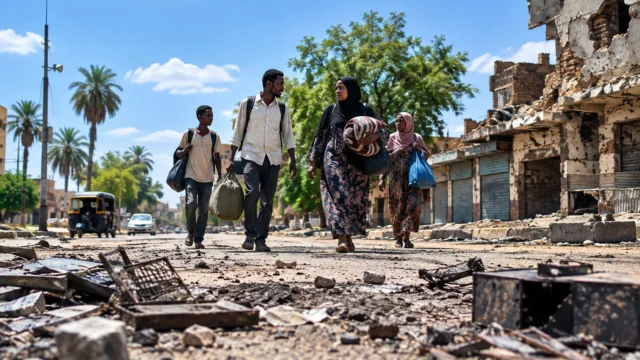
For the people of Darfur, the consequences are immediate. The more a war is sustained from afar, the longer it lasts. And the longer it lasts, the heavier the price paid by civilians: forced displacement, destruction, food restrictions, sexual violence and the disappearance of basic services. The UN report cites the fall of El-Fasher as a major turning point in the battle for Darfur. The city, the Sudanese army’s last major stronghold in the region before it was captured, endured months of siege, air strikes and urban fighting.
Sudanese authorities and several human rights organisations have also alleged abuses after the city was taken, including massacres, sexual violence and abductions. In its February 2026 fact-finding mission, the UN had already concluded that some operations in Darfur may have displayed the characteristics of a planned genocidal campaign. This characterisation remains politically and legally sensitive, but it illustrates the gravity of the alleged acts.
A pan-African impact, far beyond Sudan
This case also speaks to Central Africa, the Sahel and the Horn of Africa. It is a reminder that contemporary conflicts are increasingly interconnected. Recruitment in Bangui, a discreet flight to Nyala, a logistics base in Abu Dhabi or a passage through Chad can fuel a war that destabilises an entire region. The Security Council has already noted this in relation to the Central African Republic: mercenaries and cross-border networks create “ripples” of instability at local, national and regional levels.
From this perspective, Sudan is not merely a theatre of war. It is also a hub for the movement of people, weapons, funding and military expertise. That is what gives the case its continental significance. If control mechanisms remain weak, other African conflicts could be fuelled in the same way, by operators exploiting gaps between states, borders and regulations.
What needs to be watched now is not only the continuation of the fighting in Darfur. It is also the ability of the United Nations, neighbouring states and African institutions to close the routes that enable war to be financed, fighters recruited and forces moved. As long as these networks remain open, the battle for Nyala will not stay in Nyala. Its effects will continue to spread far beyond Sudan.