
 Algeria
 Egypt
 Libya
 Morocco
 Sudan
 Tunisia
 Benin
 Burkina Faso
 Cabo Verde
 Côte d'Ivoire
 Ghana
 Guinea
 Guinea-Bissau
 Liberia
 Mali
 Mauritania
 Niger
 Nigeria
 Sierra Leone
 The Gambia
 Togo
 Cameroon
 Central African Republic
 Chad
 DR Congo
 Equatorial Guinea
 Gabon
 Republic of the Congo
 São Tomé and Príncipe
 Burundi
 Comoros
 Djibouti
 Eritrea
 Ethiopia
 Kenya
 Madagascar
 Malawi
 Mauritius
 Mozambique
 Rwanda
 Seychelles
 Somalia
 South Sudan
 Tanzania
 Uganda
 Angola
 Botswana
 Eswatini
 Lesotho
 Namibia
 South Africa
 Zambia
 Zimbabwe
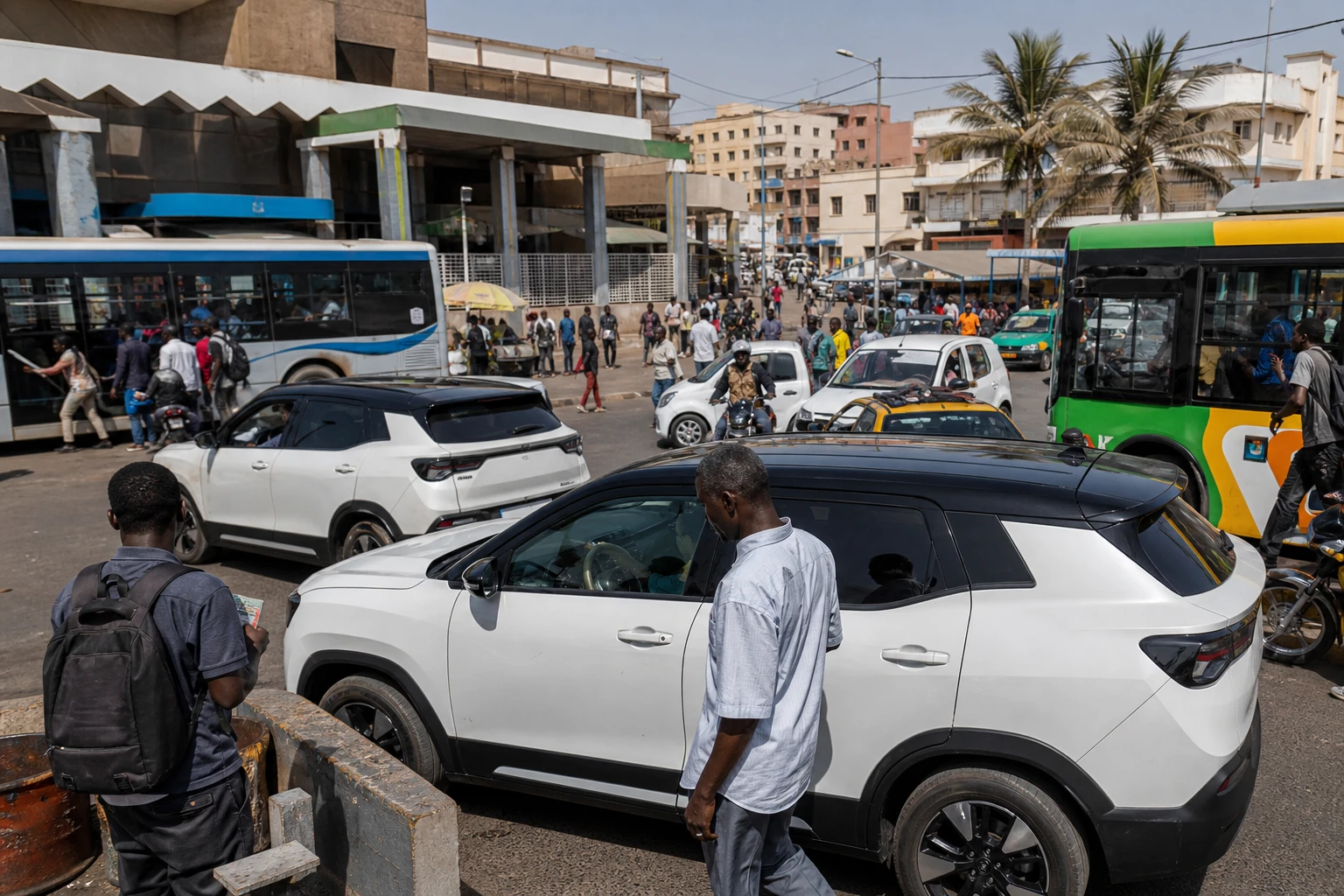
In Dakar, the debate over electric taxis now goes beyond pollution. In a city where traffic congestion pushes many people towards two-wheelers, the new fleet will have to prove it can offer a reliable, safe and affordable service.
First batch puts a new model to the test
The Land Transport Development Fund (FDTT) received 100 electric taxis in Dakar on Thursday 24 September 2026. The delivery is the first stage of a programme announced for 1,000 vehicles, run in partnership with the Bank for Trade and Industry (BCI).
The scheme aims to gradually renew Senegal’s taxi fleet. It combines financing, support for industry professionals and training. The National Office for Vocational Training (ONFP) is also involved in the driver skills component.
According to programme officials, the total investment amounts to 13 billion CFA francs. The announced timetable envisages a gradual ramp-up. The FDTT and BCI say 700 taxis will be delivered before the end of 2026, followed by a further 300 vehicles by 31 December 2027 at the latest.
Other public statements, however, refer to a target of 1,000 vehicles as early as the first quarter of 2027. The promoters will need to clarify this difference in timing. For passengers, the key issue is that the vehicles actually enter service, rather than the timetable being announced.
The taxis on display are equipped with air conditioning, safety systems and geolocation devices. Their stated range exceeds 400 kilometres. This should be enough for a working day under normal conditions, subject to the availability of charging points and the time needed to recharge.
A potential alternative to two-wheeler journeys
In Dakar, motorbikes and other two-wheelers meet a practical need. They weave through heavy traffic and can sometimes cut journey times. This flexibility explains their growing presence in daily travel.
Their expansion nevertheless raises several questions. Registration, helmet use, insurance, driver training and compliance with the Highway Code remain major concerns. The issue also involves passenger protection and the identification of operators.
Available data show that accidents involving two-wheelers are not a recent phenomenon. In 2014, the National Fire Brigade recorded 5,521 accidents involving these vehicles out of 12,547 road accidents that required its intervention.
The same report recorded 6,023 victims, including 109 deaths at the scene. In Dakar, 1,827 accidents involving two-wheelers were registered, with 30 deaths and 2,262 injuries. These figures date from 2014. They therefore cannot measure the current situation, but they highlight how long road safety has been an issue.
In this context, electric taxis could become an intermediate solution. They retain the flexibility of individual transport while operating within a more visible professional framework. However, they will replace motorcycle taxis only if the network is sufficiently extensive and fares remain within users’ means.
Operating costs will be decisive
For drivers, the economic case is central. The spokesperson for the first beneficiaries says that a total journey of 450 kilometres would cost about 5,000 CFA francs in energy with an electric taxi. He compares this with nearly 30,000 CFA francs a day in fuel for an older combustion-engine vehicle.
These figures come from statements made at the launch ceremony. They will need to be verified over time. Actual consumption will depend on the model used, traffic, air conditioning, electricity prices and charging conditions.
Profitability will also depend on maintenance. An electric fleet requires trained technicians, available spare parts and a reliable charging network. Without this infrastructure, downtime and waiting times could eat into the promised savings.
For operators, financing is therefore as important as the vehicles themselves. The mechanism presented by the FDTT and BCI is intended to ease access to credit and provide operators with security. The programme’s success will depend on drivers’ ability to meet their repayments while keeping fares affordable.
A reform extending beyond the capital
The project is part of the broader modernisation of urban transport in Senegal. Dakar faces the greatest pressure on its roads, but mobility needs are also growing in the country’s other urban centres.
The capital already has to contend with congestion, population growth and the coexistence of several networks. Taxis, buses, shared transport vehicles and two-wheelers all compete for limited space. The expansion of electric vehicles will not resolve these pressures, but it could help make services clearer and more comfortable.
The programme will also have to fit alongside other transport policies. Dakar’s Bus Rapid Transit, bus networks and fleet renewal projects cannot operate in isolation. The challenge is to organise straightforward connections between mass public transport and local taxi services.
The regional dimension is also important. Senegal belongs to the Economic Community of West African States (ECOWAS), which is seeking to strengthen trade and movement across West Africa. Electric mobility could create new needs in areas including standards, maintenance, training and regional supply.
Conditions for success
To have a real impact, the 1,000 announced taxis will need to be visible in areas where demand is greatest. Concentrating them in a few central districts would limit their usefulness and deepen inequalities in access.
Fares will be just as decisive. A modern vehicle will not become an alternative to motorcycle taxis if its fares remain beyond the means of workers, students and households in Dakar’s outskirts.
Finally, electrification does not remove the need for a road safety policy. It must go hand in hand with the registration of two-wheelers, driver training, vehicle inspections and enforcement of the Highway Code.
The first 100 taxis therefore amount to a large-scale trial. Senegal will now have to measure their availability, actual cost, usage and impact on travel. Only then can electric mobility become a lasting response to Dakar’s transport difficulties, rather than a mere technology showcase.



