
 Algeria
 Egypt
 Libya
 Morocco
 Sudan
 Tunisia
 Benin
 Burkina Faso
 Cabo Verde
 Côte d'Ivoire
 Ghana
 Guinea
 Guinea-Bissau
 Liberia
 Mali
 Mauritania
 Niger
 Nigeria
 Sierra Leone
 The Gambia
 Togo
 Cameroon
 Central African Republic
 Chad
 DR Congo
 Equatorial Guinea
 Gabon
 Republic of the Congo
 São Tomé and Príncipe
 Burundi
 Comoros
 Djibouti
 Eritrea
 Ethiopia
 Kenya
 Madagascar
 Malawi
 Mauritius
 Mozambique
 Rwanda
 Seychelles
 Somalia
 South Sudan
 Tanzania
 Uganda
 Angola
 Botswana
 Eswatini
 Lesotho
 Namibia
 South Africa
 Zambia
 Zimbabwe
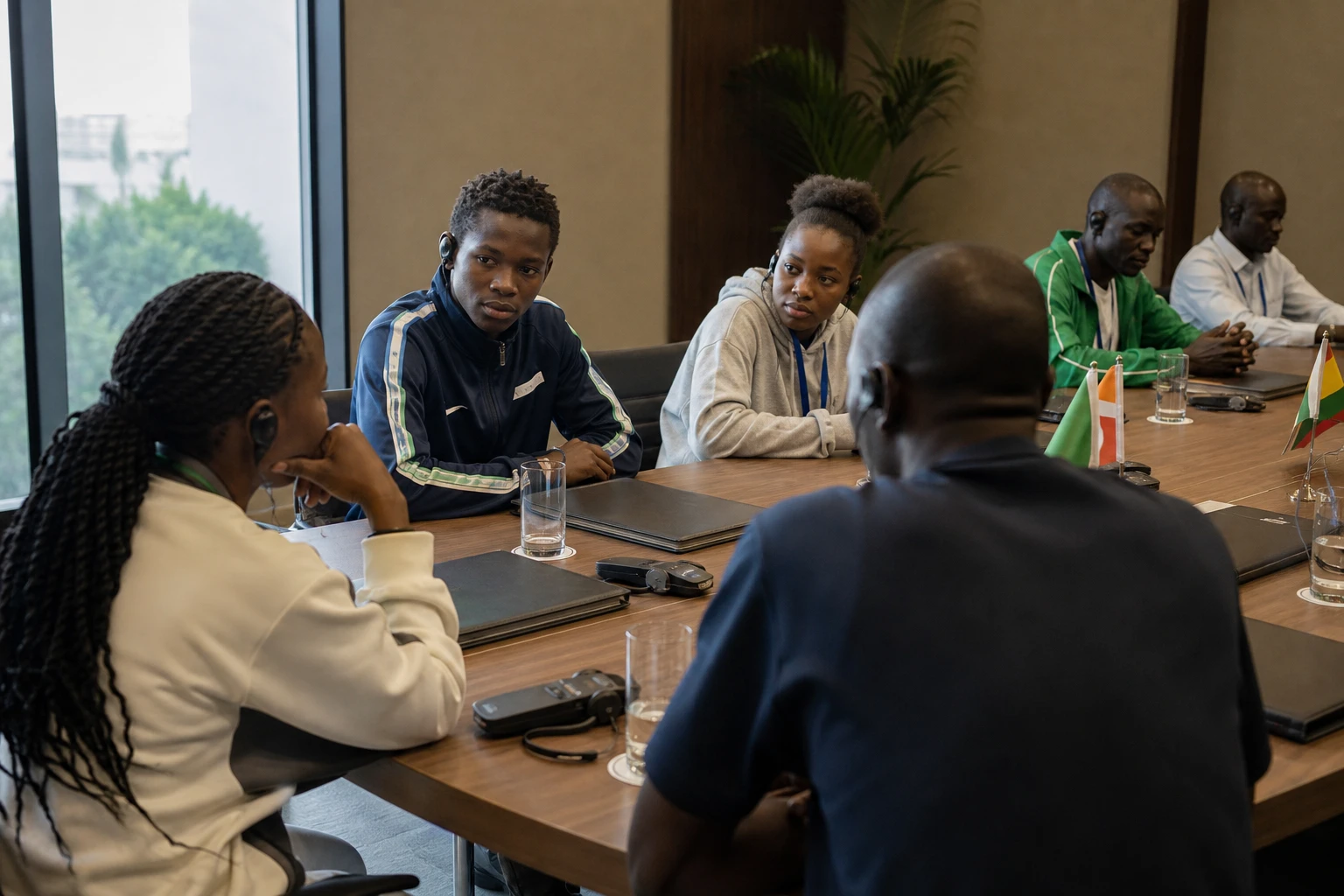
In Dakar, passing on experience will take its place alongside competition. From 31 October to 13 November 2026, the Youth Olympic Games will bring together athletes aged 15 to 18 in Senegal, many of them facing international exposure for the first time. To support them, several African champions will step away from competing to become guides, sounding boards and role models.
The “Athletes Role Models” programme is based on a simple idea: a young athlete listens differently to someone who has already experienced selection, injuries, defeats and the pressure of major events. The International Olympic Committee’s programme provides for discussions with participants, training visits, educational activities and meetings on mental preparation or career development. Selected athletes must be present in Dakar 2026 for at least five days. The official framework for the Athlete Role Model programme also states that their involvement may continue after the Games.
A first Olympic event for the continent
Dakar 2026 will not be an ordinary edition. It will be the first Olympic sporting event held on African soil. Competitions will take place in Dakar, Diamniadio and Saly. This gives the Games national and regional significance, in a West Africa where participation in sport often remains dependent on limited resources, individual pathways and community networks.
Senegal is hosting the Games as it seeks to build a more structured pipeline of sporting talent. The country has a strong culture of football, wrestling and basketball. It is also looking to raise the profile of less visible disciplines, such as canoe slalom, fencing, swimming and archery. Dakar 2026 is therefore intended to serve as an international stage, but also as a springboard for Senegalese and West African federations.
The regional dimension is important. Senegal belongs to the Economic Community of West African States, ECOWAS, which facilitates cooperation among 15 countries in the region. Young participants will not be coming only to seek a result. They will enter a space for encounters where sporting experience, languages and training methods can circulate across borders.
African champions take on a new responsibility
Ruth Gbagbi embodies this passing from one generation to the next particularly well. The Ivorian taekwondo athlete was 16 when she competed at the first Youth Olympic Games, in Singapore in 2010. She went on to compete at four editions of the Olympic Games and win two bronze medals, in Rio in 2016 and Tokyo in 2021.
In Dakar, her experience will therefore not be measured solely by the number of medals she has won. She can talk about the change in status, the pressure that comes with Olympic selection and how to sustain a career in a demanding sport. Her appointment as an Athlete Role Model was reported by the African Taekwondo Union and Ivorian media.
Kaylia Nemour brings a different story. At 17, the Algerian gymnast won the Olympic title on the uneven bars in Paris in 2024. Her victory made history for African gymnastics at the Olympic Games. It showed that a very young athlete can reach the world’s summit quickly, provided they have strong technical, medical and psychological support.
Her role with Dakar’s participants will, however, go beyond celebrating an achievement. Young gymnasts will be able to ask her about daily repetition, risk management and the concentration required in a discipline where the smallest mistake can change an entire ranking. World Gymnastics has confirmed her participation in the Athlete Role Model programme.
Nigeria’s Blessing Oborududu represents another path. A four-time Olympian, she won silver in Tokyo in 2021 in the under-68kg category. She brings young wrestlers experience built over time, through training cycles, changes in weight category and the particular demands of an international career.
Senegal at the heart of the programme
The host country will be represented in particular by Jean-Pierre and Yves Bourhis. Jean-Pierre competed at the Rio 2016 and Tokyo 2021 Games in canoe slalom. His brother Yves followed him at the highest level. In Paris in 2024, he reached the canoe slalom final and finished 12th.
The performance drew attention in Senegal. The Senegalese Press Agency reported that the athlete had hoped to win a medal for his country. His journey can speak to young competitors about a reality often absent from ceremonies: reaching a final is already an achievement, even when the podium remains out of reach.
The presence of six Senegalese athletes in the group of role models also gives particular visibility to careers built in Dakar. It allows local participants to meet athletes who understand the realities of the country, the constraints of travel, disparities in access to equipment, and the need to balance training, studies and family responsibilities.
Beyond medals, the questions that matter
The other announced athletes come from several regions of the continent. Uganda will be represented by 800-metre world champion Halimah Nakaayi and swimmer Jamila Lunkuse. Egypt will include Dina Meshref, Doaa Elghobashy, Jomana Elsaiy and Yasser Hefny, among others. Kenya’s Sheila Chajira and Ghana’s Forrester Osei are also among those selected.
Their value will lie in addressing subjects rarely seen during a final. How do you come back after an injury? How do you respond to defeat? How do you protect your mental health when results become an obligation? How do you continue your studies when competitions require long periods of travel? These questions directly concern the teenagers who will be in Dakar.
Halimah Nakaayi knows the tension between education and sport. After competing at the Youth Olympic Games in Singapore, she continued her studies and earned a degree in computer science before becoming world champion in 2019. Her journey is a reminder that a sporting career should not confine young people to a single identity.
The programme does not automatically guarantee a lasting influence. Its effectiveness will depend on the time given to discussions, the champions’ actual availability and federations’ ability to continue support after November 2026. Passing on experience cannot replace infrastructure, trained coaches or regular access to competitions.
But Dakar 2026 offers a concrete opportunity: to bring together a generation just starting out and another that has already passed through the main stages of elite sport. For Senegal, the challenge will be to make these encounters part of its sporting legacy. For Africa, it will be to show that its champions are not only faces of success. They can also pass on expertise, discipline and collective confidence.



