Algeria
 Egypt
 Libya
 Morocco
 Sudan
 Tunisia
 Benin
 Burkina Faso
 Cabo Verde
 Côte d'Ivoire
 Ghana
 Guinea
 Guinea-Bissau
 Liberia
 Mali
 Mauritania
 Niger
 Nigeria
 Sierra Leone
 The Gambia
 Togo
 Cameroon
 Central African Republic
 Chad
 DR Congo
 Equatorial Guinea
 Gabon
 Republic of the Congo
 São Tomé and Príncipe
 Burundi
 Comoros
 Djibouti
 Eritrea
 Ethiopia
 Kenya
 Madagascar
 Malawi
 Mauritius
 Mozambique
 Rwanda
 Seychelles
 Somalia
 South Sudan
 Tanzania
 Uganda
 Angola
 Botswana
 Eswatini
 Lesotho
 Namibia
 South Africa
 Zambia
 Zimbabwe
A sporting symbol and an organisational test
In Dakar, the Olympic flame is more than a ritual object. It says something broader: the place Senegal wants to occupy, and the ability of a West African country to host a global event without reducing it to the logistics of spectacle. For Senegalese people, the stakes go beyond sport. They concern the country’s image, the mobilisation of its regions and the legacy left to young people after the Games.
The context matters. Senegal is administratively divided into 14 regions, and it is these regions that the torch relay is set to cross. In a country where Dakar attracts much of the media, economic and institutional attention, the national torch tour also serves as a reminder that the event must not be confined to the capital and its outskirts.
The Dakar 2026 Youth Olympic Games will be the first Olympic Games ever held on the African continent. The IOC describes them as a historic moment for the Olympic movement, with the flame due to arrive in Dakar on 12 September and the opening ceremony scheduled for 31 October 2026. The official schedule lists 2,700 athletes, 35 sports and 151 events, putting Dakar 2026 among the major international sporting occasions.
From the Panathenaic Stadium to Senegal’s roads
The proceedings began in Athens, at the Panathenaic Stadium, where Olympic tradition gives the flame its symbolic significance. Senegal officially received the torch at a ceremony attended by representatives of the IOC and the Dakar 2026 organising committee, as well as a Senegalese delegation led by Youth and Sports Minister Djirèye Clotilde Coly. The flame was then placed in a lantern for transport to Dakar.
There is a discrepancy between public announcements over the timing, but it does not alter the overall course: the national relay was due to begin around 12 September, with an official presentation in Dakar before a tour of the country’s 14 regions. Official Senegalese and Olympic sources agree on a national route lasting about a month and a half, running until 30 or 31 October, depending on the wording, just before the Games open.
The organising committee says there will be about 450 torchbearers. They include athletes, young talents, civil society figures and well-known names such as Omar Sy, Khaby Lame, Amadou Dia Bâ, Amadou Gallo Fall and Isabelle Sambou. This is no decorative choice. It reflects a desire to make the relay a collective story, featuring people from sport, culture and communities across the country.
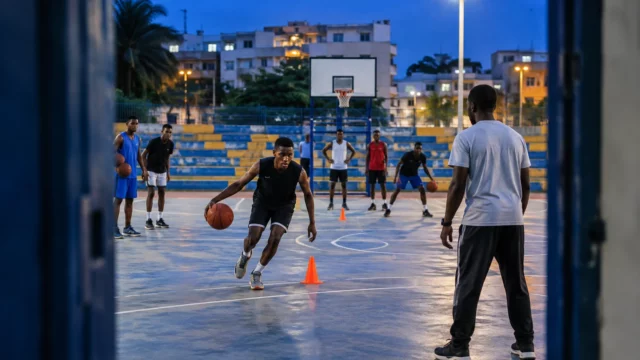
The tour is due to start in Dakar-Plateau, before the flame travels across Senegal. The programme announced in April envisages 30 stops across the 14 regions. The Senegalese state is also emphasising the material legacy, with multi-purpose neighbourhood sports grounds in Dakar, Diamniadio and Saly, as well as festivals and fan zones to bring the event to communities across the country.
What Dakar 2026 says about Senegal and Africa
For Senegal, the challenge is twofold. On the one hand, it must deliver on security, transport, hospitality and coordination between the state, the organising committee and local authorities. On the other, it must turn the event into a lasting catalyst. The authorities want to link the Games to young people, local sports facilities and the national vision for transformation. This is the most sensitive part: a major event leaves a useful legacy only if it goes beyond a one-off celebration.
This perspective is particularly important in a country that belongs to the West African Economic and Monetary Union and is a member of ECOWAS, where mobility, youth and infrastructure trends play out at a regional level. Dakar 2026 could therefore become a sporting showcase, but also a testing ground for public policy: decentralisation, young people’s access to sport, the development of event-related professions and the projection of an African image of competence rather than mere hosting.
President Bassirou Diomaye Faye has also stressed this continental dimension. At the unveiling of the mascot AYO, he described Dakar 2026 as a national priority and a continental imperative, saying Senegal carried the hopes of an Africa seeking a stronger voice on the international stage. This formulation captures the heart of the matter: Dakar is not merely hosting competitions; it is opening a chapter in which Africa is seeking to show that it can organise, bring people together and leave a measurable legacy.
What happens next will be decisive. The milestones to watch are the relay’s actual progress through the regions, the build-up of infrastructure and then the opening ceremony at Abdoulaye Wade Stadium on 31 October 2026. If Dakar 2026 lives up to its promises, it could set a precedent for other African capitals bidding to host major competitions. If it stumbles, the whole narrative of African exceptionalism will be weakened.
On a continent often viewed through the lens of its emergencies, Dakar 2026 offers a different perspective: a country putting its young people, culture and territory at the heart of a global sporting project. That is where the flame takes on its full meaning: not as a simple ritual, but as a commitment to see the project through.