Algeria
 Egypt
 Libya
 Morocco
 Sudan
 Tunisia
 Benin
 Burkina Faso
 Cabo Verde
 Ghana
 Guinea
 Guinea-Bissau
 Liberia
 Mali
 Mauritania
 Niger
 Nigeria
 Senegal
 Sierra Leone
 The Gambia
 Togo
 Cameroon
 Central African Republic
 Chad
 DR Congo
 Equatorial Guinea
 Gabon
 Republic of the Congo
 São Tomé and Príncipe
 Burundi
 Comoros
 Djibouti
 Eritrea
 Ethiopia
 Kenya
 Madagascar
 Malawi
 Mauritius
 Mozambique
 Rwanda
 Seychelles
 Somalia
 South Sudan
 Tanzania
 Uganda
 Angola
 Botswana
 Eswatini
 Lesotho
 Namibia
 South Africa
 Zambia
 Zimbabwe
As people age, the issue is no longer just medical
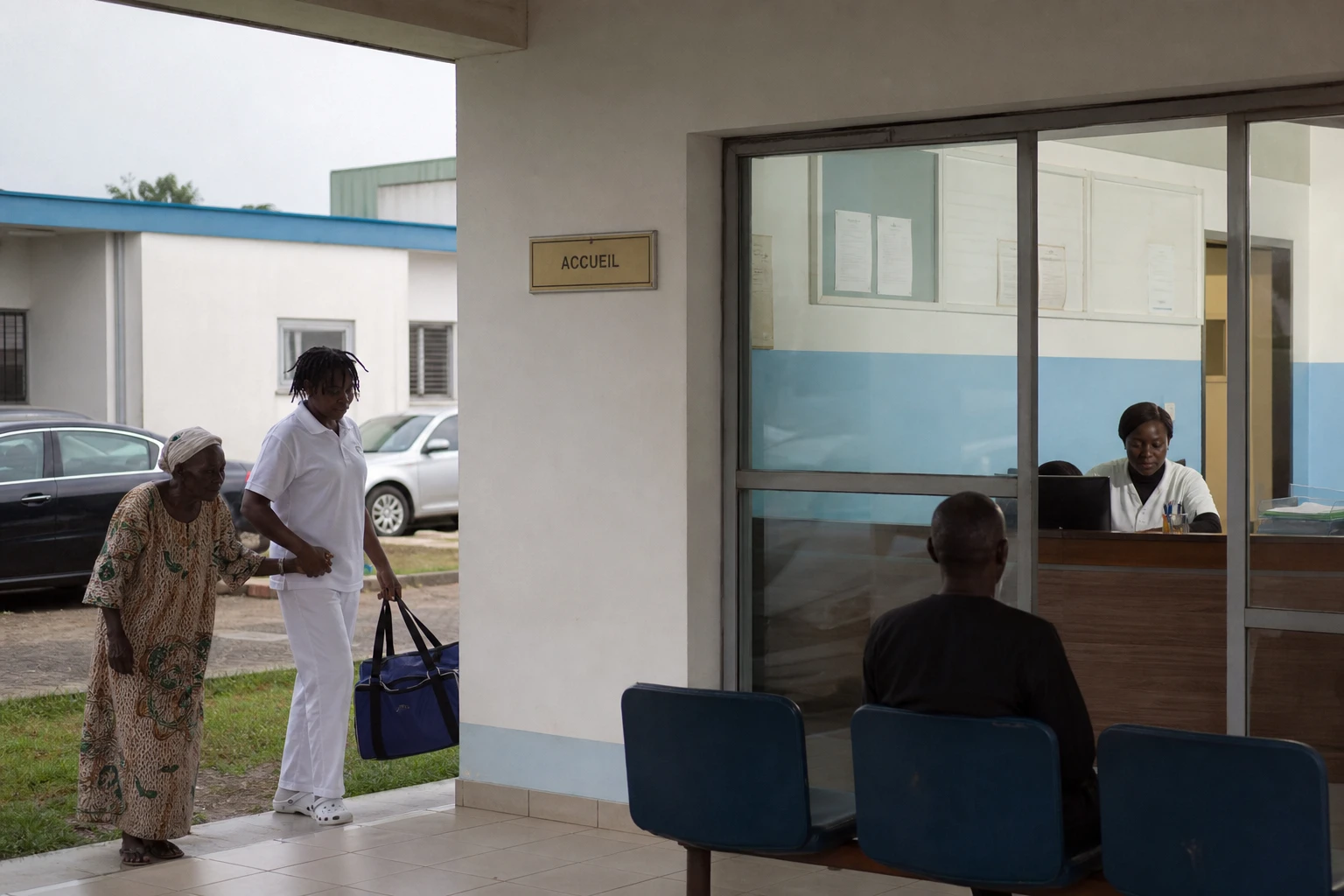
In Abidjan, care for older people no longer rests solely on the extended family. In many households, a new figure is emerging: the home-care assistant. They keep watch, provide support, observe and reassure. Behind this still little-known profession lies a simple reality: living longer is not enough; people must also be able to age in good conditions.
In Côte d’Ivoire, the issue is growing in importance because the population is ageing, even though the country remains young. According to the 2021-2025 National Health Development Plan, people aged over 60 accounted for about 4% of the population, based on projections by the National Institute of Statistics, and already numbered 606,550 in 1998. The same document notes that life expectancy was estimated at 58 years in 2019 by the World Bank, underscoring the fragility of health trajectories after the age of 60.
A profession born of changing urban families
The growth of home-care assistants says something about the country itself. In major urban centres, families are more dispersed. Children sometimes live elsewhere, and sometimes outside the continent. Households also have less time to devote to the daily care of a dependent parent. In this context, home care provides a helping hand. It does not replace the family, but makes up for its absence, especially in urban neighbourhoods where needs are more visible. This shift also reflects a broader trend in Africa, where ageing remains modest but is increasing, while domestic support networks are being reshaped.
Côte d’Ivoire’s institutional response is also taking shape in stages. The government has announced the creation of a pilot centre called the “Age-Friendly Centre” at the Anono Social Centre in Abidjan-Cocody, as well as training for staff dedicated to caring for older people. A policy document on healthcare and social support for older people has now been finalised. This public framework shows that old age is no longer a marginal issue in Côte d’Ivoire’s social policies.
At home, a presence that helps preserve independence
Home-care assistants step in when independence begins to falter. They take vital signs, help with washing, monitor meals, observe sleep and report any change in condition. They work in the most ordinary aspects of daily life, where the essentials are often at stake. In a society where chronic conditions and dependency remain difficult to manage at home, their presence can sometimes prevent hospitalisation or delay it. It also eases the anxiety of relatives. Turning to these professionals therefore meets a health need, as well as an emotional and social one.
This approach aligns with the broader Universal Health Coverage (CMU) strategy promoted by the Ivorian state. The Health Ministry says it guarantees more equal access to healthcare for people living in the country, with a monthly contribution of 1,000 CFA francs for subscribers and a medical assistance scheme for low-income households. In April 2025, 18,282,730 people were registered, or about 62% of the population. In 2026, the target rose even higher: more than 25 million people had enrolled in the CMU by the end of July, according to the ministry.
This expansion is important for older people because, in theory, it lowers the financial barrier to entering the healthcare system. It also matters to families, who must balance healthcare costs, home support and household income. When a dependent parent lives for a long time with a chronic illness, the bill is not limited to medication. It includes transport, follow-up care, tests and sometimes equipment, and now, for some households, the cost of round-the-clock human support.
The real challenge: organising care without breaking up families
The heart of the debate is not just the cost of home-care assistants. It is broader. The question is how a society organises care when families can no longer shoulder everything alone. In Côte d’Ivoire, this affects wealthy households in Abidjan, middle-class families seeking flexible solutions, and poorer households for whom home care remains out of reach without public support. Cost therefore remains a powerful social filter and can create unequal access to the dignity of ageing.
The geriatrician quoted in the original article sums up the underlying problem well: frail older people should not be left alone, but families do not always have the resources for constant supervision. Turning to a trained family caregiver can then reduce costs and improve the quality of care. This idea aligns with an approach already present in Ivorian policies: training support workers, bringing care closer to people and strengthening local services rather than relying solely on hospitals.
There is also a need to professionalise the sector. As long as care for dependent people remains a poorly regulated profession, quality will vary from one household to another. Specialist organisations that equip rooms for medical care, provide monitoring equipment and organise home follow-up point the way forward. They also show that the market is taking shape. This raises a clear question for health and social authorities: how can they set standards for training, oversight and co-ordination with doctors, nurses and families?
A signal for West Africa
Côte d’Ivoire is not alone in facing this turning point. Across West Africa, gradually longer life expectancy, urbanisation and the mobility of working people are changing how older people are cared for. ECOWAS has no single model for caring for older people, but the social issue is becoming increasingly visible in countries where urban growth is accelerating. Côte d’Ivoire’s experience is therefore a useful testing ground: it shows how the quiet ageing of a still-young population can compel the state, families and private-sector actors to devise new balances.
What needs watching now is not just the number of home-care services. It is the system’s ability to train assistants, integrate them into the care chain and make the CMU genuinely accessible to dependent older people. In other words, the question is no longer whether the profession will grow. It is under what conditions it can do so without becoming a luxury reserved for a few urban families.