Algeria
 Egypt
 Libya
 Morocco
 Sudan
 Tunisia
 Benin
 Burkina Faso
 Cabo Verde
 Ghana
 Guinea
 Guinea-Bissau
 Liberia
 Mali
 Mauritania
 Niger
 Nigeria
 Senegal
 Sierra Leone
 The Gambia
 Togo
 Cameroon
 Central African Republic
 Chad
 DR Congo
 Equatorial Guinea
 Gabon
 Republic of the Congo
 São Tomé and Príncipe
 Burundi
 Comoros
 Djibouti
 Eritrea
 Ethiopia
 Kenya
 Madagascar
 Malawi
 Mauritius
 Mozambique
 Rwanda
 Seychelles
 Somalia
 South Sudan
 Tanzania
 Uganda
 Angola
 Botswana
 Eswatini
 Lesotho
 Namibia
 South Africa
 Zambia
 Zimbabwe
Recycling, restoring soils or developing activities linked to marine resources does not automatically create sustainable jobs. For young Ivorians, the challenge is also knowing which skills to acquire, where to train and how to meet employers. A new initiative aims to bring these steps together, though its results cannot yet be measured.
A gateway to careers and training
On 5 November 2026, in Abidjan, Côte d’Ivoire’s ministries responsible for Youth and the Environment signed an agreement providing for a hub dedicated to green and blue jobs. The agreement was signed at the opening of the second edition of the Careers Days at the Palais de la culture in Treichville. The Ivorian Press Agency and Ivorian media outlet Le Mandat Express reported the announcement. The AIP report on the agreement.
The hub is intended to inform candidates about career opportunities, direct them towards training and connect them with employment support schemes. It is also meant to identify companies’ needs and projects led by young people. The agreement therefore establishes a framework for cooperation; the information available does not yet specify practical arrangements, a rollout timetable or numerical placement targets.
Green jobs include activities related to waste management, energy and the protection of natural resources. Blue jobs concern activities associated with seas, waters and their resources. In both cases, careers range from technical work to entrepreneurship. Minister Mamadou Touré described the aim as building a “clearer pathway” from interest in a career, through skills acquisition, to taking up work. He also stressed health, safety and social protection at work.
Tools already exist, but employment outcomes must be tracked
The initiative builds on previous experience. In October 2024, the International Labour Organization (ILO) presented the Ivorian government with a directory of green occupations and jobs. The tool describes professions and the skills associated with them. For example, a sorting worker may not need any prior level of training, but must be able to identify recyclable materials and follow safety instructions. The Ivorian directory of green occupations presented by the ILO.
In March 2024, Careers Days organised by UNICEF and the Ministry of Youth brought together 50 public and private organisations and offered 2,532 adolescents and young people opportunities for internships, mentoring and coaching. These figures, published by UNICEF, indicate that connections were made on a large scale. However, they do not specify how many participants subsequently found jobs or started businesses. The 2024 Careers Days review in Côte d’Ivoire.
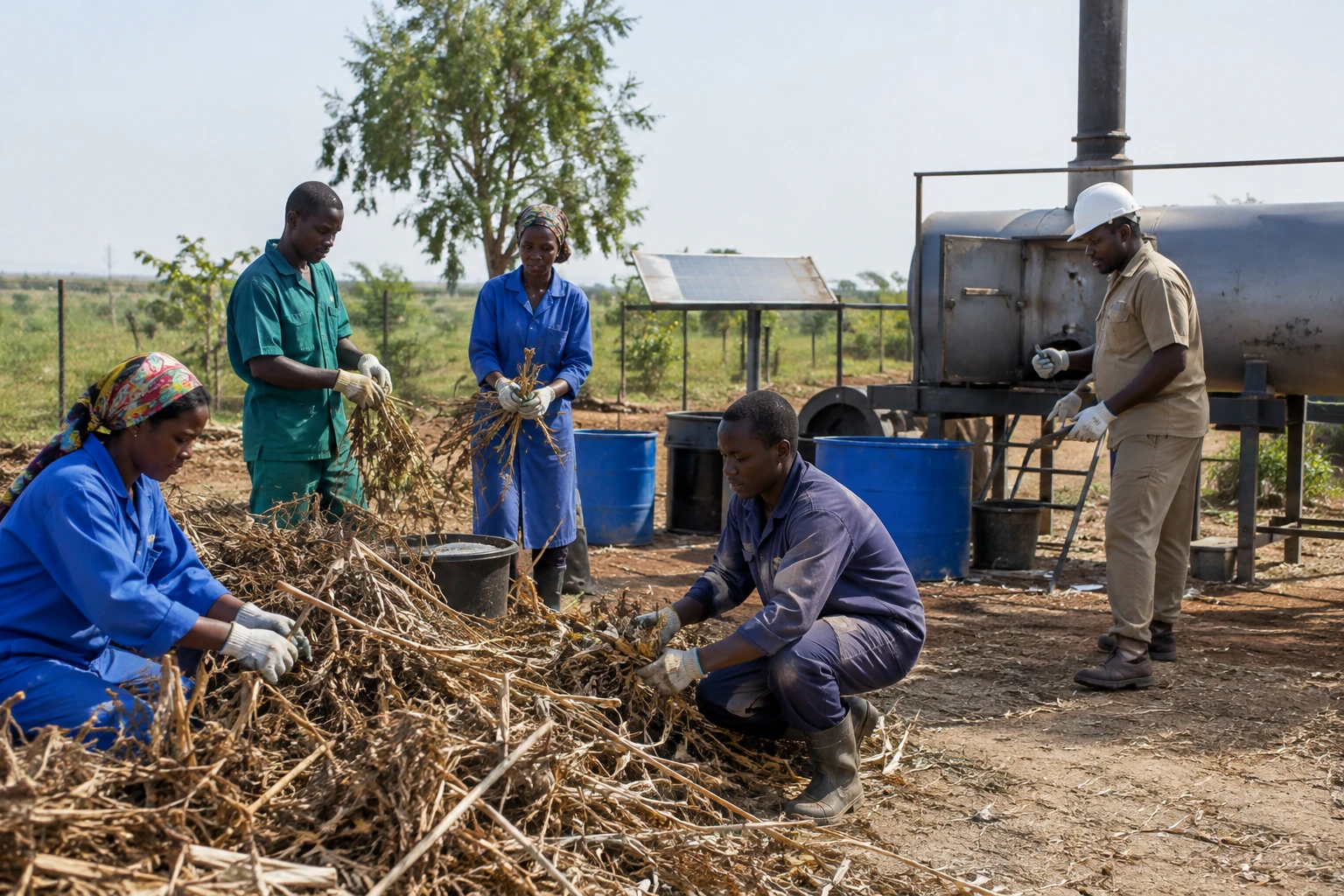
In Tchologo, in the north of the country, a project supported by Japan and implemented by the ILO illustrates another approach: combining technical skills with the creation of local businesses. Agricultural residues are used to produce biochar, a material made by processing biomass, as well as compost and digestate. In March 2026, the ILO reported that 338 beneficiaries, including 189 women, had been trained across 24 production units in Kong and Ouangolodougou. It also reported additional income, without publishing amounts or how regular it was. Results of the biochar project in Tchologo.
The challenge: turning guidance into decent work
These initiatives highlight the hub’s main responsibilities. It will need to match training to employers’ actual needs, while helping people with business projects access advice and equipment. A directory of occupations can set out the skills required; it cannot guarantee that training is available nearby or that a paid job exists.
Outcomes will also depend on regions and sectors. In Abidjan, access to companies and guidance services may make it easier to connect people with opportunities. In the regions, jobs linked to agriculture, waste or water resources require equipment, markets and appropriate support. Rural experience in Tchologo shows that training can be linked to productive activity, but the reported results are not yet enough to establish whether incomes are stable or the production units viable over the long term.
Job quality is another concern. Environmental activities are not automatically decent work: workplace safety, workers’ rights and access to social protection matter just as much as the number of people receiving guidance. In this respect, the minister’s emphasis on working conditions gives the project a concrete measure of success beyond the number of participants alone.
A West African relevance, with results still to come
Côte d’Ivoire is placing this initiative within its employment and ecological transition policy. Across West Africa, where agricultural, coastal and urban activities confront economies with differing skills needs, linking training to job opportunities is a shared challenge. The Ivorian hub remains a national initiative, however: its regional reach will depend on documented results and any exchanges with neighbouring countries.
The next step will be to make the service operational and track its effects: training that is actually accessible, internships, recruitment, businesses created and working conditions. The second edition of Careers Days took place on 5 and 6 November 2026. Visitor or contact numbers alone will not show whether the initiative opens up sustainable career paths. Its usefulness will be judged by employment outcomes broken down by occupation and region.