Algeria
 Egypt
 Libya
 Morocco
 Sudan
 Tunisia
 Benin
 Burkina Faso
 Cabo Verde
 Ghana
 Guinea
 Guinea-Bissau
 Liberia
 Mali
 Mauritania
 Niger
 Nigeria
 Senegal
 Sierra Leone
 The Gambia
 Togo
 Cameroon
 Central African Republic
 Chad
 DR Congo
 Equatorial Guinea
 Gabon
 Republic of the Congo
 São Tomé and Príncipe
 Burundi
 Comoros
 Djibouti
 Eritrea
 Ethiopia
 Kenya
 Madagascar
 Malawi
 Mauritius
 Mozambique
 Rwanda
 Seychelles
 Somalia
 South Sudan
 Tanzania
 Uganda
 Angola
 Botswana
 Eswatini
 Lesotho
 Namibia
 South Africa
 Zambia
 Zimbabwe
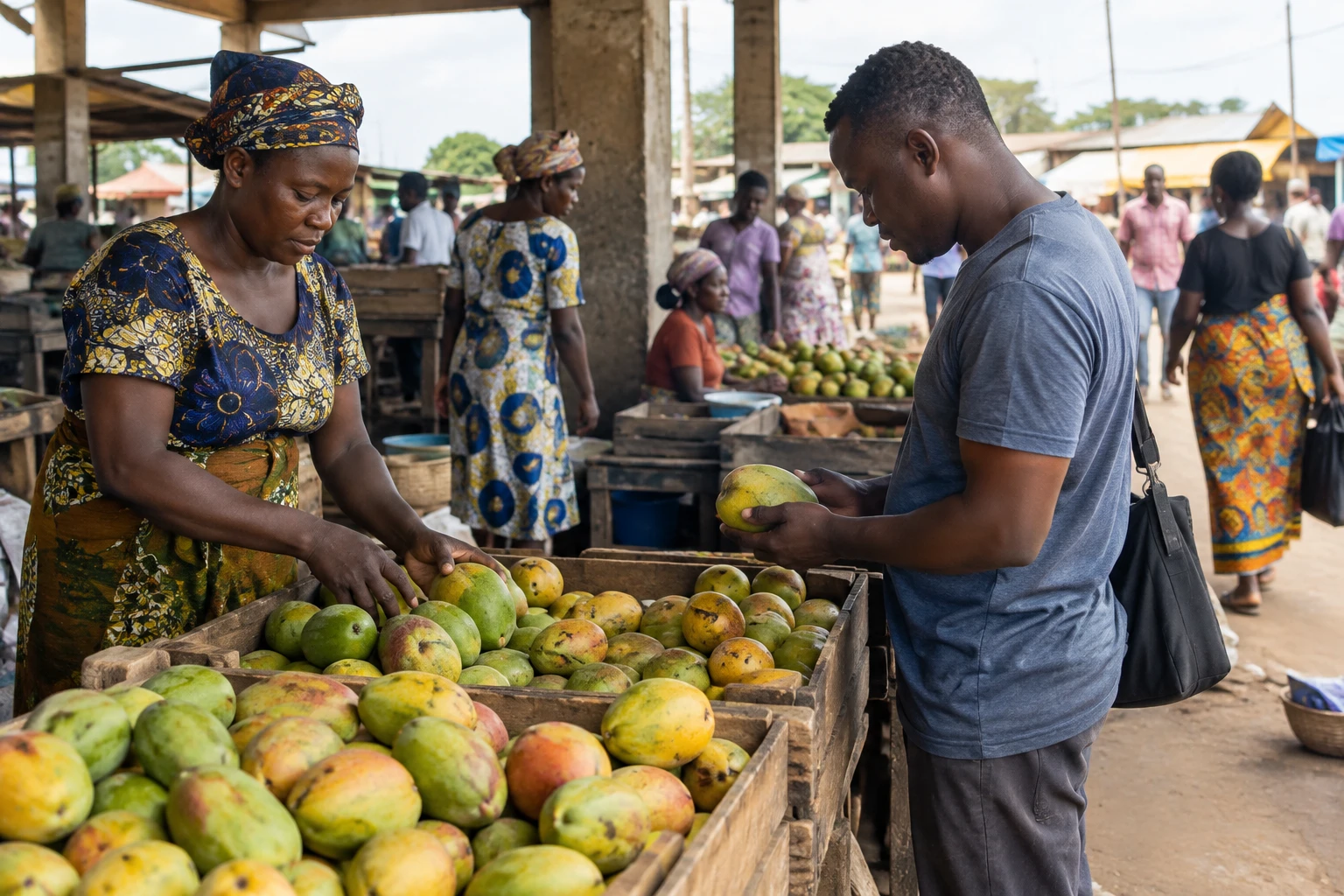
In orchards in northern Côte d’Ivoire, the next season is also being shaped by the traps laid before flowering. For producers, transporters and packing stations, the stakes are immediate: to regain an outlet that absorbs most of the country’s mango exports.
A decisive European market for the sector
Côte d’Ivoire produces around 180,000 tonnes of mangoes a year. Some 35,000 tonnes are sent to the European Union, accounting for more than 80% of volumes exported abroad, according to the Ministry of Agriculture. The activity supports the livelihoods of nearly 100,000 people, particularly in producing areas.
The suspension of shipments to the EU took effect on 1 August 2026. Agriculture Minister Bruno Nabagné Koné confirmed it on 15 October at a press conference in Abidjan. The Ivorian authorities hope exports will resume during the 2027 season, but this will depend on the EU’s assessment of the health guarantees proposed by Abidjan.
The measure follows several detections of fruit flies in consignments. According to figures presented by the minister, 27 consignments were intercepted in 2026, compared with 12 in 2025 and 32 in 2024. These figures point to a persistent problem, but on their own they do not show the rate of non-compliance: the total number of consignments shipped each year would also need to be known.
The crisis therefore affects more than exporters. Producers may lose buyers and advance payments for the season; intermediaries and packing-station workers risk seeing their activity decline. The consequences may vary between production areas and according to each operator’s ability to find other markets.
Measures to be tested before the 2027 season
The government has announced 3.5bn CFA francs, or about $5.9m, to treat around 20,000 hectares of the country’s orchards. More than three million traps are to be installed in nine producing regions before the next flowering season. The aim is to improve the detection and control of fruit flies before harvest.
The plan also provides for stronger traceability, tighter checks and a national unit tasked with monitoring exports. For 2027, the ministry says 15 exporters and nine packing stations have been removed from the list of approved operators. It has also announced the suspension of shipments by air.
These decisions change the conditions for companies seeking access to the sector. Their effectiveness will, however, depend on implementation: the actual deployment of traps, the quality of monitoring in orchards, checks at packing stations and the rapid identification of at-risk consignments. The announced amount alone is not enough to measure results. Publishing data on spending, inspections and interceptions would help assess them.
Governance is also changing. On 23 September 2026, the Council of Ministers decided to bring mangoes under the remit of the Cotton, Cashew and Shea Council. This regulation could clarify co-ordination, provided the responsibilities of the state, the sector’s inter-professional body and operators are clearly established.
The authorities plan to submit a revised systems approach to the European Commission, accompanied by an independent audit. A systems approach combines orchard surveillance, production practices and export checks, rather than relying on a single final inspection. A resumption therefore remains an objective, not a decision that has been secured.
A matter of commercial trust and co-operation
The EU decision puts phytosanitary rules at the forefront. These aim to prevent harmful organisms from spreading through imported plants and plant products. But Côte d’Ivoire’s response also concerns how costs and responsibilities are shared. Producers work in the orchards; packing stations sort and pack the fruit; exporters organise shipments. An effective system must link these stages without placing the entire burden on any one part of the chain.
The sector had already had to manage alerts before the suspension. In May 2026, Ivorian media reported interceptions and discussions among stakeholders to protect the season. In a report published in 2025, the European Commission had also identified, in several audited countries including Côte d’Ivoire, difficulties in verifying control systems and following up on non-compliance. That finding concerned the systems examined; it is not, on its own, an assessment of every Ivorian operator.
The regional context also matters. Côte d’Ivoire is a member of ECOWAS, the Economic Community of West African States, where agricultural sectors and cross-border trade bring producers and markets closer together. For Ivorian companies, diversifying destinations can reduce dependence on one buyer, but this requires meeting the specific requirements of each market and having suitable logistics channels.
The 2027 test will therefore focus on two concrete results: fewer interceptions and the authorities’ ability to demonstrate, with supporting evidence, that the measures work over time. These guarantees, more than the announcement of a timetable, will weigh in the EU’s assessment. For families and businesses in the sector, the outcome will also determine whether income linked to the season can resume.