Algeria
 Egypt
 Libya
 Morocco
 Sudan
 Tunisia
 Benin
 Burkina Faso
 Cabo Verde
 Côte d'Ivoire
 Ghana
 Guinea
 Guinea-Bissau
 Liberia
 Mali
 Mauritania
 Niger
 Nigeria
 Senegal
 Sierra Leone
 The Gambia
 Togo
 Cameroon
 Central African Republic
 Chad
 DR Congo
 Equatorial Guinea
 Gabon
 São Tomé and Príncipe
 Burundi
 Comoros
 Djibouti
 Eritrea
 Ethiopia
 Kenya
 Madagascar
 Malawi
 Mauritius
 Mozambique
 Rwanda
 Seychelles
 Somalia
 South Sudan
 Tanzania
 Uganda
 Angola
 Botswana
 Eswatini
 Lesotho
 Namibia
 South Africa
 Zambia
 Zimbabwe
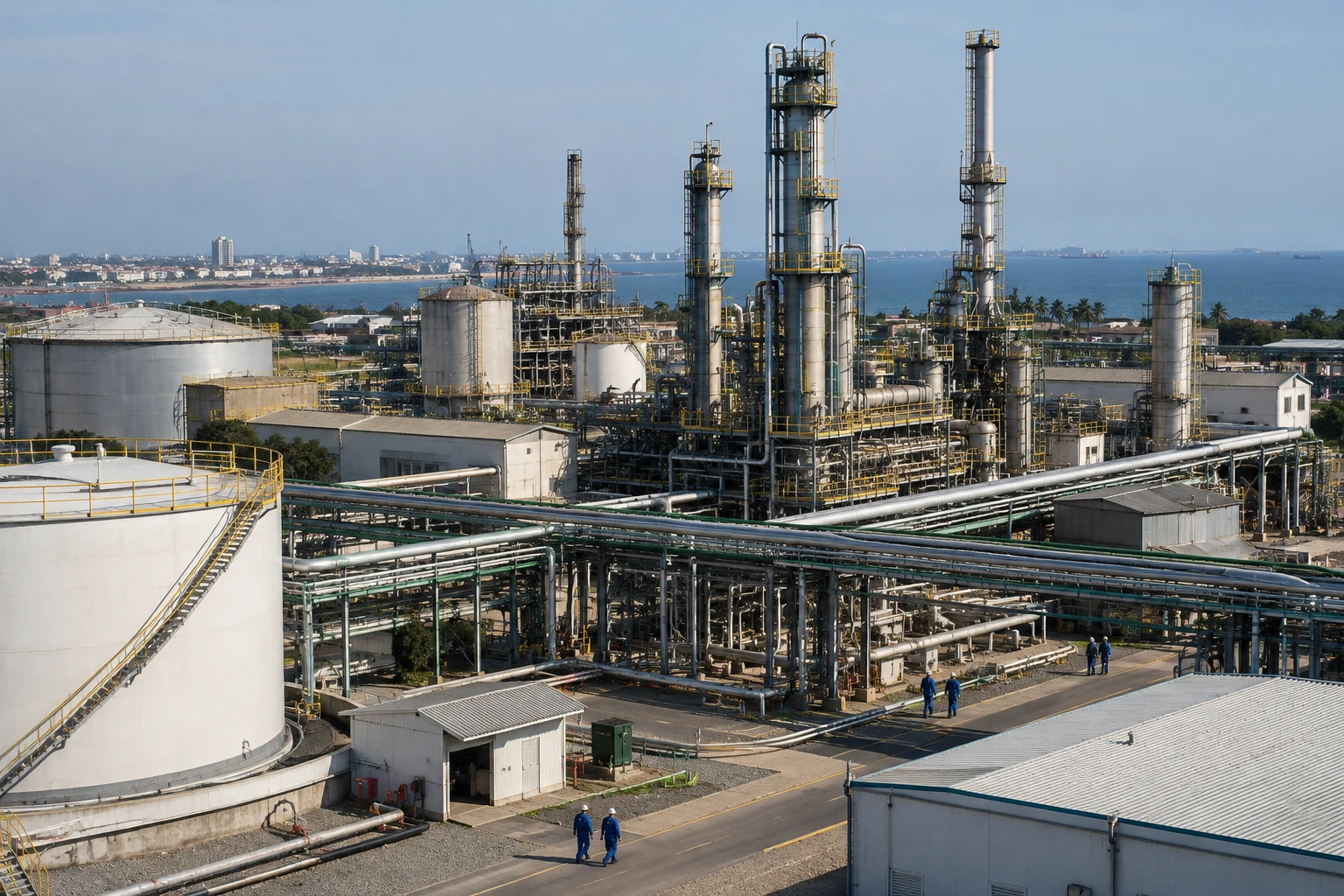
In the Republic of the Congo, producing oil does not guarantee an adequate supply of refined fuel. A new technical milestone has revived plans to modernise the Congolaise de raffinage (CORAF), but the funding and the project’s actual capacity remain to be clarified.
A supply challenge for the Congo
CORAF, located in Pointe-Noire, is the country’s only currently operating refinery. It has been running since 1982 and is wholly owned by the Société nationale des pétroles du Congo (SNPC), the state-owned company responsible for some of the country’s oil activities. Its nameplate capacity is estimated at 21,000 barrels per day, but this theoretical capacity does not mean the facility processes that volume every day.
According to the International Monetary Fund (IMF), the refinery met about 60% of the Congolese consumption of petroleum products in 2023. The rest has to be supplied through imports, exposing supply to transport costs, international prices and logistical constraints. The figure of 40% for imports cited in the available information should therefore be understood as an approximate share, liable to vary by year and product.
This gap also weighs on public finances. The IMF estimates that direct state support to CORAF averaged 1.8% of gross domestic product per year between 2018 and 2023. It recommends evaluating the refinery’s operations and preparing a gradual reduction in this support. The recommendation highlights a trade-off: maintaining domestic processing capacity while keeping its cost to the budget under control.
An engineering phase, not yet an investment decision
On 5 October 2026, Emil Alkhasli, chief executive of SOCAR Downstream, announced the launch of a preliminary engineering phase, known as Pre-FEED. It is intended to define the technical options, the project scope and the requirements needed before detailed studies. In short, this phase helps clarify what would need to be built or renovated and prepare an assessment of the work.
SOCAR Downstream, a subsidiary of Azerbaijan’s state-owned SOCAR, is acting as project management consultant to SNPC. The work stems from an agreement concluded in Baku on 4 April 2024 between the two companies, covering the improvement and expansion of CORAF. The launch of the Pre-FEED is therefore a step forward in project preparation. It confirms neither the final cost nor the construction timetable or the securing of funding.
Financing remains central. CORAF and SNPC officials have said in recent years that they are seeking partners and funding. Until the financing package is finalised, the technical phase does not justify concluding that work will begin soon. Future announcements will need to specify the investments, the targeted capacity, the products concerned and the guarantees for implementation.
Modernising, building or importing: several routes in parallel
Modernising CORAF is not the only project intended to strengthen fuel supplies. In 2020, the Congo also signed an agreement with Chinese company Beijing Fortune Dingheng Investment for a new refinery in the Pointe-Noire area, near Fouta. At the time, the Ministry of Finance set out a planned capacity of 2.5 million tonnes of hydrocarbons a year and envisaged operations beginning by 2023. That initial deadline has passed; information in the source material now refers to 2027, but no independent confirmation of that date has been established here.
A third option is external supply. In late June 2026, an SNPC delegation travelled to Lagos to meet Dangote Petroleum Refinery. Nigerian broadcaster Channels Television and African news agency APA reported that discussions had opened on a possible partnership. These are talks, not an announced contract. For the Congo, regional supply could supplement local production, but it would not by itself replace decisions on CORAF’s future.
These options serve different purposes. Renovating the existing facility could preserve skills and infrastructure already in place in Pointe-Noire. A new refinery promises greater capacity, but requires substantial investment and must actually be completed. Imports, meanwhile, could meet some needs more quickly, while maintaining dependence on external suppliers and markets.
Practical effects for consumers and public finances
For households, transport operators and businesses, the immediate issue is the reliability of supply. Delays or shortages can disrupt travel, the distribution of goods and economic activity. The consequences are not evenly spread: businesses may sometimes absorb extra costs or find logistical solutions, while small traders and workers who depend on transport have more limited room to manoeuvre.
In Pointe-Noire, refinery projects could also affect employment, training and subcontracting activity. But the benefits will depend on investment decisions, local content and the ability to operate the facilities sustainably. In Brazzaville, the authorities will need to monitor not only the cost of construction but also the operating subsidies required and the impact on the public budget.
The debate is therefore not only about the volume of crude oil produced. It concerns domestic processing, the quality and availability of fuels, and how costs and benefits are shared. The goal of doubling national oil production to 500,000 barrels per day by 2030, cited in the available information, does not by itself guarantee a corresponding increase in refined fuel supplies: extraction and refining are two distinct stages.
Regional implications to be assessed over time
A member of the Economic and Monetary Community of Central Africa (CEMAC), the Congo is part of a region where supply security and energy infrastructure extend beyond national borders. A renovated refinery or a new facility in Pointe-Noire could serve neighbouring markets, if production and logistics allow. CEMAC is the regional organisation that brings together several Central African states for economic and monetary cooperation.
But regional reach remains a possibility, not an established outcome. It will depend on the capacity actually installed, production costs, transport routes and trade agreements. The next step to watch is the publication of the Pre-FEED findings, followed by the presentation of verifiable financing and a timetable. For Congolese people, the test will be tangible: more regular fuel availability without an ever-increasing burden on the budget.
SOCAR Downstream announcement on the launch of the Pre-FEED ; IMF assessment of public support for CORAF ; US Energy Information Administration data on the Congolese oil sector.