Algeria
 Egypt
 Libya
 Morocco
 Sudan
 Tunisia
 Benin
 Burkina Faso
 Cabo Verde
 Côte d'Ivoire
 Ghana
 Guinea
 Guinea-Bissau
 Liberia
 Mali
 Mauritania
 Nigeria
 Senegal
 Sierra Leone
 The Gambia
 Togo
 Cameroon
 Central African Republic
 Chad
 DR Congo
 Equatorial Guinea
 Gabon
 Republic of the Congo
 São Tomé and Príncipe
 Burundi
 Comoros
 Djibouti
 Eritrea
 Ethiopia
 Kenya
 Madagascar
 Malawi
 Mauritius
 Mozambique
 Rwanda
 Seychelles
 Somalia
 South Sudan
 Tanzania
 Uganda
 Angola
 Botswana
 Eswatini
 Lesotho
 Namibia
 South Africa
 Zambia
 Zimbabwe
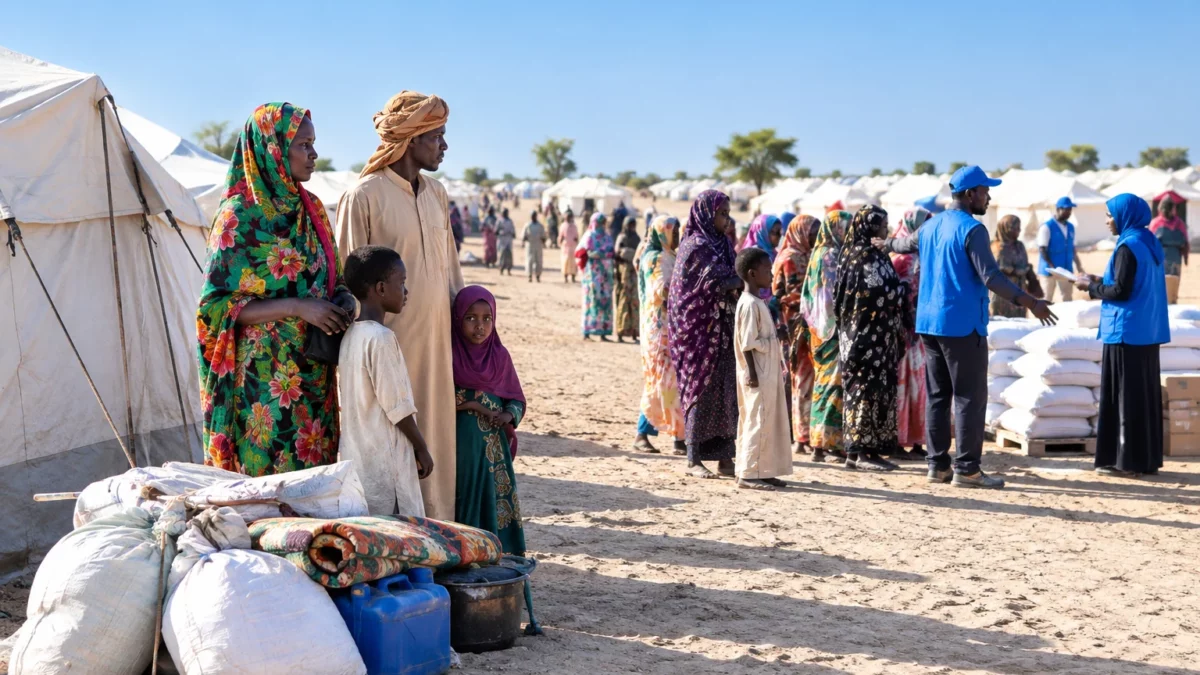
In Daboua, in Chad’s Lake Province, the arrival of families from Diffa poses a practical question: how can displaced people be protected while their nationality and needs are verified? For local authorities, the emergency is about more than providing shelter. They must also prevent a protracted crisis, just a few kilometres from a border long crossed by families, livestock and traders.
Emergency reception in Lake Province
Since 12 November 2026, more than 1,000 members of the Arab Mahamid community have arrived at the Aljeezira site near Daboua. The Chadian Press and Publishing Agency reports that they represent more than 200 households. Chadian authorities have set up tents and begun distributing food, while registration is under way.
The governor of Lake Province, Saleh Haggar Tidjani, described the situation as a “humanitarian emergency” and the arrivals as forcibly displaced people. This designation reflects the need for an immediate response. It does not, however, resolve the question of each person’s status: some have Nigerien documents, others Chadian papers or both, and several reportedly have no identity documents.
On the ground, initial requests go beyond food aid. People received at the site have also raised the need for schools and healthcare. The Chadian administration must therefore distinguish between individual cases, protect children and organise access to water and sanitation. The resources mobilised in Daboua will also matter to neighbouring villages, which already share the available services.
Nigerien decision has immediate consequences
The departures follow measures taken by Nigerien authorities in the regions of Diffa and Zinder. Information gathered by Deutsche Welle points to a deadline of 31 December 2026 to leave the country, as well as restrictions affecting access to water, schools, healthcare and identity documents. The African Commission on Human and Peoples’ Rights said it had sent an urgent appeal to the Nigerien president on 6 November concerning alleged violations targeting the Mahamid community.
Security allegations levelled against members of this community must remain attributed to the Nigerien authorities. Deutsche Welle reports that they cite alleged links to armed groups active in the Lake Chad basin. Mahamid representatives reject any collective accusation and call for any alleged offences to be examined individually. At this stage, these allegations do not justify concluding that an entire community is responsible.
This distinction is essential. An investigation focused on specific acts is not the same as measures that affect entire families’ access to water, school or civil registration. The African Commission specifically flagged these restrictions as alleged violations of fundamental rights. Its intervention is not a final ruling, but places the case within a continental framework for the protection of rights.
Families with ties on both sides of the border
The border between Chad and Niger has not always divided populations with separate histories. Mahamid families settled in south-eastern Niger from the 1970s onwards, according to accounts and historical information reported by the press. Droughts and the search for grazing land encouraged these movements. Several generations have since grown up in Diffa, where residents consider themselves Nigerien and say they have built their lives.
This history makes a return to Chad complex. Family origins alone are not enough to establish nationality, and missing or contradictory documents can complicate access to services and protection. For N’Djamena, the task is to receive those who have arrived while clarifying their status on a case-by-case basis. For families, expulsion can mean losing their homes, livestock, commercial activity and social ties built up in Niger.
The precedent of 2006 is a reminder that this is not a new issue: Niger then considered expelling Arab people living in the Diffa region, before abandoning the operation. The reappearance of a departure measure nearly 20 years later shows the persistence of tensions between security, administrative status and community belonging. It does not, by itself, mean that the current circumstances are identical.
A bilateral and regional issue to watch
Chad and Niger are members of the Economic and Monetary Community of Central Africa (CEMAC) and the Economic Community of Central African States (ECCAS), while Niger is also part of the Alliance of Sahel States. These regional frameworks do not replace bilateral dialogue. They do, however, provide forums for discussing humanitarian consequences and border tensions, at a time when cooperation between N’Djamena and Niamey has experienced friction.
Chad’s response will have different effects on different places and groups. National authorities will need to coordinate reception and administrative checks. In Daboua, local services will have to share water, healthcare and accommodation capacity with communities already there. Displaced families will need protection and continuity in schooling. Herders and traders on both sides could also be affected by movements that disrupt work and trading networks.
In the short term, two deadlines will shape what happens next: the announced date of 31 December 2026 and the ability of Nigerien authorities to respond to the African Commission’s urgent appeal. Tracking arrivals, access to services and nationality checks will help measure how the situation develops. For both Chad and Niger, the challenge is now to prevent an administrative decision and security concerns from turning into a protracted crisis for civilians.
Sources consulted: Chadian Press and Publishing Agency, on reception in Daboua ; Deutsche Welle, on the announced measures and accounts from Diffa ; African Commission on Human and Peoples’ Rights, urgent appeal of 6 November 2026 ; Tchadinfos, on arrivals in Lake Province.