Algeria
 Egypt
 Libya
 Morocco
 Sudan
 Tunisia
 Benin
 Burkina Faso
 Cabo Verde
 Côte d'Ivoire
 Ghana
 Guinea
 Guinea-Bissau
 Liberia
 Mali
 Mauritania
 Niger
 Nigeria
 Senegal
 Sierra Leone
 The Gambia
 Togo
 Central African Republic
 Chad
 DR Congo
 Equatorial Guinea
 Gabon
 Republic of the Congo
 São Tomé and Príncipe
 Burundi
 Comoros
 Djibouti
 Eritrea
 Ethiopia
 Kenya
 Madagascar
 Malawi
 Mauritius
 Mozambique
 Rwanda
 Seychelles
 Somalia
 South Sudan
 Tanzania
 Uganda
 Angola
 Botswana
 Eswatini
 Lesotho
 Namibia
 South Africa
 Zambia
 Zimbabwe
When the stage offers a surer living than royalties
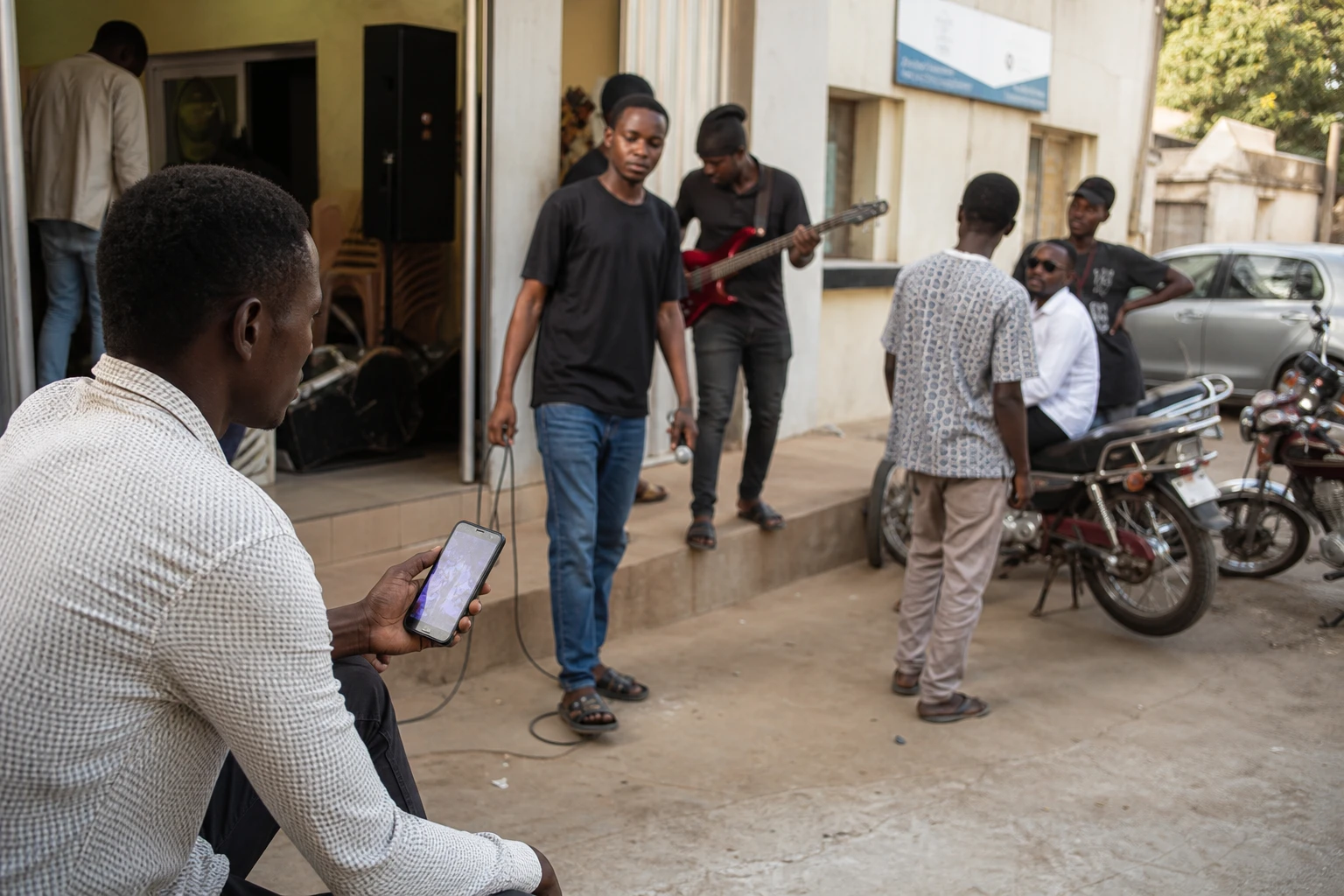
In Bangui and N’Djamena, many artists rely first not on platforms, but on the stage. Fees from bars, private parties, corporate events and official ceremonies remain the backbone of a still-fragile music economy. In these markets, the problem is not a lack of talent. It is the absence of a system capable of turning that talent into regular income.
This reality affects two Central African countries linked by cultural exchanges, similar consumption habits and the same regional legal framework: the African Intellectual Property Organization, or OAPI, whose Bangui Agreement governs intellectual property in several states in the region, including the Central African Republic and Chad. On paper, the rights exist. In practice, their collection and redistribution remain uneven, while local stages continue to absorb most of the value created.
Rights recognised, but monetisation remains limited
In the Central African Republic, the Central African Copyright Office, which is attached to the ministry responsible for culture, is supposed to administer and collect royalties on behalf of creators. The existence of this framework has not, however, been enough to establish a robust recorded-music economy. Music In Africa has previously noted that debates over the legitimacy of collective management institutions and the adaptation of the legal framework to the realities of the arts sector remain open.
In this context, live performances carry significant weight. Central African artists perform with orchestras and at dance bars, snack bars, private parties and institutional events. Download and streaming platforms bring in little, or do so too rarely. Africanews has already described a sector in which fees from shows and weddings remain the main source of income, in an environment where the recording industry has never really taken root.
Chad presents a similar picture. The Chadian Copyright Office, BUTDRA, does exist, but several local media outlets note that collection and redistribution remain inadequate. In January 2025, Tchadinfos reported a mixed assessment after 20 years of copyright law, with persistent obstacles to professionalising the cultural sector.
This institutional weakness has very tangible effects. When copyright brings in little, artists become service providers before they become authors. They perform more than they build up assets. They respond to immediate demand rather than building deferred income from the use of their works. In both capitals, the stage often pays for studio time, music videos, travel and sometimes even everyday living costs.
A cultural economy driven by venues, not yet by catalogues
In Bangui, venues such as dance bars, party spaces and cultural events shape musicians’ visibility. Festivals also play a cushioning role. The Tî-Ï Festival, launched by Idylle Mamba, and Bangui fait son cinéma, cited as an example of one-off initiatives, show how events serve as a conduit for a shallow domestic market.
Chad, too, relies on platforms for performances and discovery. The NdjamVi festival, launched in 2007, has become an important force in the circulation of bands and repertoires. Tchadinfos has reported that the event has hosted hundreds of musical acts over the years and provides an important showcase for the local scene. But this vitality on stage does not automatically translate into lasting income for creators.
The crux of the problem is as much economic as cultural. When purchasing power is low, cultural consumption follows the same downward trend. Tickets are difficult to sell. Fees are negotiated downwards. Organisers prefer flexible, often one-off arrangements to regular programming capable of structuring a sector. Artists, meanwhile, take on more performances to make up for the lack of more stable revenue streams.
This model creates an industry driven by immediate demand. It sustains visible, sometimes highly popular careers, but leaves little room for accumulation. In this context, authors do not necessarily own the rights to their distribution. Visibility does not automatically turn into an income stream. And digital platforms, in the absence of a sufficiently broad paying market and well-established collection mechanisms, do not yet make up for this weakness.
What this means for artists, audiences and governments
For artists, the consequence is simple: they have to chase bookings. Many juggle several activities. Some keep another job. Others rely on private partners, NGOs or the government when official ceremonies or public campaigns offer paid opportunities and visibility. Singing alone is not always enough to sustain a career.
For audiences, this produces a lively but irregular cultural offering. Parties, concerts and festivals remain accessible because they depend on a close-knit local network. By contrast, album production, structured promotion, tours and catalogue exports are progressing slowly. Where more mature music markets rely on royalties, synchronisation and distribution, Bangui and N’Djamena still live mainly from performances.
For governments, the stakes go beyond culture. A better-organised music sector supports jobs, tax revenues, technical services, venues, studios, printers, transport operators and an entire local economy. As long as income remains concentrated in performance fees, the value chain will remain short. Creativity circulates, but struggles to build up.
The regional dimension is clear. In Central Africa, a legal framework exists through OAPI, but its ability to generate a fully remunerative creative economy varies considerably from one country to another. The Central African Republic and Chad show that a legal framework is not enough. Credible collective management organisations, declared uses, effective monitoring and a domestic market able to absorb local creativity are also needed. Without them, the stage remains an outlet, not an industrial engine.
This issue deserves close attention because it says something broader about the place of culture in African economies. Where local scenes develop, audiences exist. Where royalties are poorly collected, value evaporates. Between the two lies a very tangible area for reform: one that could, in time, make music not only a moment of celebration, but also a fully remunerated activity.