Algeria
 Egypt
 Libya
 Morocco
 Sudan
 Tunisia
 Burkina Faso
 Cabo Verde
 Côte d'Ivoire
 Ghana
 Guinea
 Guinea-Bissau
 Liberia
 Mali
 Mauritania
 Niger
 Nigeria
 Senegal
 Sierra Leone
 The Gambia
 Togo
 Cameroon
 Central African Republic
 Chad
 DR Congo
 Equatorial Guinea
 Gabon
 Republic of the Congo
 São Tomé and Príncipe
 Burundi
 Comoros
 Djibouti
 Eritrea
 Ethiopia
 Kenya
 Madagascar
 Malawi
 Mauritius
 Mozambique
 Rwanda
 Seychelles
 Somalia
 South Sudan
 Tanzania
 Uganda
 Angola
 Botswana
 Eswatini
 Lesotho
 Namibia
 South Africa
 Zambia
 Zimbabwe
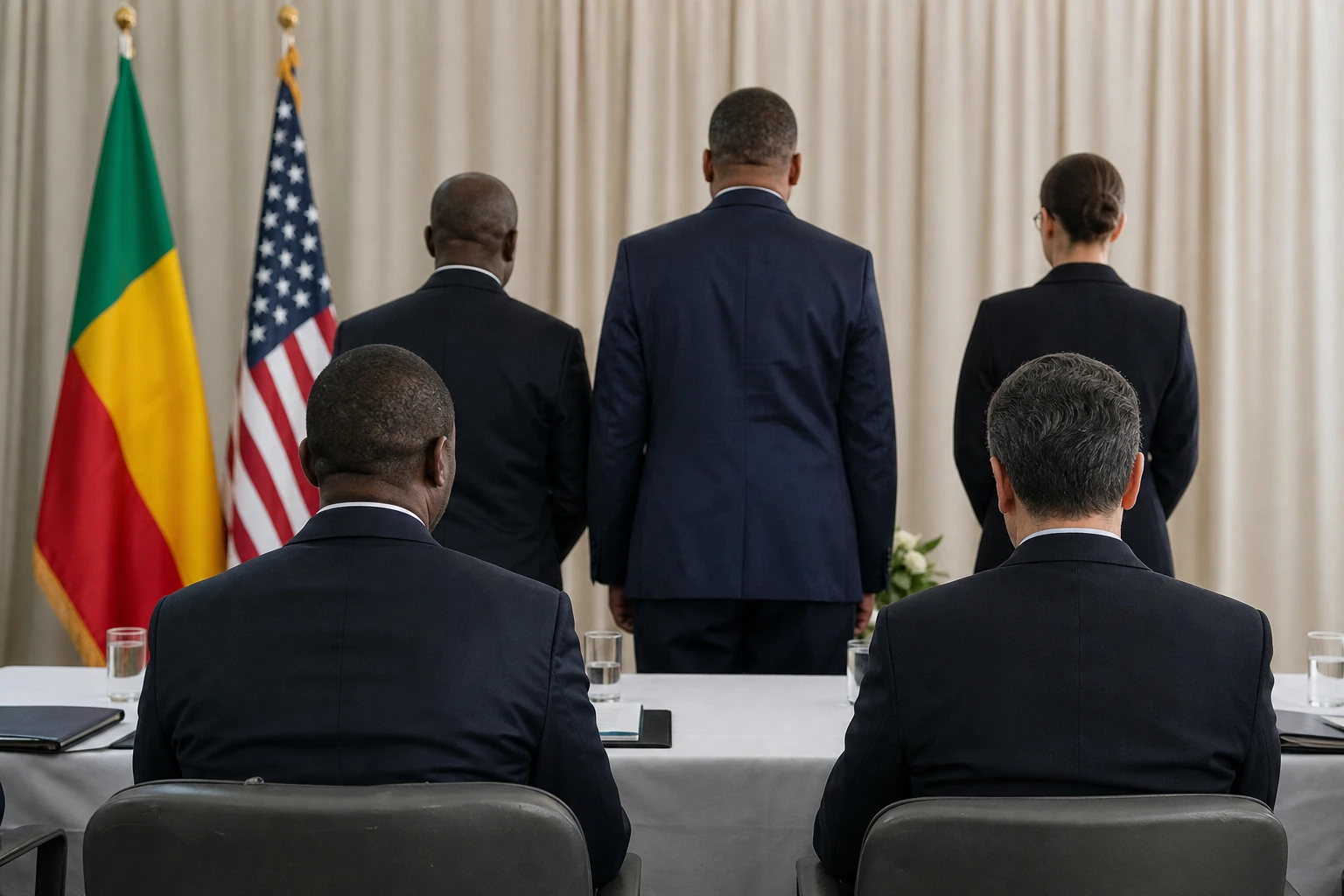
A diplomatic signal beyond Cotonou
In Cotonou, the opening of an embassy is more than a protocol formality. It also says something more concrete: Canada now wants to treat Benin as a frontline partner in West Africa, rather than as a base managed from a neighbouring capital.
For Beninese people, the issue goes beyond the ceremony itself. It concerns visas, economic exchanges, university cooperation, development assistance and political dialogue. It also signals that Cotonou, already a diplomatic and economic crossroads, is consolidating its place among the cities where a significant part of relations between West Africa and partners from outside the continent are shaped.
This development comes amid a regional context in which ECOWAS is still seeking a balance, amid political realignment, security pressures and the need for economic recovery. Benin, for its part, occupies a strategic position between the Gulf of Guinea and the Sahelian hinterland. In this space, diplomatic missions do more than receive visitors. They also support choices on influence, security and investment.
A longstanding relationship, now centred in Cotonou
Diplomatic relations between Ottawa and Porto-Novo date back to 1962. Yet for years, Canada’s presence in Benin remained limited. Canada set up an office in Cotonou in 2016, as part of its regional network. The mission opening in August 2026 therefore marks a change of scale, rather than a simple administrative continuation.
The new mission is based in Cotonou, in the MTN building, near the Novotel. It replaces an office that had been attached to the Canadian embassy in Burkina Faso. This shift in the centre of gravity is significant. It reduces the distance between Beninese counterparts and Canadian services, while giving direct exchanges with the country’s institutions greater weight.
The visit by Anita Anand, Canada’s Minister of Foreign Affairs, accompanies this upgrading. It is the first visit by a Canadian foreign minister to Benin since bilateral relations were established. She is due to meet Benin’s Minister of Foreign Affairs, Corinne Amori Brunet, as well as several members of the government, including Olushegun Adjadi Bakari, Gildas Agonkan and Hugues Oscar Lokossou. The agenda covers investment, defence, trade and external debt.
The diplomatic gesture also comes at a time when Canada is reshaping its presence in Africa. Its Africa Strategy, launched in 2025, emphasises closer cooperation with the continent’s states and institutions, with a focus on security, trade, young people and long-term partnerships. Benin fits naturally into this approach: a stable country, open to the Atlantic, and pursuing visible economic and administrative reforms.
Trade, mobility and development: practical priorities
The first expected benefit is practical. An embassy on the ground makes consular procedures easier for Beninese people who want to study, work, travel or join relatives in Canada. In a country where international mobility has become an important social lever, this administrative proximity could reduce delays, clarify procedures and make information easier to access.
The second priority is economic. The two capitals want to increase private investment and diversify trade. This matters to Benin, where upgrading exports, local processing and the growth of services remain priorities. Canada, for its part, is seeking to expand its markets in Africa. According to its Africa Strategy, merchandise trade between Canada and African countries reached 15.1 billion dollars in 2024. The message sent from Cotonou is clear: Ottawa wants to turn its diplomatic presence into a more visible economic presence.
The partnership is already supported by official development assistance. Canadian official data show 49.27 million Canadian dollars in international assistance to Benin for the 2024–2025 financial year. This funding covers several sectors, including the empowerment of women and girls, youth employability, microfinance and climate-resilient agriculture. This is no abstraction. On the ground, it means projects, partner organisations, targeted municipalities and delivery chains that directly affect Beninese households.
Security remains central to the discussions. Benin is facing growing pressure along its northern border, in an environment marked by the rise of armed groups in the Sahel and cross-border threats. The Gulf of Guinea also remains a sensitive area for maritime surveillance, customs cooperation and the movement of illicit goods. In this context, a full embassy allows for more responsive dialogue with Beninese authorities and regional partners based in Cotonou.
This dimension is all the more important because the sub-region no longer operates on the basis of automatic solidarity alone. ECOWAS continues to support political and electoral processes, as it did during Benin’s 2026 presidential election, while reiterating the principles of democratic governance. In such a context, every new diplomatic mission also serves as an observation post for the region’s political, security and economic dynamics.
What Cotonou gains, and what West Africa is watching
For Benin, the opening of this embassy strengthens an already visible course: that of a country seeking to multiply its partnerships without tying itself to a single sphere of influence. Porto-Novo retains its institutional role, but Cotonou remains the operational centre for diplomatic and economic exchanges. This is where decisions, official receptions, trade offices and many international counterparts are concentrated.
For the Beninese authorities, the benefit is twofold. On the one hand, they gain more direct access to a G7 state, useful for technical cooperation, investment and education. On the other, they strengthen their image as a stable and reliable country in a regional environment often dominated by security emergencies. In an African context where institutional credibility can attract as much as natural resources, this reputation matters.
Canada’s message is just as clear. Ottawa wants to show that its Africa strategy is not limited to general statements. By establishing an embassy in Benin, Canada is giving concrete form to its ambition for a stronger presence, closer political dialogue and more tailored cooperation with West Africa. Anita Anand’s visit to Cotonou thus serves as a test of a diplomacy seeking to move from principles to practical means.
It remains to be seen whether this new presence will lead to more projects, more balanced economic exchanges and more regular follow-up on regional issues. In the coming months, that is what will determine the real reach of this closer relationship between Ottawa and Cotonou.