
 Algeria
 Egypt
 Libya
 Morocco
 Sudan
 Tunisia
 Benin
 Burkina Faso
 Cabo Verde
 Côte d'Ivoire
 Ghana
 Guinea
 Guinea-Bissau
 Liberia
 Mali
 Mauritania
 Niger
 Nigeria
 Senegal
 Sierra Leone
 The Gambia
 Togo
 Central African Republic
 Chad
 DR Congo
 Equatorial Guinea
 Gabon
 Republic of the Congo
 São Tomé and Príncipe
 Burundi
 Comoros
 Djibouti
 Eritrea
 Ethiopia
 Kenya
 Madagascar
 Malawi
 Mauritius
 Mozambique
 Rwanda
 Seychelles
 Somalia
 South Sudan
 Tanzania
 Uganda
 Angola
 Botswana
 Eswatini
 Lesotho
 Namibia
 South Africa
 Zambia
 Zimbabwe
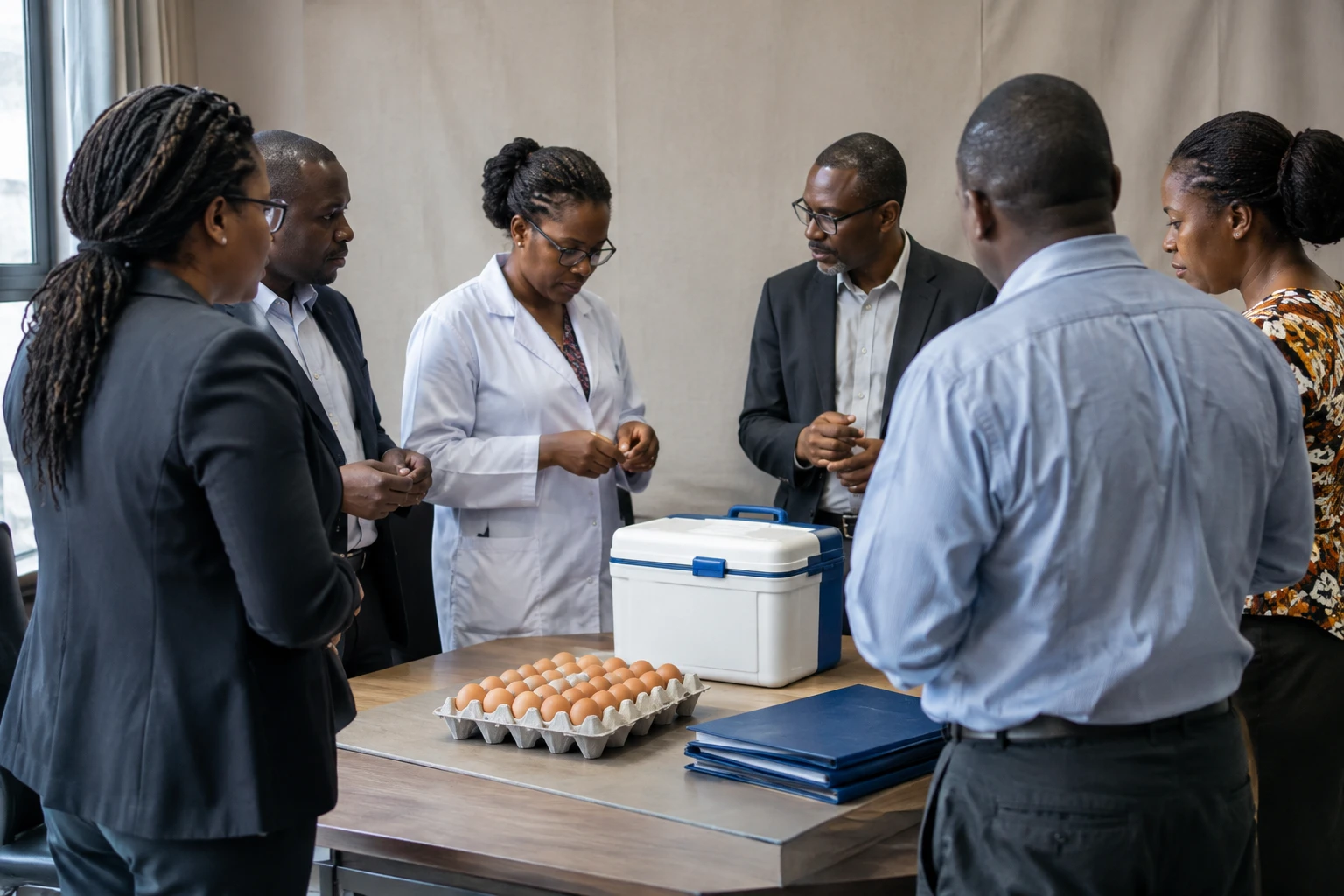
A finding in a handful of samples does not, on its own, describe an entire industry. But nor can it be dismissed on the grounds that the sample is limited. In Cameroon, the controversy over antibiotic residues, mycotoxins and metals in chickens and eggs raises a practical question: how can a scientific alert be turned into useful checks without causing undue alarm or playing down a possible risk?
Samples that do not sum up all production
The research at the heart of the debate concerns products from three poultry-producing regions: Centre, Littoral and West. A doctoral thesis submitted to the University of Yaoundé I in 2023 assesses the health risks associated with eating chickens and eggs from these regions. It examines mycotoxins, heavy metals and residues of veterinary medicines in particular.
In autumn 2026, the controversy gained fresh momentum after findings were circulated which, according to local reports, covered 48 chickens and 180 eggs. The Interprofessional Association of Cameroon’s Poultry Sector (IPAVIC) challenged the significance of conclusions drawn from a sample it considers too small in relation to production volumes. This disagreement over representativeness is not, however, enough to invalidate the analyses: it calls for scrutiny of the methods, the levels measured and how the samples were collected.
Production figures cited by the industry give an idea of the gap between the sample and national activity. Its president, François Djonou, cites annual output of around 102 million chickens and nearly three billion table eggs. He also estimates that the industry accounts for 380,000 direct jobs and 4% of gross domestic product. These figures are estimates attributed to the interprofessional association, not an independent measure from the health study.
Risk depends on the substances and doses
The word “contamination” does not automatically mean that a food will make people ill. Risk assessment depends on the substance, its concentration, the amount consumed and the duration of exposure. Regulatory thresholds are used to interpret findings; the published measurements must, however, allow concentrations to be clearly compared with those thresholds.
The substance groups cited involve different mechanisms. Mycotoxins are compounds produced by certain moulds, which can grow in animal feed, among other places. Antibiotic residues may be linked to the use of veterinary medicines and the time needed for them to clear. As for metals, their presence and levels must be established substance by substance: describing them collectively as “natural” says nothing about exposure or whether a product complies with standards.
Earlier research by Cameroonian scientists shows that these issues are not limited to the current controversy. A 2013 study of 20 poultry-feed samples detected several mycotoxins. The authors reported, in particular, an average level of aflatoxin B1 above the limit they applied to animal feed. This older finding does not prove that feed sold today presents the same problem; it highlights the value of monitoring the entire chain, from raw materials to products consumed.
The president of IPAVIC says checks are planned at feed factories and that farms are supposed to be monitored by a veterinarian. These are assurances given by the industry, not proof that every batch is checked or that every farm follows the same practices. For consumers, the central issue is therefore regular, transparent and accessible checks, accompanied by results that make it possible to understand what complies with standards and what does not.
Shared responsibility, from farm to plate
Cameroon has a legal framework for food safety. The law of 11 December 2018 covers the various stages, from production to sale, and provides for a monitoring system based in particular on standards and scientific data. The Ministry of Public Health also reiterates the principle of authorisations for food products to be placed on the market. The existence of legislation does not, however, guarantee uniform monitoring on the ground.
Responses must take account of the range of actors involved. Large integrated operations can more easily fund analyses and veterinary monitoring than small farms. In urban markets, the rapid movement of products makes traceability important; in production areas, access to veterinary services and laboratories shapes practices. Vendors and households also need precise information rather than a blanket instruction to trust or distrust.
The poultry industry plays an important economic role in Cameroon and contributes to the supply of animal protein. A poorly explained alert can undermine producers and traders, while downplaying a risk without evidence can weaken public trust. The two issues are connected: the credibility of products depends as much on their quality as on the ability to verify that quality independently.
A health issue that extends beyond national borders
The issue also concerns CEMAC, the Economic and Monetary Community of Central Africa, of which Cameroon is a member. A 2017 community regulation covers the health safety of animals, food and products of animal origin. Consistent checks across countries are important to protect consumers and regulate the movement of products in the region.
The next step should be the detailed publication of methods and findings, followed by comparison with repeated analyses of larger samples. The authorities, researchers and industry professionals have distinct roles: scientists establish the findings and their limitations, public services organise monitoring, and the industry must be able to document its practices. For Cameroon and its regional partners, the challenge is not to choose between alarm and denial, but to build a health evidence base that is understandable and verifiable.
Documentary references: University of Yaoundé I research on risks associated with chickens and eggs ; study on mycotoxins in poultry feed in Cameroon ; Cameroonian report on IPAVIC’s challenge ; Cameroonian food safety law ; CEMAC health regulation.



